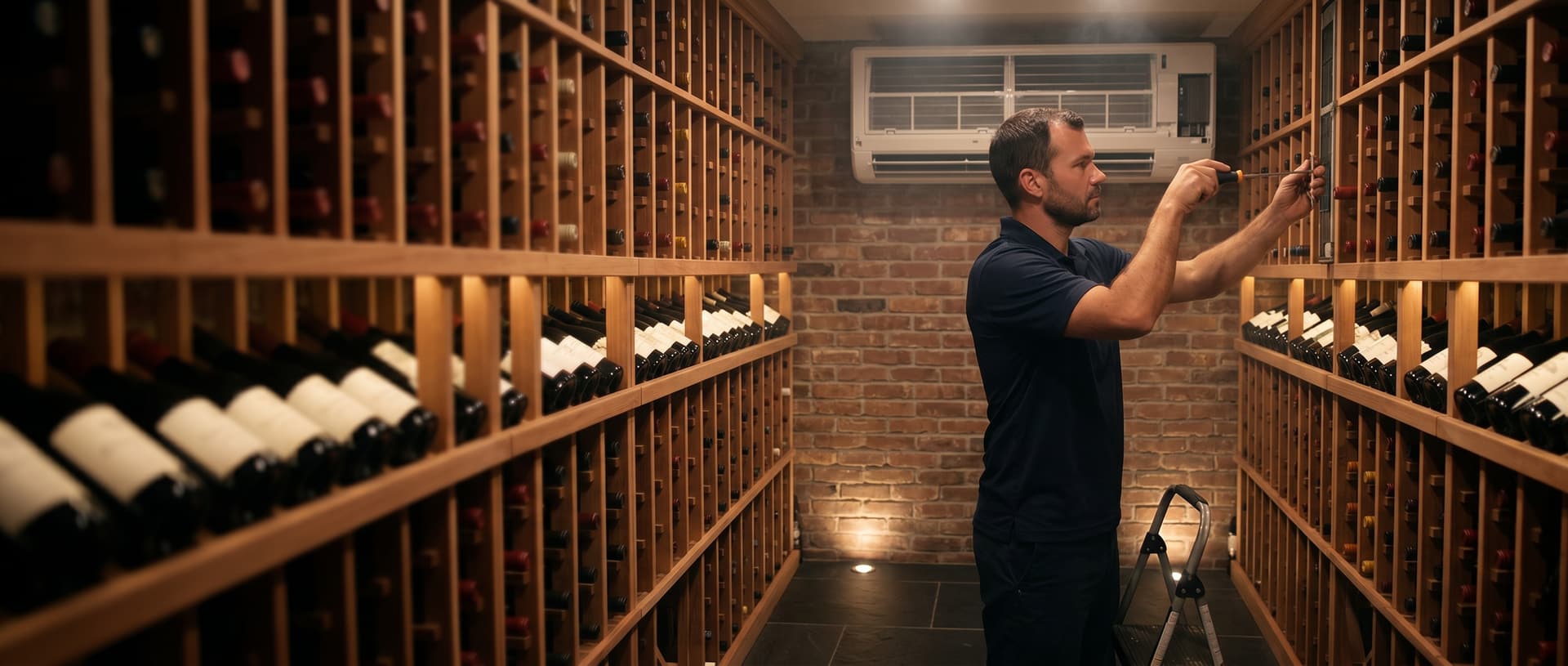
Residential Wine Cellar Repair · Walk-In Split Systems · LA Home Repair · Same Day
Wine Cellar Repair Across Southern California
Split, ducted, and self-contained cellar systems, WhisperKOOL, Wine Guardian, CellarPro, Breezaire. We treat the cellar as a system: equipment, humidity, and envelope.
AI Diagnostic · free · about a minute
Not sure what's wrong?
Describe it in your own words — get the likely causes and a repair cost range before you book.
Our Branches
10 service territories across Southern California
01, About This Service
A wine cellar is a building system, not an appliance.
When a walk-in wine cellar needs repair across Southern California, our techs at Same Day Appliance Repair trace it to a handful of patterns: through-wall self-contained unit work ($250–$650), refrigerant and component service on split and ducted systems ($450–$1,400), and cellar-grade compressor replacement ($900–$2,500+). A cellar is room-scale, WhisperKOOL, Wine Guardian, and CellarPro split systems with the equipment outside and a coil inside, so we treat it as a system: if the unit runs continuously but the room drifts, the envelope is usually the problem, not a bigger compressor. $89 residential diagnostic, waived with repair. BHGS #A49573, EPA 608 Universal certified (#1346255700410).
From Malibu estates to Beverly Hills mansions to custom-built Hollywood Hills homes, LA has one of the densest concentrations of dedicated wine cellars in the country. These aren't coolers, they're rooms. A 2,000-bottle walk-in in Bel Air, a 4,500-bottle stone-clad cellar in Pacific Palisades, a converted basement in Pasadena with a ducted split hidden behind a shelf. Different scale entirely from an appliance, and a different kind of repair call.
When a cellar fails, three things can be wrong and they rarely fail alone. The refrigeration equipment itself, compressor, evaporator, TXV, fan motors, control board. The humidity system, because a dry cellar at 30% RH will ruin a collection just as fast as a warm one. And the envelope, the insulation, the 6-mil poly vapor barrier, the door seal, the thermal bridging through a concrete floor. If the equipment is running continuously but the room drifts, the equipment usually isn't the problem.
We service WhisperKOOL, Wine Guardian, CellarPro, Breezaire, and KoolR, the five brands that dominate the cellar segment in LA. Residential refrigerator brands don't appear on cellar calls; the failure modes and parts are different. Our technicians are EPA-certified for refrigerant handling and carry the tools for leak detection, recovery, and recharge on R-404A, R-134a, and R-513A systems.
If your cellar has drifted above 65°F and holds serious bottles, anything aged, anything Burgundy, anything you care about, call us before moving anything. We can often bring temporary portable cooling to stabilize the room while parts arrive, which is gentler on the collection than redistributing bottles through household refrigerators. For a 2,000-bottle cellar, that matters.
02, Know Your System
Self-contained, split, or ducted, three systems, three failure modes
The first thing our technicians establish is which configuration you have, because where the compressor lives determines how we diagnose, what tools we need on site, and how long the repair takes.
Through-Wall Self-Contained
Entire refrigeration system in one housing, mounted through the cellar wall. Common in smaller cellars, 500 to 1,500 bottles. Exhausts warm air into an adjacent room. Straightforward to service but loud, and the exhaust room must stay below 85°F.
- Single-unit install, simpler to diagnose
- No refrigerant lines to leak
- Lower equipment cost
- Noise and vibration inside cellar
- Exhaust room heats up significantly
- Limited capacity for large rooms
Split, Evaporator Inside, Condenser Outside
Most common in serious LA cellars. The evaporator sits inside the cellar, the condensing unit lives in a mechanical room, garage, or outside. Copper line sets connect them. Quiet inside the cellar, and the condenser can reject heat anywhere with airflow. Handles 1,500 to 3,000 bottles.
- Silent and vibration-free inside cellar
- Higher capacity, better efficiency
- Condenser can be located remotely
- Line-set leaks require recovery/recharge
- More components, more service points
- LA seasonal swings stress the charge
Ducted Split, Hidden Air Handler
Largest cellars, 3,000 to 5,000+ bottles. Evaporator sits in a soffit or mechanical space and supplies the cellar through concealed ductwork. Condenser lives outside or in a garage mechanical room. Common in Malibu and Beverly Hills custom builds where aesthetics forbid visible equipment.
- Completely hidden from cellar interior
- Handles the largest private cellars
- Best air distribution
- Complex duct + refrigerant service
- Air-flow restriction mimics equipment failure
- Access for repair can be difficult
03, Common Problems
What our technicians diagnose on cellar calls
Temperature Drifting Upward
Most common failure mode. Causes include a low refrigerant charge from a slow leak, a failing compressor that's lost capacity, a dirty or blocked condenser coil, or a compromised envelope. We measure superheat and subcooling before touching anything, the numbers tell us whether it's the charge, the metering device, or airflow.
Humidity Dropping Below 50%
A dry cellar dries corks, oxidizes wine, and peels labels. Causes include an oversized cooling unit that dehumidifies aggressively, a failed humidifier on integrated systems, a door seal letting in dry conditioned house air, or a missing vapor barrier allowing moisture to migrate out into cold framing. Symptom and cause are often in different parts of the system.
Humidity Climbing Above 75%
Mold on labels, racks, and ceilings. Often a drainage problem, condensate isn't getting out of the cellar. Check the condensate line, pump, and trap first. Also points to an oversized or short-cycling unit that pulls down temperature without running long enough to dehumidify. In LA, an uninsulated floor on grade can also wick moisture in.
Compressor Short-Cycling
Compressor starts, runs briefly, shuts off on thermal overload or pressure switch, then repeats. Common causes: refrigerant charge too low, condenser coil fouled, condenser fan weak, or ambient in the mechanical room too high. On LA summer days above 95°F, a condenser exhausting into a hot garage can push a healthy system into short-cycling simply from heat rejection problems.
Evaporator Fan Failure
When the evaporator fan slows or stops, the coil ices over, airflow across the cellar collapses, and temperature rises despite the compressor running. Symptom often looks like "not cooling" but the root cause is air movement. On WhisperKOOL and CellarPro units, evaporator fan motors are a common 7–10 year replacement item.
TXV / Expansion Valve Drift
Thermostatic expansion valve meters refrigerant into the evaporator. When it drifts or clogs, superheat climbs, cooling capacity drops, and the compressor works harder for worse results. Diagnosis requires measuring superheat at the suction line, a generalist won't catch this. Replacement is a charge-recovery job; the refrigerant has to come out before the valve comes out.
Condensate Drain Blockage
The evaporator sheds water as it dehumidifies; that water has to leave the cellar. A clogged drain line, failed condensate pump, or frozen trap means water backs up inside the cellar. On split and ducted systems this can flood an air handler and damage the controls. Clearing the line and testing the pump is part of every cellar service we do.
Control Board / Sensor Failure
CellarPro VSi, Wine Guardian DS-series, and WhisperKOOL Platinum controls can all develop board-level faults, erratic temperature readings, ghost commands, display failures. On cellars with smart monitoring integration, the monitoring system often catches the drift before the homeowner does. We stock the most common boards; proprietary units may require manufacturer order.
04, The Envelope Is Part of the System
When the equipment is fine and the room is the problem
A cellar is a building assembly, most "equipment" failures are envelope failures
A properly built wine cellar has a 6-mil polyethylene vapor barrier on the warm side of the insulation, the side facing the rest of the house. Closed-cell spray foam (typically R-19 or better) fills the cavities. The door is a gasketed, insulated unit that seals against a threshold. When all four components work, a 2,000-bottle cellar holds temperature with a cooling unit that runs maybe 20–30% of the day. When any one fails, the cooling unit runs continuously and still loses ground.
The most common envelope failures we see in LA homes are missing or compromised vapor barriers in converted rooms, a former closet or basement space where the builder installed insulation but skipped the poly. Warm humid air from the house migrates into the wall cavity, hits the cold drywall, and condenses. Eventually the drywall rots and mold appears. From the cellar side, the homeowner sees "my cooling unit isn't keeping up", but the cooling unit is working correctly; it's fighting an infinite load because moist air is entering through the walls.
We diagnose envelope issues with a moisture meter on the warm side of the wall, a thermal camera on both sides, and an airflow check at the door. If the envelope is the problem, we'll tell you, we don't sell you a bigger cooling unit to paper over a building defect. We handle the work ourselves, from smaller fixes (door sweep, threshold, isolated insulation gaps) to full envelope rebuilds.
05, Brands We Service
Cellar-grade refrigeration, the five brands that dominate LA
Primary Cellar Refrigeration
Commercial & Custom HVAC-Grade
For proprietary parts, CellarPro VSi control boards, WhisperKOOL Platinum displays, Wine Guardian PLC controls, we order direct from the manufacturer and confirm lead time before scheduling. Refrigerant service on any brand is EPA-certified and in-house.
06, Recent Repairs
What our technicians actually fixed recently
"Compressor keeps cycling on and off, cellar climbing toward 62°F"
WhisperKOOL 8000 ducted split on a 2,800-bottle ocean-view cellar. Compressor short-cycling on low-pressure switch, classic low refrigerant symptom. Electronic leak detection found a slow leak at the evaporator distributor tube, likely from vibration over 8 years of service. Refrigerant charge (R-404A) was 18% below spec.
"Cellar is at 70°F, humidity at 30%, has been drifting for a week"
2,000-bottle cellar with a 14-year-old Wine Guardian condensing unit. Ambient garage 78°F, cellar 70°F and climbing, RH at 30% (humidifier had also failed). Condensing unit compressor had failed, stuck on thermal and not restarting. Given age and the state of the evaporator fan motor and control contactor, the math was a replacement, not a repair.
"Temperature swinging between 52°F and 62°F, makes no sense"
CellarPro 4200VSi on a 1,200-bottle converted-basement cellar. Symptom: wide temperature swings with no obvious cause. Diagnosis found the evaporator fan motor drawing 1.1 amps (spec 0.8A), running hot, and intermittently stalling, which was causing the coil to ice over, shut off on defrost, then resume. The VSi controller was doing its job; the fan motor was failing asymmetrically.
"Unit runs 24/7 and cellar still climbs to 62°F, is the unit bad?"
Converted-closet cellar (~400 bottles) with a CellarPro 1800QT. Equipment diagnostics came back clean, correct superheat, correct amp draw, fan healthy, coil frost pattern normal. Problem was the room: the original converted-closet build skipped the vapor barrier. Thermal camera showed moisture tracking through the drywall on the bedroom side; moisture meter read 18% at the drywall, and 11% inside the wall cavity.
07, Pricing
Cellar-grade pricing. Written estimate before we start.
$89 diagnostic fee, applied toward the repair once you approve the work. Cellar systems are larger and more complex than appliances, pricing reflects that.
Every repair includes a 90-day warranty on parts and labor. We provide a written estimate before work begins, no starting a refrigerant recovery without an approved price. For cellars at risk while parts are ordered, we can deploy temporary portable cooling to stabilize the room (rental billed separately when applicable).
Where we work
Same-day appliance repair across seven Southern California counties. Pick your city for local details.
Los Angeles County
- Agoura Hills
- Alhambra
- Arcadia
- Atwater Village
- Bel Air
- Beverly Hills
- Brentwood
- Burbank
- Calabasas
- Culver City
- Eagle Rock
- El Segundo
- Encino
- Glassell Park
- Glendale
- Highland Park
- Hollywood
- Koreatown
- La Cañada Flintridge
- Lakewood
- Long Beach
- Los Angeles
- Los Feliz
- Malibu
- Manhattan Beach
- Marina del Rey
- Monrovia
- Monterey Park
- North Hollywood
- Norwalk
- Pacific Palisades
- Pasadena
- Pico Rivera
- Redondo Beach
- San Gabriel
- San Marino
- Santa Clarita
- Santa Monica
- Sherman Oaks
- Silver Lake
- South Pasadena
- Studio City
- Tarzana
- Temple City
- Toluca Lake
- Torrance
- West Hollywood
- West Los Angeles
- Westwood
- Whittier
- Woodland Hills
08, Frequently Asked Questions
Wine cellar repair, what collectors ask us
What is the difference between a wine cellar and a wine cooler?
A wine cooler (/services/wine-cooler-repair/) is a self-contained appliance, typically 15 to 180 bottles, that plugs into an outlet. A wine cellar (this page) is a dedicated conditioned room or walk-in enclosure, usually 500 to 10,000+ bottles, built with an insulated envelope, a 6-mil poly vapor barrier, and serviced by an HVAC-grade refrigeration unit that includes active humidity control. The equipment lives outside the cellar on a ducted or split system, while a coil or evaporator sits inside. Cellars are a building system, cooler, humidity, vapor barrier, and envelope all working together, not a plug-in appliance.
Why does humidity control matter in a wine cellar?
Wine cellars target 50–70% relative humidity. Below 50% RH, corks dry out and shrink, air enters the bottle, and the wine oxidizes, expensive bottles are ruined silently, sometimes over years. Labels dry, peel, and lose value for collectors. Above 70% RH, mold grows on labels, racks, and ceilings. A residential refrigeration unit without humidity control, essentially a window AC, will dehumidify the cellar every cycle and drive RH into the 30s. That's why real cellar units from WhisperKOOL, Wine Guardian, CellarPro, and Breezaire include humidity management as a core design feature, not an afterthought.
My cellar temperature is fluctuating, what's wrong?
Fluctuation usually points to one of four places. A refrigerant charge that's low from a slow leak, common in older split systems. An evaporator fan that's drawing weak current and not circulating air properly. A TXV (thermostatic expansion valve) that's drifted or stuck. Or a control board with a failing temperature probe, which can cause the unit to cycle on incorrect readings. On ducted systems, an air flow restriction, a dirty filter, a collapsed flex duct, causes the same symptom. We diagnose by measuring superheat, subcooling, amp draw, and return-air temperature rather than guessing.
Do you work on WhisperKOOL, Wine Guardian, CellarPro, Breezaire, and Vinotheque units?
Yes, those five brands plus KoolR and US Cellar Systems are the cellar cooling systems we service most often in LA. We carry evaporator fan motors, control boards, and condensate pumps for the common models (WhisperKOOL Platinum + 8000 series, Wine Guardian D025 through D088, CellarPro 1800 through 8200 series, Breezaire WKCE + WKL, Vinotheque proprietary). Refrigerant service, leak detection, recovery, recharge, is handled in-house with BHGS #A49573, EPA 608 Universal certification (#1346255700410). For proprietary parts like CellarPro VSi control boards or WhisperKOOL Platinum displays, we order direct from the manufacturer and confirm lead time before scheduling.
Is my problem the equipment or the cellar envelope?
This is the most important question on a cellar call, and most repair companies skip it. If a cooling unit is running continuously but the room won't hold temperature, the equipment may be fine, the envelope may be failing. We check for missing or compromised 6-mil poly vapor barrier on the warm side, insulation gaps, door seal failure, and condensation inside walls (a sign the vapor barrier is missing and moisture is migrating into the framing). A cellar where the equipment is working correctly but the room drifts needs envelope work, not a bigger cooling unit. We'll tell you honestly which one it is.
Can you repair a ducted split wine cellar system?
Yes. Ducted split systems, where the condensing unit lives in a mechanical room or outside, and the evaporator sits in the cellar with copper line sets connecting them, are our specialty in larger Malibu and Beverly Hills cellars. We service the refrigerant circuit (leak detection, recovery, recharge of R-404A, R-134a, or R-513A), the evaporator and blower assembly, the line set and insulation, the condensate drain and pump, and the controls. LA's seasonal temperature swing stresses these systems in ways a constant-climate installation doesn't, we understand the failure modes specific to this region.
What does the 90-day warranty cover on wine cellar repairs?
Every wine cellar repair we complete carries a 90-day warranty on parts and labor. If the same issue returns within that window, we come back at no charge, in writing before we leave. For refrigerant work, the warranty covers the repair and the charge, not a pre-existing leak elsewhere in the system that we disclosed at the time of service.
My cellar temperature rises even though the compressor is running, what fails first?
On split and ducted cellars that's frequently the evaporator fan. When the evaporator fan slows or stops, the coil ices over, airflow across the cellar collapses, and temperature rises despite the compressor running, so the symptom looks like 'not cooling' when the real cause is air movement. Our techs at Same Day Appliance Repair check the evaporator fan motor early, since on WhisperKOOL and CellarPro units it's a common 7–10 year replacement item. $89 residential diagnostic, waived with repair.
There's water backing up inside my wine cellar, what causes that?
The evaporator sheds water as it dehumidifies, and that condensate has to leave the cellar; a clogged drain line, a failed condensate pump, or a frozen trap makes the water back up inside, and on split and ducted systems it can flood an air handler and damage the controls. Our techs at Same Day Appliance Repair clear the line and test the pump as part of every cellar service, so the condensate path drains the way it should. $89 residential diagnostic, waived with repair.
09, Other Services & Cities
More appliance repairs across Los Angeles
Same day wine cellar repair across Los Angeles
Split, ducted, or self-contained, WhisperKOOL, Wine Guardian, CellarPro, Breezaire. EPA-certified refrigerant service, 90-day warranty, temporary cooling available.