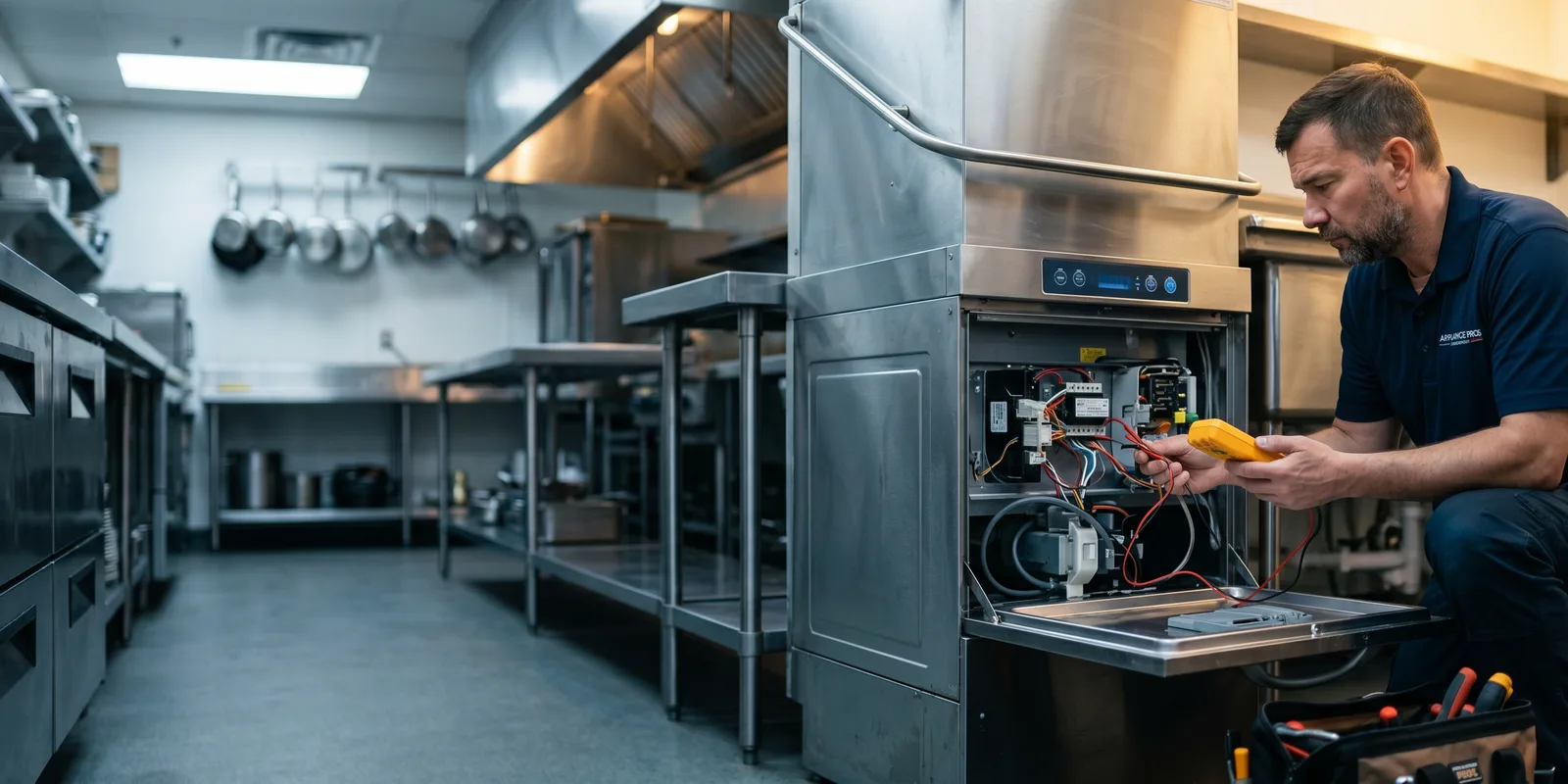
Commercial Kitchen · Dishwasher Repair · Restaurant + Hotel + Institutional · Same Day
Commercial Dishwasher Repair in Los Angeles
Commercial dishwasher service and dish machine repair for door-type, undercounter, conveyor and glass washer machines. Not cleaning, not draining, not reaching sanitizing temperature, Jackson, Hobart, Champion, CMA across Southern California restaurants, hotels, schools, and food service. Same-day across Los Angeles, Orange, Ventura, Santa Barbara, San Bernardino, Riverside & San Diego counties. Health code compliance specialists.
AI Diagnostic · free · about a minute
Dishwasher acting up?
Describe it in your own words — get the likely causes and a repair cost range before you book.
Our Branches
10 service territories across Southern California
What is your restaurant dishwasher doing?
By machine type: Undercounter · Door-type and rack conveyor · Flight-type · Glass washer.
By brand: Hobart · Jackson · Champion · Meiko · Winterhalter · CMA · Electrolux Professional · Miele Professional.
01, About This Service
A commercial dishwasher that isn't sanitizing isn't just inconvenient, it's a health code violation in progress.
We repair and service every type of commercial and restaurant dishwasher and dish machine in Los Angeles food service kitchens: undercounter dishwasher repair, door-type machines, rack conveyor dishwasher repair, flight-type dish machine repair and bar glass washer repair. Every commercial dishwasher service call ends with a sanitizing temperature check.
When LA operators search for commercial dishwasher repair near me, the underlying need is rarely just "make it work again" — it's "make it sanitize correctly before tomorrow's health inspection." Most operators think of commercial dishwasher failure in terms of clean vs. dirty dishes. But the real standard across Southern California county health authorities (LA County DPH, OC Health Care Agency, Ventura County Environmental Health, San Bernardino DEHS, Riverside County DEH, all enforcing CalCode) isn't "clean", it's sanitized. A commercial dishwasher is required to reach 140°F for chemical sanitizing machines or 180°F on the final rinse for high-temperature machines. A machine that's washing dishes but not hitting these temperatures is producing sanitized-looking dishes that may carry bacterial contamination, and failing health inspection if an inspector runs a temperature check during a routine visit.
The second issue specific to LA is hard water. At 300–400 mg/L total dissolved solids, LA water deposits mineral scale inside spray arm holes, on heating elements, and on glassware during the drying cycle. Bars and restaurants lose the professional presentation of their glassware when scale builds unchecked, cloudy wine glasses or spotted pint glasses are a direct consequence of a dishwasher that isn't maintaining proper rinse aid dosing and descaling intervals. From Downtown LA's restaurant cluster on Spring Street and the Arts District, through Beverly Hills steakhouses on Brighton Way, West Hollywood bars on Santa Monica Boulevard, Hollywood restaurants on Sunset, Santa Monica's Main Street and Montana corridor, Pasadena's Old Town, Long Beach's downtown and Pine Avenue, and the Culver City Arts District — our techs see the same scale-related failure patterns across the full LA restaurant landscape.
We service all major commercial Jackson, Hobart, and Champion dishwasher types and brands, with Jackson parts carried specifically on service vehicles. All repairs include a temperature verification to confirm the machine is meeting sanitizing spec before we leave.
If your commercial dishwasher is not reaching 140°F (chemical sanitize) or 180°F (high-temp final rinse), stop relying on it for sanitizing and call (424) 325-0520 immediately. This is a county health-code violation waiting to be discovered. We treat sanitizing temperature failures as priority same-day calls, the health code risk makes it one.
02, Sanitizing Temperature & Health Code
The temperature your dishwasher must reach, and what happens when it doesn't
Southern California county health-authority regulations (CalCode-based) specify minimum temperatures for commercial dishwashers. "Looks clean" is not the standard, measured temperature is.
Two types of commercial dishwashers, two temperature standards
California's CalCode (Title 17/22, adopted by all Southern California county health departments) follows FDA Food Code guidelines for warewashing equipment. There are two compliant sanitizing methods, chemical and high-temperature. Whichever type your machine is, it must consistently reach its required temperature to be in compliance with LADPH, OC HCA, Ventura, San Bernardino DEHS, or Riverside DEH inspection.
140°F Wash Temperature
Chemical sanitizing machines use chlorine, iodine, or quaternary ammonium at cool-to-warm temperatures. The chemical does the sanitizing work, but the wash temperature must still reach 140°F to properly clean before chemical contact. If the machine isn't heating adequately, chemical sanitizing effectiveness is compromised.
180°F Final Rinse
High-temperature machines use hot water itself to sanitize, no chemicals required. The final rinse must reach 180°F at the dish surface. A heating element failure, thermostat drift, or booster heater failure can drop final rinse temperature below this threshold while the machine continues to operate normally in every other way.
We verify final rinse temperature against a calibrated thermometer on every commercial dishwasher service call, and tell you the reading before we leave.
03, Machine Types We Service
Every commercial dishwasher and dish machine configuration in Southern California food service
Under-Counter Dishwashers
Compact units for small restaurants, cafes, and bars. Door-type with single rack per cycle. Jackson Conserver, Hobart AM15, and similar.
Door-Type Dishwashers
Single-tank door-type machines for medium-volume operations. The most common type in Southern California independent restaurants. Jackson WWS series, Champion DH, CMA 180.
Conveyor Dishwashers
Continuous belt or rack conveyor for high-volume operations. Common in hotel banquet kitchens, large restaurants, and institutional settings. Hobart C-series, Jackson TempStar.
Flight-Type Dishwashers
Largest commercial dishwashers for very high volume, pegged belt conveyors without racks. Institutional kitchens, hospital cafeterias, large hotels.
Glasswashers
Specialty undercounter machines optimized for bar glassware, gentler cycle, lower temperature, specific chemical dosing for spot-free results. Common in Southern California bars and hotel lounges (DTLA, Newport Beach, Beverly Hills, Costa Mesa).
Pot Washers
High-pressure spray systems for pots, pans, and large cookware. Common in hotel and institutional kitchens where separate pot washing is required by volume.
04, Common Failures
What our technicians diagnose most often in Southern California commercial dishwashers
Across LA County commercial dishwasher service calls our techs at Same Day Appliance Repair dispatch — DTLA hotel banquet operations 24/7 (JW Marriott, Ritz-Carlton, Conrad, InterContinental), Beverly Hills hospitality (Four Seasons Beverly Wilshire, Peninsula, Waldorf Astoria, Montage), LAUSD school nutrition cafeteria FT2000 flight-type fleet, hospital cafeteria service (Cedars-Sinai, UCLA Health, Keck Medicine, Children's Hospital LA), restaurant kitchens running 8-14 hours daily, and sports venue concession dishwashing (Dodger Stadium, SoFi Stadium, Crypto.com Arena) — the failure distribution clusters predictably. About 30 percent scale buildup from LADWP hard water 8-12 grains/gallon (quarterly delime, labor $250–$520, critical; Hobart AM16 / Jackson RackStar / CMA-180 high-volume operations need monthly Inland Empire). 20 percent heating element + booster heater system (year 6-9, labor $300–$640 + parts). 15 percent wash arm bearing wear (year 5-8, labor $300–$640 + parts). 15 percent door gasket + latch sensor (year 5-7, labor $275–$580 + parts). 10 percent chemical dispenser pump (year 7-9, labor $250–$520 + parts). 10 percent drain pump (year 7-9, labor $275–$580 + parts) + wash pump seal kit (year 8-10, labor $275–$580 + parts). Health code 180°F final rinse sanitization spec compliance critical — below spec triggers California Retail Food Code CCP exceedance.
Not Cleaning Properly / Food Residue
In LA specifically, scale-clogged spray arm holes are the most common cause, mineral deposits from hard water progressively block the small holes in spray arms, reducing water pressure and distribution. Also: failed wash pump motor reducing overall pressure, or detergent dispenser failure leaving dishes with inadequate chemical contact time. We descale spray arms before recommending part replacement.
Not Reaching Sanitizing Temperature
The health code failure mode. For high-temp machines: failed heating element or booster heater, thermostat drift, or scale buildup on the heating element insulating it from the water. For low-temp chemical machines: failed heating element dropping wash temperature below effective cleaning range. We check against a reference thermometer and tell you the reading.
Not Draining
Failed drain pump motor (most common), blocked drain line with food debris, or a faulty drain solenoid. Water pooling in the wash tank after cycle is a health hazard, bacteria accumulate in standing water that then contacts clean dishes on the next cycle. We treat drainage failures as health code priority calls.
Leaking
Door gasket compression failure (water leaking from door edges), overfill from a faulty water inlet valve, or a damaged pump seal. Any water on a commercial kitchen floor is both a slip hazard and a health inspection issue. Turn off the machine and call us, we typically diagnose and repair same day.
Cloudy Glasses / Spotted Dishes
LA hard water mineral deposits on glassware during the drying cycle. Root cause: rinse aid dispenser failure (rinse aid prevents scale adhesion), or a water softener/treatment system that needs servicing. We check and calibrate chemical dispensers on every call, proper rinse aid dosing is the primary defense against scale on glassware.
Chemical Dispenser Failure
Commercial dishwashers use automatic dispensers for detergent and rinse aid. When a dispenser fails, clogged injector, failed pump, or empty supply not triggering an alarm, dishes may appear washed but lack proper chemical treatment. Dispenser failure also affects sanitizing compliance on low-temp machines.
300–400 mg/L TDS, why LA dishwashers need more frequent descaling
Southern California water's high mineral content (300–400+ mg/L TDS across all 7 counties; Inland Empire wells often run higher) deposits scale inside spray arm holes, on heating elements, on the interior wash tank, and on glassware during drying. For a machine running 200+ rack cycles per day, this accumulation is measurable within weeks. Scale inside spray arms reduces hole diameter and water pressure, the machine cycles normally but can't deliver adequate cleaning force. Scale on heating elements insulates them and reduces heating efficiency, pushing the machine toward temperature non-compliance. Descaling every 3–4 months is the practical standard across Southern California for high-volume operations, not the 6-month schedule designed for lower-hardness water supplies.
05, Jackson Commercial Dishwashers
The most common commercial dishwasher brand across Southern California, and why we stock Jackson parts on the van
Jackson WWS and Conserver series run most Southern California restaurant dish lines
Jackson Commercial Products is the dominant brand across Southern California's independent restaurant market, affordable, reliable, and with a parts availability network that makes them practical for commercial kitchens. The Jackson WWS series door-type machines and Conserver undercounter units are the models we see on service calls more than any other commercial dishwasher brand.
Common Jackson failure patterns across Southern California: wash pump impeller scale buildup from regional hard water (the impeller collects scale that reduces flow without triggering an obvious error), door latch wear on high-volume operations (the door latch assembly on Jackson door-type machines is a consumable part in heavy use), and heating element scale coating that reduces high-temp final rinse performance below 180°F spec.
We carry Jackson wash pump motors, door latch assemblies, heating elements, spray arm assemblies, and door gaskets on service vehicles specifically because these are the most common same-day repair needs on Jackson equipment across Southern California.
06, Brands We Service
Every commercial dishwasher brand across Southern California
Jackson parts carried on service vehicles. Temperature verification included on every service call. NSF-approved descaling products used on all cleaning services.
07, Recent Repairs
What our technicians actually fixed recently
"Dishes coming out with food still on them, spray pressure seems low"
Scale-clogged spray arms on a Jackson WWS-30S door-type machine, the upper and lower spray arm holes had accumulated significant mineral scale from LA hard water, reducing effective spray coverage by roughly 40%. The machine was cycling at the correct temperature and pressure at the pump, but the restricted holes meant water wasn't reaching the dishes adequately. Classic LA presentation that's easily confused with pump failure.
"Wine glasses coming out spotted and cloudy, customers complaining"
Failed rinse aid dispenser on a Hobart LXEH glasswasher, the dispenser pump had seized, stopping rinse aid injection during the final rinse. Without rinse aid, OC coastal hard water was depositing mineral scale on every glass during drying. The machine was otherwise functioning correctly, it was the absence of rinse aid that was causing the visual issue. The bar had been running this way for approximately 3 weeks before the glass quality became customer-visible.
"Health inspector cited us, final rinse temperature only 168°F"
Booster heater failure on a Champion high-temperature dishwasher, the booster heater raises incoming water temperature to meet the 180°F final rinse requirement. When the booster heater element failed, the machine was still washing and rinsing but the final rinse was only reaching the incoming hot water temperature (approximately 140–160°F from the building's water heater), not the 180°F required for high-temp sanitizing. The restaurant received a Ventura County Environmental Health code violation and a 30-day correction period.
"Machine not draining, water overflowing the wash tank onto the floor"
Failed drain solenoid valve on a Jackson TempStar conveyor dishwasher, the solenoid that opens the drain at the end of each cycle had failed in the closed position, preventing drainage. The wash tank filled to capacity and began overflowing. In a hotel kitchen running continuous covers, this was an immediate shutdown, standing water on a commercial kitchen floor with a health inspection pending the following week.
08, Pricing
Transparent pricing. Temperature verification included on every call.
All commercial dishwasher repairs include a 90-day warranty on parts and labor. Every service call includes a final rinse temperature check, and we tell you the reading.
09, Frequently Asked Questions
Commercial dishwasher repair, what Southern California operators ask us
What's the most common commercial dishwasher failure?
Across LA County commercial dishwasher service calls our techs at Same Day Appliance Repair dispatch, three failure modes dominate. (1) LADWP hard water scale buildup year-over-year — LA water hardness 8-12 grains/gallon (roughly double the national average) means tank heaters scale faster, rinse arm jets clog faster, booster heater elements crust faster. Quarterly delime (labor $250–$520 per service) is right schedule for commercial duty in LADWP territory; monthly for Inland Empire high-throughput. Single most common 'not cleaning' cause. (2) Heating element + booster heater contactor year 6-9 — final rinse temperature can't reach 180°F sanitization spec, health code violation territory. Labor $300–$640 + parts for the element or contactor. (3) Wash arm bearing wear year 5-8 — bearing wear restricts spray pattern coverage. Labor $300–$640 + parts.
How fast can you respond to a commercial dishwasher emergency in LA?
Same-day across Los Angeles, Orange, Ventura, Santa Barbara, San Bernardino, Riverside, and San Diego counties during business hours. Our techs at Same Day Appliance Repair prioritize commercial dishwasher emergencies because dishwasher downtime means health code violation territory if final rinse can't reach 180°F sanitization spec. Failures that put Friday dinner service, the Saturday hospitality peak, or a hotel banquet at risk get pushed to front of dispatch queue. Multi-brand single-call efficiency — single visit can address Hobart AM16 + Jackson RackStar + CMA-180 multiple-machine kitchen in sequence. Hoshizaki Alliance California warehouse parts pipeline (1-3 day turnaround).
How much does commercial dishwasher repair cost?
Commercial diagnostic is $120, applied to the repair if approved. Labor on most repairs runs $250–$750, with parts quoted after diagnosis. Chemical dispenser, fill valve, door latch, or control board work is toward the lower end. Conveyor work and premium brands (Hobart, Jackson, Meiko, Winterhalter) run higher. Written estimate before any work begins. Commercial dishwasher repair near me pricing in LA is transparent — the diagnostic fee gets credited against the repair invoice, so when you approve the work, you pay only the repair cost.
Which areas of Southern California do you cover?
All seven Southern California counties: Los Angeles, Orange, Ventura, Santa Barbara, San Bernardino, Riverside, and San Diego. We dispatch from 10 service territories so the technician on your commercial call is coming from the closest one. Same-day commercial priority dispatch across all 7 counties. When operators search commercial dishwasher repair near me from Downtown LA, Beverly Hills, West Hollywood, Hollywood, Santa Monica, Pasadena, Long Beach, Culver City, or the South Bay, our branch dispatch network puts a tech on-site faster than central LA-only competitors.
My commercial dishwasher is not reaching sanitizing temperature, is this a health code issue?
Yes. CalCode requires 140°F for chemical sanitize machines and 180°F final rinse for high-temp machines, enforced by all Southern California county health authorities (LA County DPH, OC HCA, Ventura, San Bernardino DEHS, Riverside DEH). A machine not hitting spec is a health code violation. Stop relying on it for sanitizing and call us at (424) 325-0520, we treat this as a priority same-day call. We check final rinse temperature on every service call and tell you the reading.
My commercial dishwasher is not cleaning dishes properly, what causes that?
Across Southern California, scale-clogged spray arm holes from hard water are the most common cause. Also: failed wash pump motor, depleted chemical dispenser, or temperature below spec. We descale spray arms and check all four factors before recommending part replacement, often cleaning alone restores performance.
Why are my glasses coming out cloudy?
Mineral scale from Southern California's hard water depositing on glass during drying, almost always caused by a failed rinse aid dispenser or inadequate rinse aid dosing. We check and calibrate chemical dispensers on every call. A water softener on the incoming line is the long-term solution for premium glassware quality.
Do you repair Jackson commercial dishwashers?
Yes. Jackson is the most common commercial dishwasher brand across Southern California restaurants. We carry Jackson wash pump motors, door latch assemblies, heating elements, spray arm assemblies, and door gaskets on the van. Jackson WWS series and Conserver units are our most frequent service calls.
My commercial dishwasher is leaking, what should I do?
Turn off the machine and stop using it, water on a commercial kitchen floor is a slip hazard and a health inspection issue. Common causes: door gasket failure, faulty water inlet valve, or damaged pump seal. We diagnose and repair same day in most cases. Document the leak location if you can, it helps us bring the right parts.
How often should a commercial dishwasher be serviced?
Every 3–4 months for high-volume operations across Southern California, every 6 months minimum for all commercial machines. Southern California water's hardness accelerates scale buildup on spray arms and heating elements faster than most manufacturer schedules assume. Each service includes a temperature check.
When does it make sense to repair vs replace a commercial dishwasher?
Commercial dishwashers (Jackson, Hobart, Champion) are built for 12-15 year service lives with proper maintenance. Repair almost always makes sense unless the wash tank is corroded through (typically only on units 15+ years old that haven't been descaled regularly). Replacement runs $5,000–$25,000+ for a new unit plus installation, plumbing, and electrical.
10, Other Commercial Services
Complete commercial appliance repair across Southern California
Counties We Serve
7 counties · 10 service territories. Same-day commercial dispatch from the closest branch.
Need commercial dishwasher repair near me? Same-day across Southern California.
7 counties · 10 service territories · BHGS #A49573, EPA 608 Universal certified #1346255700410, · 90-day warranty. Jackson, Hobart, Champion, CMA. Sanitizing temperature verification (140°F/180°F per CalCode) on every call. $120 diagnostic. Operators across LA searching commercial dishwasher repair near me reach our branch network — typical same-day dispatch from Downtown LA, Beverly Hills, West Hollywood, Hollywood, Santa Monica, Pasadena, Long Beach, and Culver City.