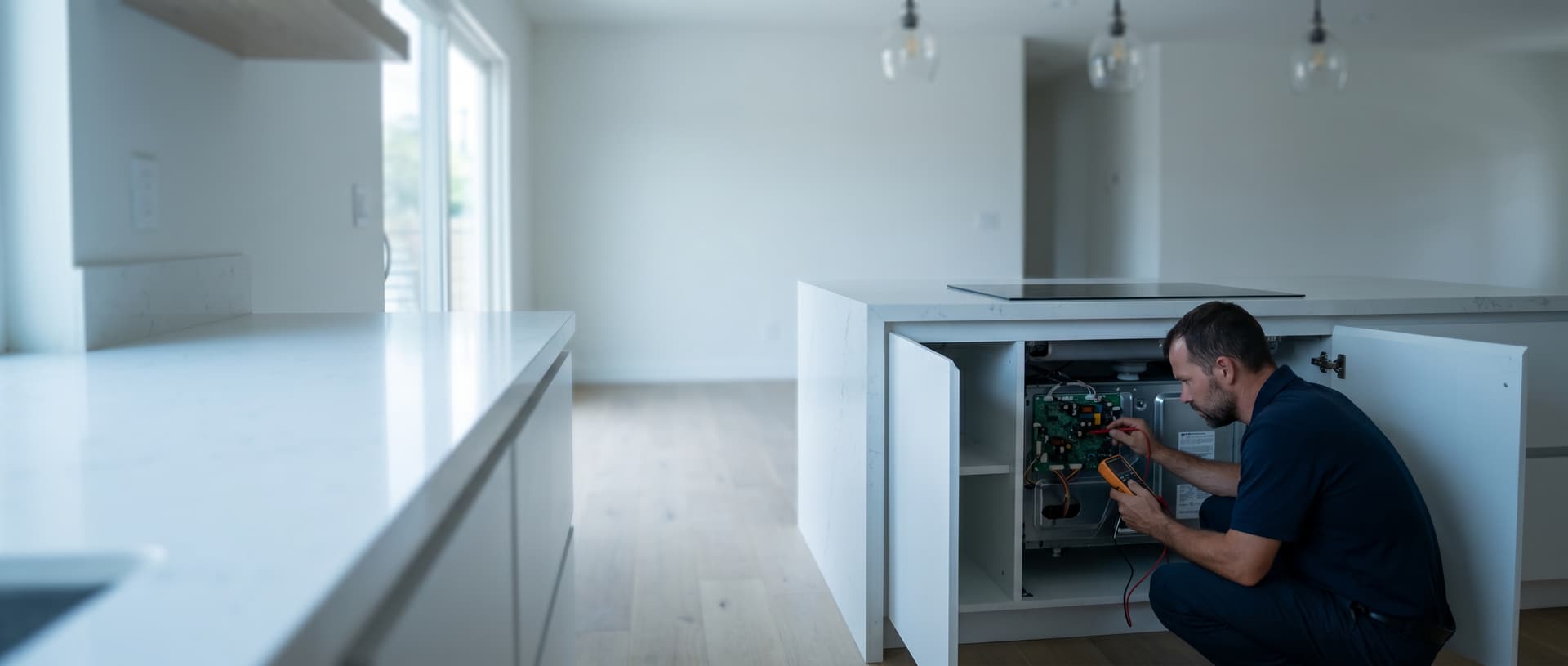
Residential Induction Cooktop Repair · 240V + Inverter Boards · LA Home Repair · Same Day
Induction Cooktop Repair Across Southern California
Same-day across Los Angeles, Orange, Ventura, Santa Barbara, San Bernardino, Riverside & San Diego counties. One zone dead, F-code on display, cooktop shuts off mid-cook, cracked glass, we diagnose the inverter, control board, and cooling system on Wolf, Thermador, Miele, Bosch, and every other induction cooktop in Southern California kitchens. BHGS #A49573.
AI Diagnostic · free · about a minute
Cooktop acting up?
Describe it in your own words — get the likely causes and a repair cost range before you book.
Our Branches
10 service territories across Southern California
01, About This Service
Induction is not a kind of electric cooktop. It's a different machine.
When an induction cooktop needs repair across Southern California, our techs at Same Day Appliance Repair trace it to a handful of patterns: a failed inverter/IGBT module on a single dead zone ($350–$900+), cracked glass ($550–$1400+), and the cooling-fan, touch-control, and sensor work that makes up the standard repair band ($180–$420). Before any of that we confirm cookware is ferromagnetic with a magnet test and verify the 240V dedicated circuit against the unit's nameplate, since both produce no-heat symptoms on an otherwise healthy cooktop. $89 diagnostic, applied to the repair. BHGS #A49573, EPA 608 Universal certified (#1346255700410).
Induction cooktops look like glass-top electrics, but mechanically they have almost nothing in common. There are no heating elements under the glass. There are copper coils that generate an alternating magnetic field, and there is a large bank of power electronics, IGBT transistors, rectifier, inverter, control board, cooling fan, that drive those coils at high frequency. When a homeowner says "my cooktop won't heat," we're almost always looking at a failure in that electronics stack, not at a heating element.
This is why induction repair across Southern California has grown fast as a specialty. The region's electrification push, LA's ordinance on gas in new construction, AQMD pressure on combustion appliances across the South Coast Air Basin, parallel restrictions in Orange and Ventura jurisdictions, and tax credits for induction and heat-pump conversions, has moved a lot of Wolf gas ranges out and Wolf induction cooktops in. Same for Thermador, Miele, Gaggenau. A Wolf CT36I or a Thermador Freedom induction is not something a technician trained on coil-top electrics can diagnose by instinct. We've invested specifically in induction diagnostics because that's where the volume went, across all seven counties.
Most induction service calls fall into four buckets: a single zone stopped heating (usually an IGBT module), the whole cooktop shuts off mid-use (usually the internal cooling fan), an F-code is displayed (decode first, diagnose second), or the glass cracked (assess before you decide to repair or replace). We handle all four regularly, with OEM parts for the premium European brands that make up most of Southern California's induction market. Same-day service across Los Angeles, Orange, Ventura, Santa Barbara, San Bernardino, Riverside, and San Diego counties, BHGS #A49573.
Before scheduling a repair for a cooktop that "won't heat," verify your cookware is induction-compatible. Put a refrigerator magnet on the pan's bottom, if it sticks firmly, it will work. Cast iron and magnetic stainless work; copper, aluminum, glass, and non-magnetic stainless do not. A meaningful share of "broken" induction calls turn out to be cookware carried over from a previous gas or electric kitchen. We'll still come out and confirm, but the test takes 10 seconds and can save you the diagnostic fee.
02, How Induction Actually Works
The glass stays cool. The pan itself becomes the heater.
Understanding the four-layer stack explains almost every induction failure mode. Each layer is a failure point, and each fails in a recognizable way.
One coil. One magnetic field. One pan that becomes its own heating element.
The control board commands the inverter to switch the IGBT power transistors on and off at roughly 20–50 kHz. That switching drives alternating current through a flat copper coil directly beneath the glass. The coil generates a rapidly alternating magnetic field. When a ferromagnetic pan sits on the glass over that coil, the magnetic field induces eddy currents directly inside the pan's iron, and the electrical resistance of the pan converts those currents into heat. The glass itself is a passive barrier; it warms only from the pan sitting on it, never from its own heating element.
This is why an induction cooktop has failure modes that gas and electric simply do not have. There is no flame to fail, no resistive coil to burn out, no spark module to clog. What can fail is the power electronics, and those electronics run hot and require active cooling, which introduces another failure point that pure gas and electric cooktops don't have.
- Cast iron (bare or enameled)
- Carbon steel
- Magnetic stainless steel (most 18/0 or "induction ready")
- Enameled steel
- Magnetic clad pans (Demeyere, All-Clad D3/D5, some Cuisinart Multiclad)
- Aluminum (unless magnetic-plate bonded)
- Copper (unless induction-plate bonded)
- Glass / Pyrex
- Ceramic / stoneware
- Non-magnetic stainless steel (many 18/10 without magnetic disc)
03, Common Induction Failures
What actually breaks on induction cooktops
One Zone Dead (IGBT / Inverter Module)
By far the most common induction repair. Each zone or pair of zones runs off its own IGBT power transistor stage. When a single zone stops heating while others work, the inverter module driving that zone has failed, usually a blown IGBT from a power surge, a short from moisture ingress, or simple thermal fatigue over years. The coil itself is usually fine. Replacing the IGBT module or the inverter PCB restores the zone.
Cooktop Shuts Off During Cooking
Almost always a cooling fan issue. The electronics in an induction cooktop generate serious heat, and a small internal fan pulls air through the enclosure to keep the IGBTs below their thermal limit. When the fan bearing seizes, the IGBTs overheat within 5–15 minutes and the safety circuit shuts the cooktop off. It will restart once cooled and shut off again on the next high-power cook. Fan motor replacement resolves it.
F-Code on Display
F0, F2, F7, F47, E6, each code maps to a specific fault category, but the mapping differs by brand. F7 on a Miele is not F7 on a Thermador. Before we replace anything we decode the exact code against the brand and model service documentation. Guessing based on a generic F-code list is how you end up replacing a good control board when the actual issue was a $40 sensor.
Control Board Failure
The main control board coordinates the inverters, handles user input, processes sensor data, and manages safety logic. When it fails, usually from moisture reaching the board after a serious boil-over, or from a power event, symptoms vary from total dead cooktop to weird partial behavior (one zone stuck on high, random shut-offs, phantom F-codes). Control board is the most expensive common part on premium brands.
Induction Coil Failure (Moisture)
Coil failures are less common than inverter failures but do happen, almost always after liquid has made it past the glass seal, a heavy boil-over that ran down the side, a flood from above, or a cracked glass left in service. The coil develops a short or an open circuit and that zone quits. Replacement requires removing the glass, and depending on the model the coil may come as a standalone part or as an integrated coil-plus-inverter assembly.
Touch Controls Unresponsive
Every induction cooktop uses capacitive touch, there are no mechanical switches. When the touch panel stops responding, the cause is usually moisture under a control zone, grease buildup, a cracked glass near the touch pads, or a failed touch PCB. We clean and test the capacitive array before assuming the board has failed. A cooktop that recently "died" after a spill almost always just needs to dry out and get cleaned, not a new board.
Cracked Glass
Dropped cast iron, expanded from a thermal shock, or cracked around a touch zone, cracked induction glass is a safety issue and must be replaced before use. The electronics below are exposed to liquids and the crack will spread under load. Glass replacement is straightforward on most induction models; the part itself is expensive on premium brands ($550–$1400). We assess crack extent and give you a honest repair-vs-replace recommendation.
Breaker Trips Repeatedly
Induction draws heavy current, 30A, 40A, sometimes 50A dedicated circuits depending on unit size. When a breaker trips repeatedly under load, the cause is often not the cooktop itself but an undersized or aging circuit that can't deliver rated current. We verify the circuit spec against the cooktop's nameplate before assuming appliance fault. If the cooktop is pulling within spec and the breaker still trips, there's a wiring issue that needs an electrician.
04, F-Code Diagnostics
We decode the error code before we touch any part
F-codes on induction cooktops are brand-specific and model-specific. A technician who guesses from a generic chart replaces the wrong part. Here's how we approach them.
The general pattern below shows typical F-code categories on European induction cooktops (Miele, Bosch, Thermador). Exact meanings vary by model year and firmware. We look up the specific fault tree for your model before quoting, this is one of the biggest reasons we avoid misdiagnosis on induction.
Important: these are illustrative patterns, not a diagnostic substitute. Model and firmware revision change meanings. Have your model number ready when you call and we'll often know the likely root cause before the truck arrives.
06, Recent Repairs
What our technicians actually fixed recently
"Front left zone just stopped, the others still work"
Classic single-zone-dead presentation on a Wolf CT30IU that had been installed eight months earlier as part of a gas-to-induction conversion. Customer had previously had a Wolf gas range and swapped to induction to comply with the new building's electrification spec. Diagnostic pointed straight at the inverter module serving the front left zone, the IGBT stage had failed, likely a factory-defect early-life fault given the age. Coil tested healthy.
"All zones work, but cooktop shuts off after 10 minutes at high heat"
Textbook cooling fan failure on a Newport Coast home Thermador. Customer ran the diagnostic herself before we arrived, she noticed the cooktop would work on simmer indefinitely but cut out reliably when she pushed two zones to high for more than 10 minutes. That specific pattern (thermal cutoff under high power) is the fan. Opened the underside, confirmed the internal cooling fan bearing had seized, the rotor wouldn't turn freely by hand.
"F7 error, the whole cooktop won't heat at all"
F7 on a Miele KM series is a main control board / power supply fault. Customer in Thousand Oaks recalled a heavy pasta boil-over a week earlier, water had gone down the sides of a large pot and she hadn't cleaned underneath aggressively. Opened the unit, confirmed moisture damage on the main control board with corrosion on several pads around the power input section. Coils, inverters, and fan all tested fine, the failure was isolated to the main board.
"Dropped a cast iron skillet, cracked across two zones"
Two-year-old Bosch Benchmark with a crack running across two of the front zones after a cast iron skillet was dropped from overhead cabinet height. Electronics tested healthy, no error codes, coils and inverters all reading in spec with the crack bypassed. Real question was repair vs replace: unit was $2,100 new, glass replacement came to $850 installed, electronics had years of life remaining. We walked the customer through both paths honestly.
07, Pricing
Straightforward pricing. What we quote is on the invoice.
Every repair includes a 90-day warranty on parts and labor, in writing before we leave. We never start work without your written approval of the estimate. If a part carries an unusually long lead time (common with Miele and Gaggenau OEM), we tell you upfront.
Where we work
Same-day appliance repair across seven Southern California counties. Pick your city for local details.
Los Angeles County
- Agoura Hills
- Alhambra
- Arcadia
- Atwater Village
- Bel Air
- Beverly Hills
- Brentwood
- Burbank
- Calabasas
- Culver City
- Eagle Rock
- El Segundo
- Encino
- Glassell Park
- Glendale
- Highland Park
- Hollywood
- Koreatown
- La Cañada Flintridge
- Lakewood
- Long Beach
- Los Angeles
- Los Feliz
- Malibu
- Manhattan Beach
- Marina del Rey
- Monrovia
- Monterey Park
- North Hollywood
- Norwalk
- Pacific Palisades
- Pasadena
- Pico Rivera
- Redondo Beach
- San Gabriel
- San Marino
- Santa Clarita
- Santa Monica
- Sherman Oaks
- Silver Lake
- South Pasadena
- Studio City
- Tarzana
- Temple City
- Toluca Lake
- Torrance
- West Hollywood
- West Los Angeles
- Westwood
- Whittier
- Woodland Hills
08, Frequently Asked Questions
Induction cooktop repair, what people ask us
My induction cooktop isn't heating, is it broken?
Before assuming the cooktop is faulty, test cookware compatibility. Induction only works with ferromagnetic cookware, cast iron, magnetic stainless, enameled steel. Copper, aluminum, glass, and non-magnetic stainless will not heat even on a perfectly working induction cooktop. Put a refrigerator magnet on the pan bottom, if it sticks firmly, the pan is compatible. A surprising share of "broken induction" calls turn out to be carry-over cookware from a previous gas or electric kitchen. If your cookware is confirmed magnetic and the cooktop still won't heat, it's a genuine fault, usually the IGBT inverter or the control board.
Which areas of Southern California do you cover for induction cooktop repair?
Same-day across Los Angeles, Orange, Ventura, Santa Barbara, San Bernardino, Riverside, and San Diego counties, Beverly Hills and Brentwood gas-to-induction conversions, Newport Coast and Irvine premium kitchens, Thousand Oaks and Westlake Village in Ventura, Rancho Cucamonga and Riverside in the Inland Empire. Ten service territories total. Wolf, Thermador, Miele, Gaggenau, Bosch, every premium induction brand running Southern California kitchens. BHGS #A49573.
What does the F error code on my induction cooktop mean?
F-codes are brand-specific. On Miele and Bosch, F0 typically means touch control communication, F2 is a temperature sensor, and F7 points to the main control board or power supply. Thermador and Wolf use similar but not identical codes. We decode the exact code for your specific model before touching any hardware, generic F-code charts lead to replacing the wrong part. Have your model number ready when you call.
Do you repair Wolf, Thermador, and Miele induction cooktops?
Yes, these are among our most frequent induction calls, especially as electrification ordinances and the broader gas-to-induction conversion trend across Southern California (LA's new-construction gas restrictions, AQMD pressure on combustion appliances, and tax incentives across multiple jurisdictions) drive premium-brand induction volume. Wolf CT-series, Thermador Freedom and Masterpiece, and Miele KM-series are all serviceable with OEM parts. Lead time matters: Miele and Gaggenau parts often ship from Germany and can take 5–10 business days. Wolf and Thermador domestic stock is usually faster. We give you the honest timeline before ordering.
My induction cooktop shuts off during cooking, what's wrong?
Almost always a cooling fan issue. Induction electronics run hot, and a small internal fan keeps the IGBTs below their thermal limit. When the fan bearing seizes, the IGBTs overheat within 5–15 minutes and safety protection cuts power. The cooktop cools, restarts, and shuts off again on the next high-power cook. Fan replacement resolves it. Less commonly, a blocked ventilation slot (cabinet issue) or a failing thermal sensor can produce the same symptom.
Can induction coils be replaced individually?
On most induction cooktops, yes, when the failure is on the inverter/IGBT side (which it usually is), we replace that module and restore the affected zone without touching other zones. Some units have integrated coil-plus-inverter assemblies where the two come as one service component; unit cost is higher but replacement is cleaner. A few higher-end models have modular individual zones. We identify which configuration your model uses before quoting, the cost difference between a discrete IGBT and a full assembly can be significant.
My induction cooktop glass cracked, should I repair or replace?
Depends on age, brand, and crack extent. Glass replacement on a 2-year-old Wolf, Thermador, or Miele is usually worthwhile, the underlying electronics have most of their life left and the glass alone runs $550–$1400. On older mid-range induction where unit cost new is close to glass replacement cost, replacement is often the better call. We assess honestly. Until the glass is replaced, do not use the cooktop, moisture will reach the coils and a spreading crack under a heavy pot can fail badly.
When does it make sense to repair vs replace an induction cooktop?
Under 5 years old: repair almost always wins, especially on premium brands. 5–10 years with a single inverter or fan failure on a Wolf, Thermador, Miele, or Gaggenau: repair, the rest of the unit has years of life. 10+ years with multiple failures, or a control-board failure on a mid-range unit where the board cost approaches replacement cost: we'll quote both and tell you directly which makes more financial sense. New induction cooktops run $1,400 (mid-range) to $5,000+ (premium European), plus install. Glass replacement on a 2-year-old premium unit with healthy electronics is almost always worthwhile.
What does the 90-day warranty cover on induction repairs?
Every repair carries a 90-day warranty on parts and labor. If the same issue returns within that window, we come back at no charge. Warranty is provided in writing before we leave. Note that the warranty covers the specific repair performed, if a different component fails later, that's a separate service.
Why does my induction cooktop keep tripping the breaker?
Induction draws heavy current on dedicated 30A, 40A, or sometimes 50A circuits depending on unit size, so a breaker that trips repeatedly under load is often an undersized or aging circuit rather than the cooktop itself. Our techs at Same Day Appliance Repair verify the circuit spec against the cooktop's nameplate first; if the unit is pulling within spec and the breaker still trips, that's a wiring issue for an electrician, not an appliance fault. $89 diagnostic, applied to the repair.
My induction touch controls stopped responding after a spill, is the board dead?
Usually not. Every induction cooktop uses a capacitive touch array with no mechanical switches, and the most common cause of unresponsive controls is moisture under a control zone, grease buildup, or a cracked glass near the touch pads rather than a failed touch PCB. Our techs at Same Day Appliance Repair clean and test the capacitive array before assuming the board failed, since a cooktop that died after a spill often just needs to dry out and get cleaned. $89 diagnostic, applied to the repair.
09, Other Services & Counties
More appliance repairs across Southern California
Same-day induction cooktop repair across Southern California
7 counties · 10 service territories · BHGS #A49573 · 90-day warranty. Wolf, Thermador, Miele, Bosch, inverter, coil, control board, glass. F-codes decoded. $89 diagnostic.