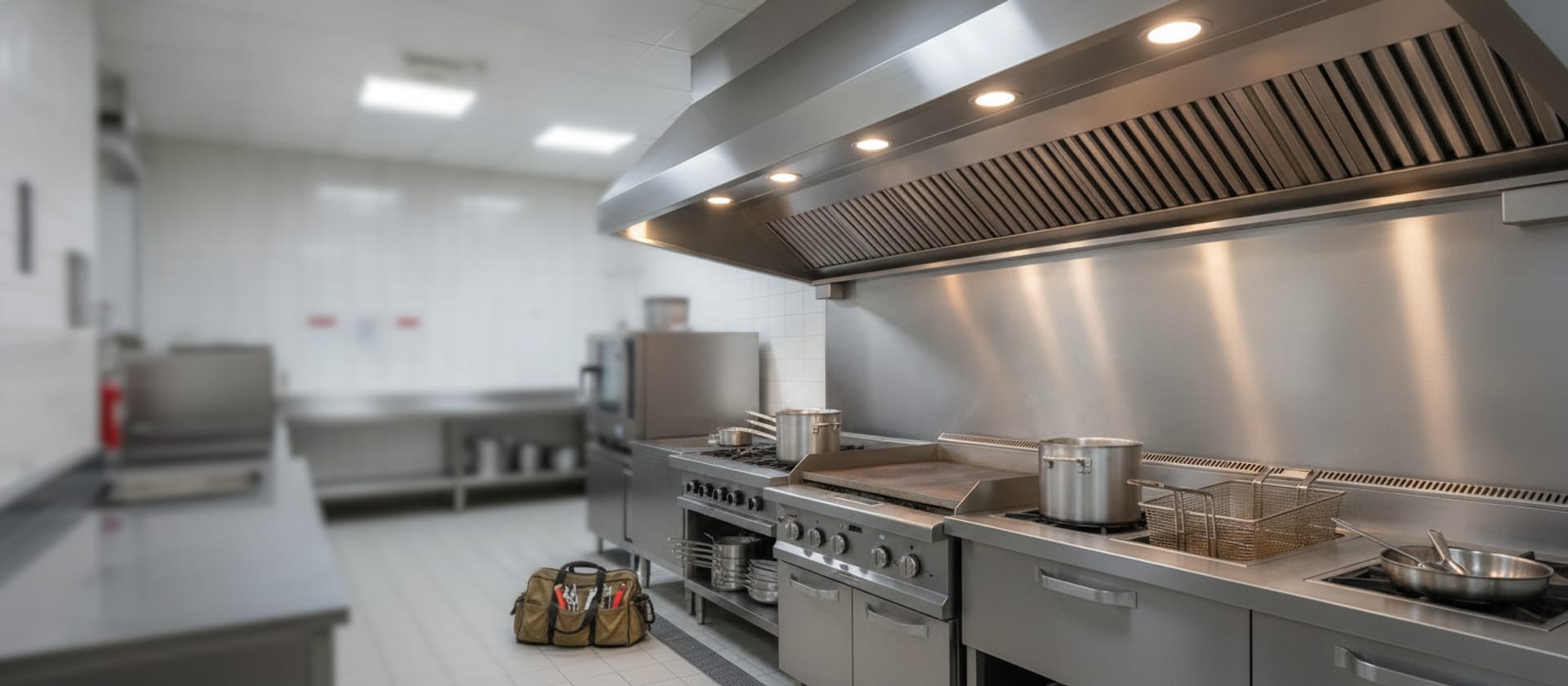
Halton Hood Repair
Halton Commercial Kitchen Hood Repair
Halton Capture Jet + UV-Hood + KVE-series commercial kitchen hood repair Southern California. Michelin/hotel specialist. Finnish design. $120. (424) 325-0520.
AI Diagnostic · free · about a minute
Not sure what's wrong?
Describe it in your own words — get the likely causes and a repair cost range before you book.
Our Branches
10 service territories across Southern California
Where we work
Local branches across Southern California
Ten branches covering Los Angeles, Orange, Ventura, Santa Barbara, San Bernardino, and Riverside counties. Same-day visits when a technician is available.
Los Angeles
Brentwood, Bel Air, Pacific Palisades, Santa Monica, Westwood, Century City, Culver City, Westside, Long Beach
Halton, independent Finnish family, Lahti since 1969
When a Halton hood goes down in an LA Michelin or 5-star-hotel kitchen, the failures our techs at Same Day Appliance Repair run most are in the specialty subsystems most hood techs never trained on. On Capture Jet hoods a "not capturing like it used to" call usually starts at the jet-air fan, the balance dampers, and the front-edge slot cleanliness before the main exhaust fan. On MARVEL demand-controlled systems it's IR-sensor drift, a controller-communication fault, or a calibration that's wandered. On UV-Hood systems it's UV-C lamp end-of-life and ballast service, done under strict safety protocol because the lamps are ozone-generating and cause burns within seconds. Across all of them the shared items, pressure switches, jet-air fan belts and bearings, exhaust fan motors, and VFDs, still show up. We service Capture Jet, UV-Hood, MARVEL, KVE, and KSA lines at Providence, Spago, Ritz-Carlton DTLA, Four Seasons and Peninsula Beverly Hills, and comparable luxury kitchens, with parts routing through Halton North America (3-to-7-day lead on specialty items). Typical work runs $200-$340 for a Capture Jet balance-damper adjustment, $280-$460 for a jet-air fan belt or bearing, $700-$1,400 for an exhaust fan motor, $850-$1,400 for a MARVEL controller, and $1,100-$1,900 for a VFD. Commercial diagnostic is $120, waived with the repair, BHGS #A49573, EPA 608 Universal certified (#1346255700410).
Across the Halton hoods our techs service in LA, the failures cluster by subsystem. Capture Jet issues lead at the high-grease fine-dining stations, the jet-air fan, balance dampers, and front-edge slots that herd the plume back into the filters, diagnosed before the main exhaust. MARVEL demand-control faults are next, IR and thermistor sensor drift, controller-communication errors, and calibration passes that keep the variable-speed fans matched to cooking load (and the Title 24 energy savings intact). UV-Hood ballast and lamp service follows, on a strict power-lockout protocol. Then the shared mechanical items, pressure switches, jet-air fan belts and bearings, filter-bank mounts and gaskets. Exhaust fan motors, VFDs, and the MARVEL controller board are the last and most expensive, and the specialty parts route through Halton North America rather than a parent-conglomerate network, so our techs pre-confirm lead time. Critically, Halton MARVEL is a different company entirely from Marvel residential refrigeration, they share the word and nothing else.
Halton Group has manufactured indoor-air-quality and commercial kitchen ventilation equipment from Lahti, Finland since 1969. The company is family-owned and has remained in continuous private Finnish ownership across its entire history, it has not been folded into Ali Group, ITW Food Equipment Group, Middleby Corporation, Welbilt, or any of the US commercial foodservice conglomerates that now own most of the American commercial hood brands. For operators used to US-conglomerate ownership being the norm on commercial equipment, that independence reads as unusual; for Halton, it is the defining characteristic.
Independence shapes the engineering program. Halton's R&D concentrates on indoor-air-quality fundamentals, capture and containment, grease elimination, and ventilation-energy optimization. Capture Jet jet-induction (1995), UV-Hood grease oxidation, and MARVEL demand-controlled ventilation are the three signature platforms that come out of that program. None of them are catalog-configured add-ons to a generic hood body; they are engineering systems that change how the hood performs in the kitchen and how it needs to be serviced.
In the US, Halton operates through Halton Company and its North American office network; parts and specialty components route through that channel rather than through a parent-conglomerate distribution system. In practice for LA kitchens, that usually means 3–7 day lead times on Halton-specific parts (MARVEL sensors, UV ballasts, Capture Jet balance dampers), longer than Captive-Aire's US parts chain for conventional hood components, but consistent for the engineering-driven specifications Halton operators actually care about.
Halton products we service in LA
Capture Jet, CJ-series flagship
Halton's signature jet-induction exhaust hood. Low-velocity push-jet along the front edge herds cooking plume back into the filter bank, lowering required exhaust CFM and reducing spillage at the cook line. Service domain adds jet-air fan, balance dampers, supply plenum, and front-edge slot cleanliness to conventional hood diagnostics.
UV-Hood, grease oxidation
High-output UV-C lamps mounted inside the plenum break down grease particulate into CO2 and water vapor, reducing duct fire risk and extending NFPA 96 cleaning intervals. Service requires UV-safety protocols: lockout verification, UV-rated PPE, and never defeating the access-panel interlocks.
KVE-series, front-of-house ventilation
Halton's front-of-house ventilation line for restaurant dining rooms, bar areas, and exhibition-cooking stations. Design priority is low-noise, visual cleanliness, and integration with architectural ceiling, service focus is typically fan quietness, balance, and filter accessibility.
KSA and MARVEL canopies
Halton's kitchen-section canopy line. KSA canopies commonly pair with MARVEL demand-controlled ventilation to modulate exhaust and make-up air with cooking load. Common LA spec in Michelin + luxury-hotel kitchens where energy-management and Title 24 compliance drive the design.
MARVEL DCV, control platform
Demand-controlled ventilation platform. IR + heat sensors detect cooking activity; VFDs on exhaust and supply fans modulate airflow. Typical Title 24 compliance savings 30–60% versus fixed-speed fan operation. Diagnosis covers sensors, controller board, VFD coordination, and calibration across the whole hood bank.
Make-up air and VFD coordination
Halton hood banks typically interlock with make-up air units and run variable-frequency drives across both exhaust and supply sides. Interlock-fault and VFD-communication diagnostics span the whole hood + MUA + ductwork chain, not just the hood assembly itself.
Capture Jet, where most LA Halton diagnostics start
The most common Halton service call we get in LA is some version of "the hood isn't capturing the way it used to." On a conventional pull-only hood, that diagnosis starts at exhaust fan CFM and filter loading. On a Capture Jet hood, it starts one step earlier, jet-air fan operation and balance-damper position, because the capture performance depends on the jet working correctly.
Capture Jet uses a separate low-horsepower fan to push air through a supply plenum and out through narrow slots along the front edge of the hood. That jet flow creates a low-velocity curtain that herds cooking plume upward and back into the filter bank. If the jet fan is off, running slow, running backward, or the slots are grease-clogged, the capture system reverts to pull-only, and in a kitchen designed around Capture Jet CFM numbers, that means measurable spillage at the line. Techs who don't know Capture Jet will sometimes bump the main exhaust fan speed up to compensate, which makes the kitchen hot and cold (make-up air over-pulled) and papers over the actual failure.
Diagnostic sequence we walk: verify jet-air fan running and direction-correct; check jet-air fan belt and bearing if applicable; measure slot air velocity at each slot along the front edge; open and inspect the balance dampers; check the slot openings for grease accumulation from inadequate cleaning cycles; confirm the jet-air supply plenum has no crushed or disconnected ducting above the ceiling. Once Capture Jet is verified running to spec, conventional hood diagnostics (exhaust fan, filter loading, ductwork) proceed from there. Most "Halton not capturing" calls resolve at the jet-air side; only after those are clean do we move to the main exhaust.
UV-Hood, effective, but service discipline required
UV-Hood delivers real operating value. Grease that would otherwise accumulate on filter backsides and inside the first 6–10 feet of grease duct gets broken down by high-intensity UV-C exposure as it enters the plenum, reducing duct fire risk, stretching the interval between NFPA 96 certified cleanings, and keeping filters cleaner longer. Operators running 14–18 hour service with high-grease cooking (charbroil, wok, fryer banks) get the clearest ROI.
On the service side, UV-Hood is not a casual add-on. The UV-C lamps operate at wavelengths that cause skin burns and corneal damage in seconds of direct exposure, and they generate trace ozone at operating output. Halton engineers UV-Hood with access-panel interlocks that cut UV power when filters come out or plenum panels open; those interlocks are the single most important safety feature on the equipment, and our protocol is absolute: never bypass, never defeat, never work around an energized UV-C source.
Our service protocol on UV-Hood calls: confirm system power off at the disconnect before panel removal; verify lamp-off state visually before hands enter the plenum; use UV-rated eye protection during ballast diagnostic and lamp replacement; lamp disposal follows Halton North America handling guidance (mercury content, not conventional waste). This is standard for commercial UV-C work, but it is work that requires the right training. If you are getting UV-Hood priced by a tech who shrugs at the interlocks, get a different tech.
MARVEL DCV, California Title 24 and utility-rebate context
California's Title 24 building energy code treats commercial kitchen ventilation aggressively. Fixed-speed exhaust running at design CFM for 14-hour restaurant operations is an enormous energy load, both directly on the fan motors and indirectly on the make-up air system, which conditions outside air to replace exhausted air. MARVEL modulates exhaust and supply airflow down when cooking activity drops and back up when it rises; the net savings on a typical LA restaurant operation range 30–60% on ventilation-related electricity plus the make-up air heating/cooling that drops with it. Southern California utility rebate programs (SoCalGas, LADWP, SCE) recognize DCV installations in many rate categories; our repair work keeps the commissioning documentation defensible to the utility when they audit.
On the diagnostic side, MARVEL adds IR plume sensors and heat thermistors at each hood section, a central MARVEL controller, and VFD coordination across exhaust + supply + (where present) Capture Jet jet-air and UV-Hood ballasts. When a MARVEL-equipped hood is misbehaving, running at full speed when the line is idle, not ramping up under cooking load, reporting controller faults on the remote interface, the failure almost always sits in sensor drift, controller communication, or VFD addressing rather than in the mechanical hood hardware. Our diagnostic sequence: check sensor outputs at the controller; verify VFD network communication; review controller fault-code history; check MARVEL calibration against current hood bank configuration (kitchens get rearranged, and sensors occasionally end up looking at the wrong cooking section).
One fact-accuracy note for LA owners cross-checking brand names: Halton MARVEL is a demand-controlled-ventilation control platform. Marvel Industries (residential refrigeration, Leitchfield Kentucky, Middleby AGA Rangemaster) is a completely unrelated company that happens to share the word. If you have Halton MARVEL, you need Halton service; Marvel residential refrigeration parts will not fit.
Where LA Halton installs concentrate
Halton's LA install base is narrower than Captive-Aire's, but it is high-value, the specifications tend to sit at the top end of restaurant and hospitality:
- Michelin-starred kitchens, Providence (Hollywood), n/naka (Palms), and comparable fine-dining kitchens specify Halton regularly for Capture Jet containment. Fine-dining chefs care about cook-line spillage in a way quick-service operators don't, and Capture Jet solves that specifically.
- 5-star hotel banquet and à la carte, Ritz-Carlton DTLA, Four Seasons Beverly Hills, Peninsula Beverly Hills, Waldorf Astoria Beverly Hills, Montage Beverly Hills, Beverly Hills Hotel, Bel-Air Hotel. Banquet kitchens pushing high-volume service rely on MARVEL DCV for Title 24 energy economics; UV-Hood turns up on the hotter lines.
- Country club fine-dining programs, Bel-Air Country Club, Los Angeles Country Club, Wilshire Country Club, and comparable private-club kitchens where the kitchen is being specified by an engineering consultant with a DCV / energy mandate.
- Corporate campus dining, larger tech campus fine-dining programs in West LA and Culver City where the campus-energy team has pushed for DCV across commercial kitchen zones.
- Outbound coverage beyond LA, Santa Barbara + Carmel resort-property banquet kitchens occasionally route Halton service work back to LA techs because no local coverage exists. We do run that work; lead time depends on parts availability through Halton North America.
Halton or Captive-Aire, honest comparison
Operators occasionally ask us which one is "better." Neither is better in the abstract; they solve different problems and both have real engineering strength. Captive-Aire is US market #1 for a reason, broad product line, dense US-based parts chain, strong dealer network, excellent price-to-performance on conventional kitchen ventilation, and deep LA service coverage. For most mid-market LA restaurants, Captive-Aire is the default specification and a sensible one.
Halton is a more specific choice. If a kitchen specification is being driven by energy-code strategy (MARVEL DCV for Title 24 + utility rebates), fire-risk reduction at high-grease volume (UV-Hood extending NFPA 96 cleaning intervals), or chef-driven Michelin-tier containment (Capture Jet reducing cook-line spillage), Halton is usually the right answer. Initial cost runs higher than Captive-Aire at spec; LA service-network density is thinner (fewer local techs know the Halton subsystems); but operators who specify Halton do so because the engineering trade-offs match their operation, and the value is real when it matches.
Our coverage spans both. When a Halton operator calls us, we service what is installed; we don't try to convert anyone to Captive-Aire or vice versa. If you are planning a new kitchen and weighing specification, the decision is a scoping conversation with your mechanical engineer, not a brand argument. And for clarity: our commercial exhaust hood coverage for either brand is the commercial $120 diagnostic scope. For residential range hoods, see our residential range hood page, that's a separate $89 diagnostic with a different product + install base.
What Halton hood repair costs in LA
$120 flat commercial diagnostic, waived with repair.
| Repair | Typical range (parts + labor) |
|---|---|
| Pressure switch replacement | $220–$380 |
| Capture Jet balance-damper adjustment | $200–$340 |
| Filter-bank mount and gasket service | $260–$440 |
| Jet-air fan belt / bearing service | $280–$460 |
| MARVEL sensor replacement | $340–$560 |
| UV-Hood lamp replacement (per lamp) | $180–$340 |
| UV-Hood ballast replacement | $420–$720 |
| MARVEL full calibration pass | $450–$780 |
| Exhaust fan motor replacement | $700–$1,400 |
| MARVEL controller board | $850–$1,400 |
| VFD replacement | $1,100–$1,900 |
Most Halton calls land $400–$950 parts-and-labor. MARVEL + UV-Hood + Capture Jet subsystem work runs at the higher end due to specialty parts routing through Halton North America (3–7 day typical lead time) and the extra diagnostic skill required. See our commercial exhaust hood repair cost guide.
Related Halton and commercial hood pages
Halton hood repair, frequently asked
Who owns Halton?
Halton Group is independent family-owned, headquartered in Lahti, Finland. The company was founded in 1969 and has remained in private Finnish family ownership continuously since, it has not been acquired by Ali Group, ITW Food Equipment Group, Middleby, Welbilt, or any of the US foodservice conglomerates that now own most of the commercial hood brands Americans recognize. That independence shapes Halton's engineering roadmap. Instead of being folded into a multi-brand cooking-equipment conglomerate's annual integration priorities, Halton's R&D is internally directed toward indoor-air-quality work, Capture Jet jet-induction, UV-Hood grease oxidation, MARVEL demand-controlled ventilation. In practice for LA kitchens running Halton, that means specific engineering choices you don't see on US-conglomerate hoods, and a parts chain that routes through Halton's own North American office rather than a parent-company distribution network.
What is Capture Jet, and why does it matter for repair?
Capture Jet is Halton's signature exhaust-hood technology, a trademarked jet-induction system introduced in 1995. Instead of relying only on the exhaust fan to pull cooking effluent upward into the filters, Capture Jet adds a low-velocity push-jet along the front edge of the hood that actively herds plume and smoke back toward the filter bank. The effect in the kitchen is measurable: less spillage at the cook line, lower exhaust CFM required to contain the same cooking load, and meaningful energy savings on make-up air heating and cooling. For service, Capture Jet adds components most commercial hood techs don't see often, the jet-air supply plenum, a dedicated jet-air fan (separate from the main exhaust fan), balance dampers, and the jet-air piping from supply plenum to front-edge slots. When a Halton hood is 'not capturing like it used to,' the diagnostic usually starts with jet-air fan operation + balance-damper position + slot cleanliness before escalating to exhaust fan or filter issues. Most LA techs never learned Capture Jet because most hoods they service are conventional pull-only designs.
What is UV-Hood, and is there a safety concern servicing it?
UV-Hood is Halton's UV-treated grease oxidation line. High-output ultraviolet lamps mounted inside the hood's plenum break down grease particulate into CO2 and water vapor before it accumulates in the grease duct, substantially reducing fire risk and stretching NFPA 96 cleaning intervals. The tech is genuinely effective, and LA Michelin + 5-star hotel operators specify it for the fire-risk-reduction + cleaning-economics argument. On the service side, UV-Hood adds real safety considerations. The UV-C lamps are ozone-generating at operating wavelengths; the hood is engineered with interlocks that cut UV power when filter access panels open, but service personnel must never defeat those interlocks or work around energized lamps. Direct UV-C skin or eye exposure causes burns and corneal damage within seconds. Our techs carry the appropriate protocols: verify power-lockout before panel removal, confirm lamp-off state before hands-in, use UV-rated safety glasses during ballast diagnostic work, and never bypass the interlock switch to run the lamps with the hood open. UV-Hood service requires the right training and discipline, it is not a casual add-on to conventional hood work.
What is Halton MARVEL?
MARVEL is Halton's demand-controlled ventilation (DCV) system, a control platform that ramps exhaust and make-up air up and down based on actual cooking activity rather than running at full design CFM continuously. Sensors detect heat + optical plume at each hood section; the controller modulates variable-frequency drives on the exhaust and supply fans to match current cooking load. In a 14-hour restaurant operation, MARVEL typically cuts exhaust-fan energy and make-up air conditioning energy by 30–60% compared with fixed-speed hood operation, meaningful in LA, where Title 24 building-energy regulations and utility rebate programs both favor DCV installations. For repair, MARVEL adds IR sensors at the hood bank, heat thermistors, a central MARVEL controller, and VFD coordination with Capture Jet and UV-Hood subsystems. A MARVEL calibration pass, a controller-communication fault, or a sensor drift diagnosis is very different from conventional hood work, and critically, MARVEL is a different company from Marvel residential refrigeration (Middleby AGA Rangemaster). They share the word but nothing else.
Where in LA do you see Halton hoods installed?
The LA Halton install base concentrates at the top tier of hospitality and restaurant. Michelin-starred kitchens specify Halton regularly for Capture Jet containment and UV-Hood cleanliness economics, Providence in Hollywood, n/naka in Palms, Spago at the Beverly Hilton property, Melisse (when it ran the original Santa Monica location), and comparable fine-dining operations. The 5-star hotel banquet and à la carte kitchens are even denser install territory, Ritz-Carlton DTLA, Four Seasons Beverly Hills, Peninsula Beverly Hills, Waldorf Astoria Beverly Hills, Montage Beverly Hills, Beverly Hills Hotel, Bel-Air Hotel, and comparable luxury properties run Halton on at least some of their kitchen lines. Outside the Michelin + luxury-hotel cluster, Halton turns up in higher-end private country club kitchens, select corporate-campus fine-dining programs, and Santa Barbara / Carmel resort properties that send service work back to LA Halton techs because no local coverage exists.
Why Halton instead of Captive-Aire for a new LA restaurant?
Captive-Aire is US market #1 for commercial hood manufacturing and the default specification for most LA restaurants. Halton is a more specific choice, typically driven by energy-code strategy (MARVEL DCV for Title 24 compliance + utility rebates), fire-risk reduction (UV-Hood extending NFPA 96 intervals at high-grease operations), or chef-driven specification for Michelin-tier containment (Capture Jet reducing cook-line spillage at fine-dining stations). Cost is higher than Captive-Aire at specification; service-network density is thinner (fewer LA techs know Halton versus Captive-Aire); but operators who specify Halton do so because the engineering trade-offs match their operation. Neither is 'better', they solve different problems. Our coverage spans both, and we don't push one brand over the other. If you already have Halton installed, we service the equipment you have; if you're choosing between them for a new kitchen, the decision is a scoping conversation with your mechanical engineer, not a brand loyalty argument.
What does Halton hood repair cost in LA?
$120 flat commercial diagnostic, waived with repair. Typical Halton service ranges: Capture Jet balance-damper adjustment $200–$340, jet-air fan belt or bearing $280–$460, pressure switch $220–$380, filter-bank mount and gasket service $260–$440, exhaust fan motor $700–$1,400, VFD replacement $1,100–$1,900, UV-Hood ballast $420–$720, UV-Hood lamp replacement $180–$340 per lamp (safety-protocol required), MARVEL sensor replacement $340–$560, MARVEL controller board $850–$1,400, full MARVEL calibration pass $450–$780. Most Halton calls land $400–$950 parts-and-labor. MARVEL + UV-Hood + Capture Jet subsystem work runs at the higher end due to specialty parts routing through Halton North America (3–7 day typical lead time) and the extra diagnostic skill required. See our commercial exhaust hood repair cost guide. For residential range hoods, see our residential range hood repair page, that's a separate $89-diagnostic scope.
My Halton hood isn't capturing smoke like it used to, where do you start?
On a Halton, a loss of capture usually points at the Capture Jet system before the main exhaust fan, which is the opposite of where most hood techs start. Capture Jet adds a low-velocity push-jet along the front edge that herds the cooking plume back toward the filters, so when it weakens, the cook-line starts spilling smoke. Our techs check jet-air fan operation (it's a dedicated fan separate from the exhaust), the balance-damper position, and the front-edge slot cleanliness first, a balance-damper adjustment is $200 to $340 and a jet-air fan belt or bearing $280 to $460, before escalating to exhaust fan or filter issues. Most LA techs never learned Capture Jet because most hoods they see are conventional pull-only designs. Same Day Appliance Repair, $120 commercial diagnostic, waived with repair.
Is it safe to service a Halton UV-Hood, and do the UV lamps need replacing?
It's safe with the right protocol, and no, it isn't a casual job. UV-Hood uses high-output UV-C lamps inside the plenum to oxidize grease into CO2 and water vapor, which cuts fire risk and stretches NFPA 96 cleaning intervals, but those lamps are ozone-generating and direct UV-C exposure burns skin and damages the cornea within seconds. The hood has interlocks that cut UV power when access panels open, and our techs never defeat them: we verify power-lockout before panel removal, confirm the lamps are off before reaching in, and use UV-rated safety glasses during ballast work. The lamps do reach end-of-life and need scheduled replacement ($180 to $340 per lamp), and ballast service runs $420 to $720. We document lamp dates for warranty and AHJ records. Same Day Appliance Repair, $120 commercial diagnostic, waived with repair.
Halton hood issue? Call the branch nearest your kitchen.
Same-day across Los Angeles, Orange, Ventura, Santa Barbara, San Bernardino, Riverside, and San Diego counties. $120 commercial diagnostic, waived with repair.