Bel Air · Stone Canyon · Bellagio Road · Upper Bel Air
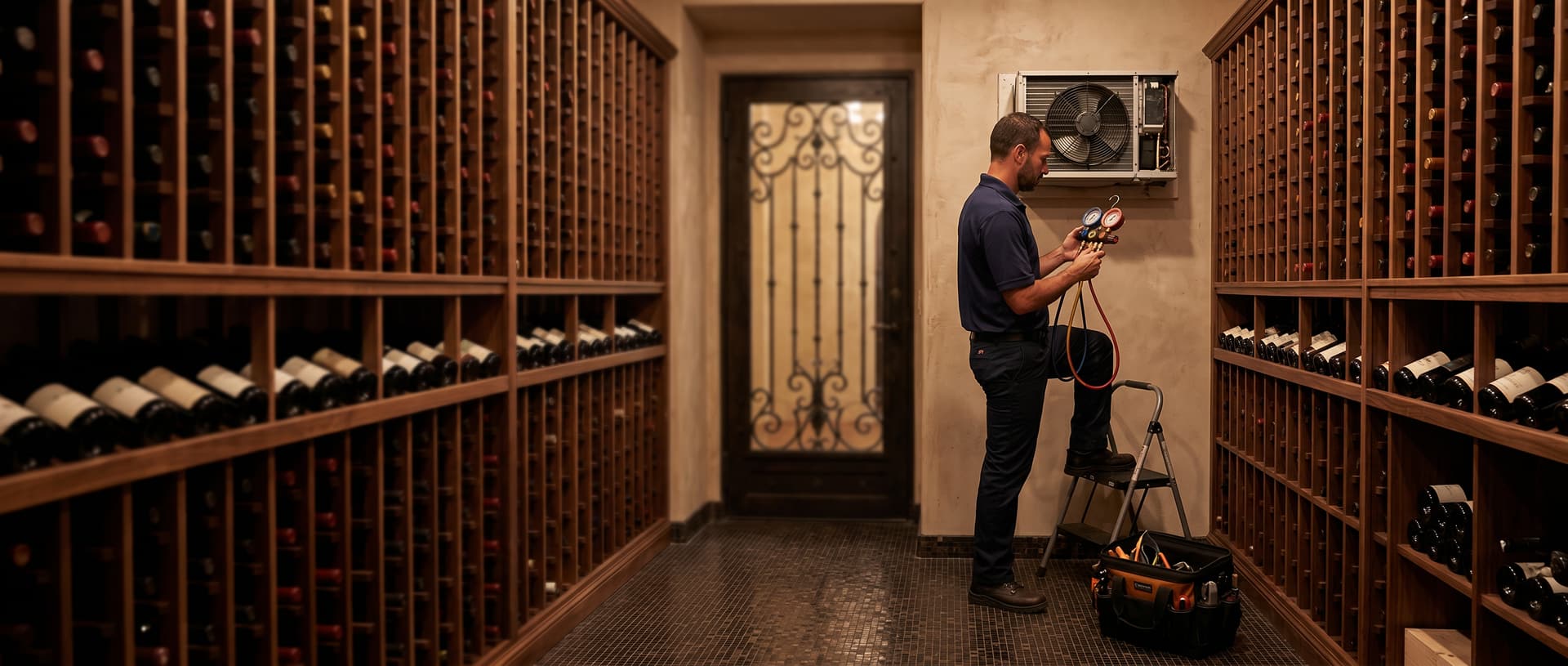
Wine Cellar Repair in Bel Air
Ducted and split refrigeration · WhisperKOOL Extreme · CellarPro VSx · Wine Guardian D-series · Fondis European · US Cellar Systems · Breezaire WKL · Vinotheque. EPA 608 Universal certified (#1346255700410) refrigerant work. BHGS #A49573 licensed. Surge-damage diagnostics, estate-coordinated service, after-hours dispatch. $120 diagnostic from West Hollywood.
01, About this service
Bel Air cellars run larger, deeper, and more architecturally integrated than anywhere else we work.
The thing we tell new technicians on their first Bel Air dispatch: forget what a Beverly Hills cellar looks like. Bel Air is its own scale. Where a serious Beverly Hills cellar runs 500 to 2,000 bottles in a self-contained walk-in, the Bel Air baseline starts higher, 1,000 bottles is small here, 3,000 is common, and the largest collections we work on regularly run 5,000 to 8,000 bottles across primary cellars, secondary tasting rooms, and back-of-house overflow storage. The properties themselves are bigger, the cellars were built into the architecture from the start rather than retrofitted, and the refrigeration is almost always engineered as part of the home's mechanical systems rather than dropped in as a self-contained appliance.
Geography matters too. Stone Canyon, Bellagio Road, Copa de Oro Road, and the Upper Bel Air ridges sit on hillside grids that experience more frequent power events than the flatter parts of the Westside, particularly during Santa Ana wind season when the utility de-energizes lines preemptively and surge events on restoration are common. Roscomare Valley and Casiano Estates have similar exposure. We see surge-damaged control boards and inverter compressors in Bel Air at roughly twice the rate we see them in Beverly Hills proper, and we account for that in how we diagnose and how we recommend protection going forward.
Collection values across our Bel Air mix run from about $75,000 (a serious 1,500 bottle cellar of mostly Napa cabs, Burgundy, and Italian) to several million on a few of the largest curated estates, collections where mature DRC, vintage Petrus, pre-1990 California heritage producers, and museum-tier Bordeaux are the daily working inventory. At the top of the range, the cooling system is the single most important piece of mechanical equipment in the house and a multi-day failure is a multi-hundred-thousand-dollar exposure. That changes the urgency, the dispatch protocol, the parts inventory we keep close, the bridge-cooling we deploy, and the coordination we maintain with the homeowner's wine consultant, estate manager, and home-automation integrator.
This page is for wine cellar refrigeration specifically, the dedicated cooling units (split, ducted, or self-contained) that maintain a walk-in or built-in cellar at 55-58°F and 60-70% relative humidity. If what you have is a freestanding or built-in wine cooler (a kitchen appliance, typically 24-300 bottles), see wine cooler repair instead. Call us at (323) 870-4790 with the model number and we will identify the right service path in two minutes.
02, What fails
Wine cellar failures we see in Bel Air estates.
A Bel Air cellar cooling system is engineered HVAC running 18-22 hours per day at moderate load, often across two or three pieces of separated equipment (air handler, condenser, humidification module, sometimes a heat-recovery loop tied into the home's mechanical system). It is more reliable than people expect, but it has predictable failure modes, and the consequences of failure on a $500,000+ collection are large enough that early diagnosis and protective monitoring matter.
1. Compressor failure on aging WhisperKOOL Extreme units
WhisperKOOL Extreme tii compressors are reliable through the first 10 years and increasingly likely to fail from year 12 forward, particularly on units that have run continuous duty in larger Bel Air cellars (1,500-3,000 cu ft) where the compressor is at moderate-to-high load most of the day. The signal is unambiguous: cellar climbing past 60°F over a 24-48 hour window, the unit appears to be running but never satisfies setpoint, the compressor is hot to the touch when accessible. We verify with sealed-system pressure readings before condemning the compressor, refrigerant charge loss can mimic compressor failure and the diagnostic path is different. On Extreme 8000 and 15000 tii units past year 13-14 with a major compressor or refrigerant fault, we lay out repair-vs-replace economics honestly. Sometimes the unit warrants a full replacement rather than a $1,200 sealed-system rebuild on aging hardware.
2. Ducted system failures (the Bel Air specialty)
Ducted whole-room systems dominate Bel Air cellars in a way they do not in any other Westside neighborhood. Wine Guardian D200 and D300, US Cellar 3600 High Static, ducted CellarPro variants, and high-static Fondis installations all use the same architecture: an air handler in or near the cellar, a condensing unit 30-60 feet away in a mechanical room or on the roof, supply and return ducting that has to maintain static pressure, and (often) a humidification module in the air stream. Failures show up as reduced airflow at the cellar registers, rising temperature without obvious unit failure, or condensate problems at the air handler. The diagnostic path includes duct integrity check, static pressure measurement, refrigerant line set inspection, and verification that both the air handler and condenser are operating in spec. A typical ducted-system service call runs 2.5-4 hours; we factor that into the estimate up front.
3. Split system refrigeration failures
Split-system cellar cooling (CellarPro 6200VSxi, Mini Split, Wine Guardian ductless, certain Fondis configurations) puts the evaporator inside the cellar and the condenser outside, connected by a refrigerant line set that runs through the wall, the ceiling, or in some hillside Bel Air installations through 40-60 feet of crawlspace or hardscape. Common failure modes: refrigerant charge loss at the line-set joints (more common on installs over 10 years old), variable-speed inverter compressor failure (frequently surge-induced), evaporator fan motor wear, and outdoor-condenser fan failure on hillside installs where dust and debris foul the coil faster than expected. Repair time on a split system runs 1.5-3 hours and we work both sides.
4. Custom climate control integration failures
Most Bel Air cellars built since 2014 are tied into Crestron, Control4, or Savant for monitoring and (in some cases) setpoint adjustment. The most common integration failure pattern: the cellar's actual cooling system has a low-level fault (thermistor drift, control board glitch, sensor calibration issue) that the home-automation system either masks (showing the homeowner the dashboard setpoint, not the actual cellar reading) or amplifies (issuing alerts the homeowner ignores after the third false positive). We diagnose the underlying refrigeration fault, document what the smart-home integration is reporting versus measured reality, and coordinate with the homeowner's integrator on any cleanup needed in the automation layer. We do not reconfigure Crestron, Control4, or Savant ourselves, that belongs to the integrator, but we work alongside them.
5. Power surge damage (Santa Ana hillside common cause)
This is the single most common Bel Air-specific failure mode and the one that catches new homeowners off guard. Stone Canyon, Roscomare Valley, Casiano Estates, and the Upper Bel Air ridges sit on grid segments that see frequent outage cycles during Santa Ana wind events, preemptive de-energization, line restoration with surge conditions on the return, and occasional direct surge events from line damage. Sensitive cooling-system electronics absorb the hit. We see control board failures (WhisperKOOL Extreme tii, CellarPro VSx, Wine Guardian electronics), variable-speed compressor inverter failures on newer split systems, humidification controller faults on ducted systems, and intermittent thermistor failures that trace back to a surge event 2-6 weeks earlier. After repair, we recommend a whole-cellar UPS or surge-protection device on the cellar feed; $300-$500 of protection prevents the next $1,800 board.
6. Evaporator coil issues on CellarPro 4200VSx
The CellarPro 4200VSx has a known evaporator freeze-over pattern in cellars with marginal vapor barriers, when humidity climbs above 70% RH, the evaporator coil ices over, airflow stops, the cellar warms. We see this enough times per year in Bel Air to make it the first thing we check on a 4200VSx complaint. The fix is rarely the unit itself: humidity setpoint adjustment, drain pan inspection, and (sometimes) addressing an underlying vapor barrier defect. A clean repair is usually under $300 with no parts replacement; the underlying vapor barrier work, if needed, is referred to a contractor with cellar experience. We will identify the vapor barrier issue honestly even though it is not in our service scope, the homeowner needs to know.
7. Control board moisture failures
Control board failures are the second-most-common parts replacement we do in Bel Air cellar service after fan motors. Two main failure paths: (a) gradual moisture-driven degradation on units in higher-humidity cellars without proper electrical compartment sealing, slow corrosion on PCB traces eventually causes erratic behavior, then full failure, and (b) acute surge damage from Santa Ana wind events as covered above. WhisperKOOL Extreme tii control boards, CellarPro VSx logic boards, and Wine Guardian electronics modules are the most common parts we replace. We carry the most common variants on the West Hollywood truck; less common boards are 2-5 day OEM lead time through authorized distribution.
8. Door seal degradation
Cellar doors run continuous duty, closed nearly all the time, in a high-RH environment, exposed to thermal cycling. Gaskets harden and shrink at year 6-10. Failed gaskets show up as unexpected condensation on the door glass, increased cooling-unit run time, and humidity excursions. Replacement is straightforward and typically under $250 including labor. On the larger Bel Air cellars with custom architectural glass doors (frameless, mahogany frames with custom seals, double-glazed thermal-break designs), gasket replacement requires either OEM custom-order parts or coordination with the original cellar designer; we identify the right part at the diagnostic visit and order through the appropriate channel.
03, Brands and models
Wine cellar cooling systems we repair in Bel Air.
Bel Air's brand mix is broader than Beverly Hills because of two factors: the larger cellar sizes pull more ducted and split systems into the picture, and the older estates from the 1990s still run European Fondis units that are rare elsewhere on the Westside.
WhisperKOOL
Extreme 4000 tii · Extreme 8000 tii · Extreme 15000 tii · Platinum Mini · Platinum Twin · Platinum Quantum · Platinum Slim
The most-specified self-contained cellar cooling brand in Bel Air for cellars in the 1,000-3,500 cu ft range. Common service items at year 5-9: condenser fan motor, evaporator thermistor, drain pan and condensate, control board approaching year 10. Platinum series uses a separate parts platform from Extreme; we stock both. Common parts on the West Hollywood truck, less common items 2-3 day OEM lead.
CellarPro
1800QTx · 1800XTx · 3200VSx · 4200VSx · 6200VSxi (split) · 8200VSi · Mini Split series
Strong presence in Bel Air, particularly the 4200VSx in mid-size cellars and the 6200VSxi split system in larger ducted-into-mechanical-room installs. The 4200VSx evaporator-freeze pattern is the first thing we check on any 4200VSx complaint. The 6200VSxi split system on hillside Bel Air properties sometimes adds outdoor unit access time on the diagnostic. Parts chain is good; 1-2 day OEM lead on uncommon parts.
Wine Guardian (ductless + ducted)
Ductless split (D025, D050, D088) · Ducted split (D200, D300) · Through-the-wall TTW · Sentry compact
Wine Guardian dominates the larger Bel Air cellars (3,000+ bottles) where the cooling unit is concealed in a remote mechanical room and ducted to the cellar through engineered supply and return runs. Acoustic isolation is a core spec for cellars adjoining living space. Service is more involved than self-contained units (technician time on both the air handler and condensing unit, sometimes attic or hillside crawlspace access); we factor that into the estimate up front.
Breezaire WKL
WKL 2200 · WKL 3000 · WKL 4000 · WKL 6000 · WKL 8000
The workhorse self-contained through-the-wall unit in Lower Bel Air cellars built between 1998 and 2015. Mechanically simple, parts chain is mature, repair economics are good through year 10. Common service items: evaporator fan, capacitor, drain pan, defrost timer. Past year 12 with a major fault, replacement economics tend to win, a new Breezaire WKL or WhisperKOOL Platinum drop-in is often within $400 of a major Breezaire repair on a unit nearing end-of-service-life.
Fondis (the Bel Air specialty)
CHC series · Wine C25 · Wine C50 · Wine C100 · high-static ducted variants · custom European installations
Fondis is concentrated in Bel Air more than any other neighborhood we serve, many of the early-1990s estate cellars were built around French-spec Fondis units and many of them are still running. Build quality is excellent and service intervals are long; when failures do occur, parts come through specialty European distribution and lead times are 5-10 days, occasionally 2-3 weeks. We coordinate parts ordering at the diagnostic visit and deploy bridge spot-cooling if collection-at-risk justifies it. On Fondis units past year 28-30 with major faults, transition to a current-generation Wine Guardian or CellarPro is sometimes the right call; we lay out both paths and let the homeowner decide.
Vinotheque, Vinotemp, US Cellar Systems
Vinotheque ducted · Vinotemp Wine-Mate split · US Cellar RM series · US Cellar 3600 High Static · US Cellar Mini Magnum
Vinotheque ducted shares parts platforms with several OEMs, we identify the underlying source on diagnostic before quoting. Vinotemp Wine-Mate split systems appear in mid-2000s Bel Air installations. US Cellar Systems is well-represented, particularly the RM series and 3600 High Static in fully ducted installs where the condenser sits on the roof or in a hillside mechanical room. Custom ducted systems built by local cellar designers often use US Cellar internals; we have direct authorized distribution access.
04, What Bel Air cellars look like
Bel Air wine cellars: what we see in these estates.
Scale changes everything. The typical Bel Air cellar we service is a dedicated room of 500 to 2,000+ bottles built into the architecture of the home, with refrigeration engineered as part of the mechanical system. We have worked on collections of 8,000+ bottles across primary and secondary cellars, and on a handful of curated estate collections valued well into seven figures. Larger cellars mean ducted and split systems dominate; self-contained units are usually relegated to secondary tasting rooms, kitchen-adjacent display cellars, or back-of-house overflow.
Home automation is standard. Most Bel Air cellars built since 2014 are tied into Crestron, Control4, or Savant for temperature monitoring, alerting, and (sometimes) remote setpoint adjustment. We coordinate with the homeowner's home-automation integrator when we need to bypass an automation layer for diagnostic, and we make sure the cellar comes back online inside the smart-home system after service is complete. We do not reconfigure smart-home systems; we work alongside the integrator and document what we touched.
Insurance requirements drive monitoring. Collections valued above roughly $250,000 are typically insured under a specialty wine policy (Chubb, AIG, Fireman's Fund) that requires documented temperature monitoring with logged data, often with redundant cellular-connected sensors independent of the home's primary network. We see this on most serious Bel Air cellars and we make sure any repair we do leaves the monitoring chain intact and verified. On a few larger collections we have helped specify additional independent monitoring (cellular-connected temperature loggers) when the homeowner wanted redundancy beyond what the smart-home system provides.
24/7 monitoring and after-hours response is part of the service standard. Cellar emergencies do not respect business hours and a $500,000+ collection at risk justifies after-hours dispatch. Our West Hollywood branch covers Bel Air after-hours and weekend calls for active cellar failures. We carry the most common WhisperKOOL, CellarPro, Wine Guardian, and US Cellar service parts on the truck so a typical cellar repair can finish on the diagnostic visit even at 11pm on a Saturday. Modest after-hours premium applies; we tell you the rate before we dispatch.
Discreet professional service is the baseline. Our service vehicles are unmarked beyond a small company emblem. We do not photograph cellars or property without explicit permission. We do not discuss collection details with anyone outside the service authorization chain. We work through estate managers, wine consultants, and homeowner-designated contacts as appropriate, and we coordinate with security clearance protocols on properties that require them. This is how we work in Bel Air; it is a baseline expectation, not a premium upgrade.
05, Recent repairs
Recent Bel Air wine cellar repairs.
Four representative service calls, model, symptom, diagnosis, repair, cost, and time. Names and addresses are not published; the technical scenarios are typical of what we see in each Bel Air neighborhood.
Wine Guardian D300 ducted system, Stone Canyon
Symptom: Cellar humidity dropped to 46% RH over a 10-day window; homeowner concerned about cork integrity on long-cellared Burgundy. Temperature was holding at 56°F. Approximately 6,500 bottle cellar with the air handler in a mechanical room above the cellar ceiling and the condensing unit on a hillside terrace approximately 45 feet away.
Diagnosis: Humidification module solenoid valve failed (stuck closed). Cooling system itself was operating correctly. Whole-house RH at 34% combined with the failed humidification was producing the cellar dry-out. Static pressure on the duct system measured normal; refrigerant charge verified normal.
Repair: Replaced humidification solenoid valve (OEM, ordered from Wine Guardian distribution, 3-day lead, collection was not at acute risk so no bridge cooling needed). Verified humidification cycle, re-pressurized supply line, confirmed RH recovery to 65% target over 36 hours of operation. Recommended quarterly humidification inspection on this unit going forward and added the property to our preventive maintenance schedule.
Cost & time: $720 total ($120 diagnostic + parts + return install visit). Two-visit job over a 4-day window.
WhisperKOOL Extreme 15000 tii, Upper Bel Air
Symptom: Estate manager reported cellar climbing to 63°F two days after a Santa Ana wind event with multiple grid outage cycles. Roughly 4,200 bottle cellar with collection valued north of $500,000.
Diagnosis: Surge-damaged control board on the Extreme 15000 tii. Compressor and refrigerant verified clean; condenser and evaporator fans operating; thermistor reading correct. The control board itself was failing intermittently, running for 20-30 minutes, then locking up the cooling cycle. Classic post-surge electronics signature. Homeowner had no surge protection on the cellar feed.
Repair: Replaced control board (OEM, on-truck inventory for the Extreme tii series), verified system operation over a 2-hour run cycle, confirmed setpoint hold. Installed a whole-cellar surge protection device on the dedicated breaker feeding the cellar. Documented the repair for the estate's specialty wine insurance carrier.
Cost & time: $865 total (control board + surge protection + labor). Same-day, completed on the diagnostic visit, approximately 3 hours on-site.
Fondis CHC series, Bellagio Road (1996 estate)
Symptom: Original 1996 Fondis CHC unit running but cellar warming gradually over a 2-week period, homeowner described it as "a couple of degrees warmer every few days." Approximately 2,800 bottle cellar with significant Bordeaux holdings.
Diagnosis: Slow refrigerant leak at a service-port valve, almost certainly developing over the previous 6-12 months. Compressor and electronics tested clean. Coil moderately fouled (last service was approximately 4 years prior, which is longer than we recommend even on Fondis). Cabinet and structural integrity excellent, Fondis build quality at year 30 was visibly superior to most modern equivalents.
Repair: Sourced replacement service-port valve through European distribution (8-day lead). Deployed two portable spot-cooling units for the duration to maintain cellar at 58°F while we waited for the part. On return visit, evacuated the system, replaced the valve, weighed in fresh refrigerant charge per Fondis spec, full coil cleaning, system performance verification. Discussed replacement-vs-repair honestly with the homeowner, at year 30 the unit was still serviceable but the homeowner asked us to scope a Wine Guardian D200 replacement for planning purposes, which we did separately.
Cost & time: $1,420 total (parts + bridge cooling + two-visit labor + refrigerant). Eleven days from initial dispatch to final verification.
CellarPro 6200VSxi split system, Copa de Oro Road
Symptom: Cellar climbing to 64°F over 36 hours; outdoor condenser unit visibly running but evaporator fan inside cellar making intermittent rattling noise.
Diagnosis: Evaporator fan motor in advanced bearing wear, running but airflow degraded, motor temperature elevated, mechanical noise increasing. Outdoor condenser tested clean. Refrigerant charge normal across both sides of the split. Coil moderately fouled inside the cellar (last service approximately 26 months prior). Approximately 2,400 bottle cellar.
Repair: Replaced evaporator fan motor (OEM, on-truck inventory), full coil cleaning, drain pan inspection, system performance verification at setpoint over a 2-hour run cycle. Verified refrigerant charge stability and line-set integrity. Recommended annual service interval going forward; homeowner added the property to our maintenance schedule.
Cost & time: $545 total. Same-day, completed on the diagnostic visit, approximately 2.5 hours on-site.
06, Pricing
Wine cellar repair costs in Bel Air.
Diagnostic is $120, applied toward the repair when you approve work. Labor and parts are quoted in writing before any work begins. These ranges reflect typical 2024-2025 wine cellar refrigeration repair pricing across the brands and components we service most in Bel Air.
After-hours and weekend emergency dispatch carries a modest premium, quoted before we dispatch. Bridge spot-cooling deployment for collection-at-risk situations is included in the service call when warranted; we do not nickel-and-dime emergency cellar work. Premium-brand parts uplift is real, Wine Guardian and Fondis OEM parts run higher than equivalent CellarPro or Breezaire components, and we tell you the brand-specific differential before you authorize repair. Fondis parts in particular carry 5-10 day lead time through European distribution; we deploy bridge cooling during the wait when collection-at-risk warrants. Pricing on this page is residential service.
07, Coverage
Wine cellar service across Bel Air neighborhoods.
Stone Canyon and the Bel Air Hotel corridor. Some of the largest cellars we work on (3,000-7,000 bottles), heavily ducted Wine Guardian and US Cellar high-static installs, with mechanical equipment in dedicated rooms or hillside terraces. Hillside grid exposure means more surge events from Santa Ana wind cycles; we recommend whole-cellar surge protection on every install we touch.
Bellagio Road and the historic estate corridor. Older estates from the 1990s and earlier; this is where Fondis European units are most concentrated, alongside legacy WhisperKOOL Platinum and CellarPro VSx in cellars updated through the 2000s. Fondis parts lead times factor into the service plan up front.
Copa de Oro Road and the upper-ridge properties. Mid-size to large cellars (1,500-4,000 bottles), strong CellarPro and Wine Guardian split-system presence, hillside split-system installs with 30-60 ft line sets to outdoor condensers. Service access on outdoor units sometimes adds time; we factor it into the estimate.
Upper Bel Air and the gated estates. The largest collections we work on in this neighborhood, 5,000-8,000+ bottles across primary and secondary cellars, custom ducted systems with US Cellar 3600 High Static or comparable, multiple zones, integrated home-automation monitoring. Service is more involved (multi-zone access, longer diagnostic time, security clearance protocols) and we plan accordingly.
Lower Bel Air, Roscomare Valley, and Casiano Estates. Mix of modern and mid-century cellars in the 1,000-3,000 bottle range, broader brand mix (WhisperKOOL Extreme, CellarPro 4200VSx, Breezaire WKL on older installs, Wine Guardian on newer). Roscomare Valley sees the most frequent surge events of any Bel Air sub-neighborhood; surge-damage diagnostics are common here.
Outside of strictly Bel Air proper, we cover adjacent Holmby Hills, Beverly Glen, and parts of Brentwood and Westwood from the same West Hollywood dispatch territory. Call (323) 870-4790 with the address and we will confirm the dispatch window.
08, FAQ
Wine Cellar Repair, Bel Air FAQ.
How fast can you reach a Bel Air wine cellar emergency, including after-hours and weekends?
Same-day in nearly every case during standard hours, and yes, we dispatch after-hours and weekends for active cellar failures with collection-at-risk. Our West Hollywood branch is the closest dispatch point to Bel Air, typical drive time is 12 to 22 minutes depending on Sunset Boulevard and Beverly Glen traffic. Upper Bel Air addresses (Stone Canyon, Bellagio Road, Copa de Oro) add a few minutes for the climb past the gates. We treat any cellar with a collection valued above $50,000 as priority dispatch and we will move other calls to reach you faster when interior temperature is climbing. Standard hours are 7am-9pm Monday-Friday, 8am-7pm Saturday, 9am-5pm Sunday. After-hours and overnight emergency dispatch carries a modest premium that we quote before we roll. Call (323) 870-4790 anytime, voicemail rolls to the on-call dispatcher outside standard hours.
Do you handle older Fondis European units common in 1990s Bel Air estates?
Yes, Fondis is one of the brands we see disproportionately in Bel Air compared to other Westside neighborhoods, and the older CHC and Wine C-series units are still running in many estates built between 1992 and 2005. Build quality is excellent and many of these units are still serviceable past year 25 with the right parts. The honest constraint is parts lead time. Fondis components come through specialty European distribution and we typically see 5-10 day lead times on common parts, occasionally 2-3 weeks on uncommon ones. We coordinate parts ordering at the diagnostic visit and deploy bridge spot-cooling for collection-at-risk situations while we wait. On Fondis units past year 28-30 with major refrigerant or compressor faults, we will sometimes recommend a transition to a current-generation Wine Guardian or CellarPro split system rather than chasing parts, we lay out both paths in writing and let the homeowner and their wine consultant decide.
Do you work with wine consultants and cellar architects rather than just estate managers?
Yes, and that workflow is more common in Bel Air than in any other neighborhood we serve. Many Bel Air collectors retain a wine consultant who manages cellar inventory, tracks bottle provenance, and coordinates cellar-related vendors. Some estates also have an ongoing relationship with the architect or cellar designer who built the cellar originally. We are comfortable working in that chain, we send diagnostic reports and written estimates to whichever party is authorized, we coordinate scheduling around the consultant's inventory schedule, and we loop in the original cellar designer when a repair touches anything structural (vapor barrier, glass door assembly, mechanical room access). We do not act outside our scope. Refrigeration is what we fix; cellar design, racking, and inventory management belong to the consultant and the architect.
How do you approach service on a ducted wine cellar system versus a self-contained unit?
They are different machines with different service protocols. A self-contained unit (WhisperKOOL Extreme tii, Breezaire WKL, older Fondis CHC) lives in the cellar wall or ceiling and we service it in place. A ducted system (Wine Guardian D200/D300, US Cellar 3600 series, CellarPro Mini Split, Fondis high-static variants) splits the equipment between an air handler in the cellar (or a remote ceiling cavity) and a condensing unit outside the cellar, sometimes 30 to 60 feet away in a mechanical room, attic, hillside terrace, or roof. Service time on a ducted system is typically 1.5 to 2x longer than a self-contained because we work both sides of the system, verify duct integrity and static pressure, and check the line set for refrigerant integrity. We factor that into the diagnostic estimate up front. On Bel Air estates with ducted Wine Guardian or US Cellar systems, we plan a 2-3 hour minimum on the diagnostic visit.
We had a Santa Ana wind event with power outages and now the cellar unit is dead, what happened?
Power surge damage. This is one of the more common failure modes we see in hillside Bel Air cellars, particularly along Stone Canyon, Roscomare Valley, and the Casiano Estates ridge, areas where the grid sees frequent outage cycles during Santa Ana wind events and where surge conditions on the line return often damage sensitive electronics on restoration. The most common surge casualties on cellar cooling systems are control boards (WhisperKOOL Extreme tii, CellarPro VSx, Wine Guardian electronics), variable-speed compressor inverters on newer split systems, and humidification controllers on ducted systems. We diagnose the surge damage scope, replace what failed, and, importantly, we recommend a whole-cellar UPS or surge-protection install on units that have taken a hit. A $300-$500 surge protector on the cellar feed is cheap insurance against a $1,800 control board on the next event.
What does wine cellar repair cost in Bel Air?
Diagnostic is $120, applied toward the repair when you approve work. Typical repair bands: minor service items (gaskets, sensors, drain clearing, capacitors) $180-$320. Control board replacement on WhisperKOOL Platinum, CellarPro VSx, or Wine Guardian electronics $380-$680. Compressor replacement and sealed-system refrigerant work $580-$1,200. Ducted system repair (Wine Guardian D200/D300, US Cellar high-static, ducted CellarPro) $800-$2,400 depending on access and component scope. Split system repair (CellarPro 6200VSxi, Mini Split, ducted variants) $680-$1,800. Full self-contained unit replacement installed $1,800-$4,500+. We provide a written estimate before any work begins, with brand-specific parts cost broken out so you can decide repair vs replacement honestly. Pricing on this page is residential service.
What about Wine Guardian, Breezaire, Vinotheque, and US Cellar Systems?
We service all of them and they cover the bulk of Bel Air ducted and split installations. Wine Guardian ductless and ducted split systems (D025, D050, D088, D200, D300) are concentrated in the larger Upper Bel Air estates where the cellar adjoins primary living space and acoustic isolation matters; we work both the air handler and the condensing unit on every diagnostic. Breezaire WKL through-the-wall units appear in mid-1990s through mid-2010s cellars in Lower Bel Air; parts chain is mature and repair economics are good through year 10-12. Vinotheque ducted systems (which share parts platforms with several OEMs) appear in custom installations from the 2005-2015 era, we identify the underlying source on diagnostic before quoting. US Cellar Systems (RM series, 3600 High Static, Mini Magnum) is well-represented in Bel Air, particularly in fully ducted installs where the condenser sits on the roof or in a hillside mechanical room; parts chain is good and we have direct authorized distribution.
How do you protect a 3,000+ bottle collection during a multi-day repair on a ducted system?
Bridge cooling. Ducted system repairs that wait on a custom part (variable-speed compressor, ducted air handler, US Cellar high-static condenser) can take 3-7 days from diagnostic to completion. During that window we deploy portable spot-cooling units sized to the cellar volume, typically two to four 9,000-12,000 BTU portable refrigeration units placed strategically at the supply and return points to maintain 58-62°F until the permanent system is back online. The bridge cooling is included in the service call when the cellar is collection-at-risk; we do not nickel-and-dime emergency cellar work. We also coordinate with the homeowner or wine consultant on whether to relocate the highest-value bottles (typically anything over $1,000/bottle) to a secondary cellar or off-site storage during the repair. On collections valued above $250,000 we recommend a written bridge-cooling protocol kept on file with the estate manager.
Why is my Bel Air cellar humidity dropping, and how do you fix it?
Cellar humidity below 55% RH is a real problem, dry corks let oxygen reach mature wine, and on cellars with significant Bordeaux, Burgundy, or pre-1990 California holdings, the consequences can be severe. The diagnostic order on a Bel Air dry-cellar call: (1) verify whole-house humidity, many Bel Air estates run aggressive HVAC dehumidification, particularly during summer, and the cellar's set humidity becomes harder to maintain when the rest of the house is at 32% RH. (2) Check the humidification module on ducted systems (Wine Guardian, US Cellar, ducted CellarPro). The water solenoid valve is the most common failure point; replacement is $200-$350. (3) Verify vapor barrier integrity, outside-air infiltration through a compromised vapor barrier dries the cellar even when the cooling system is working. (4) On older Fondis units without active humidification, we sometimes retrofit a standalone cellar humidifier rather than fight the unit's passive design. Diagnosis order is cheapest-to-most-involved; we work through it transparently.
Do you work with smart-home systems like Crestron, Control4, and Savant?
Yes. Most Bel Air cellars built since 2014 are tied into a whole-house automation platform for temperature monitoring, alerting, and (sometimes) remote setpoint adjustment. We coordinate with the homeowner's home-automation integrator when we need to bypass an automation layer for diagnostic, and we make sure the cellar comes back online inside the smart-home system after service is complete. We do not modify or reconfigure smart-home systems, that is the integrator's domain, but we coordinate cleanly with them, document any setpoint changes we make, and confirm the cellar's monitoring is reporting correctly before we leave. On collections with serious value we sometimes recommend additional monitoring redundancy (independent cellular-connected temperature sensor) so a smart-home failure does not silently mask a cellar emergency.
Repair or replace? When does it make sense to replace a Bel Air cellar cooling system?
Honest answer: we recommend replacement when (1) the unit is past 12-15 years old AND has a major refrigerant or compressor failure, (2) replacement parts are no longer available through OEM distribution (more common on older Breezaire WKL, discontinued Vinotemp, and certain pre-2000 Fondis variants), (3) the cumulative repair cost approaches 50% of replacement value, or (4) the existing system is undersized for the cellar (a common finding in older estates where a 1990s cellar was built for 1,500 bottles and the homeowner has since expanded to 3,500). Below those thresholds, repair is almost always the right call. Where we sometimes push back on homeowners is replacing a 6-year-old WhisperKOOL Extreme over a $400 fan motor, that is the wrong call. Our diagnostic report includes a clear repair-vs-replace recommendation with cost ranges for both paths, and we route the upgrade conversation through the homeowner's wine consultant when one is involved.
Wine cellar down in Bel Air? Same-day from West Hollywood.
$120 diagnostic, applied toward the repair. WhisperKOOL, CellarPro, Wine Guardian, Breezaire, Fondis, US Cellar Systems, Vinotheque. Ducted and split system specialists. EPA 608 Universal certified (#1346255700410) refrigerant work, BHGS #A49573 licensed, surge-damage repair, after-hours dispatch for collection-at-risk emergencies.