Malibu · Carbon Beach · Malibu Colony · Point Dume
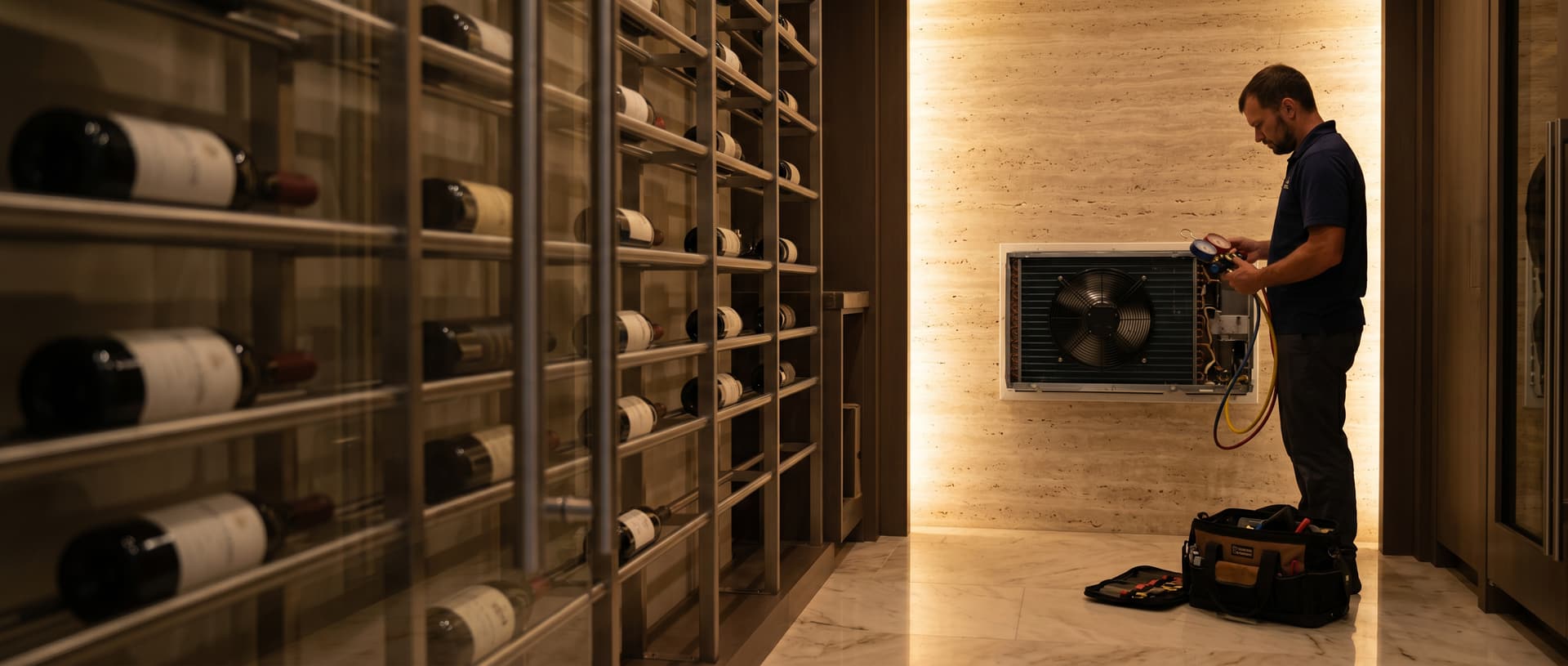
Wine Cellar Repair in Malibu
WhisperKOOL · CellarPro · Wine Guardian · Breezaire · Fondis · Vinotheque. Coastal cellars run a different failure tree, salt air, humidity over-correction, above-garage thermal cycling, ducted split systems. $120 diagnostic, same-day across Malibu.
Our Branches
8 service territories across Southern California
01, About this service
A Malibu wine cellar lives in a microclimate the rest of LA doesn't.
Malibu cellars span a wider spectrum than almost anywhere else we work. Carbon Beach has 4,000-bottle ducted-split builds in conditioned wine rooms with WhisperKOOL Extreme 15000 tii or CellarPro 6200VSxi at the heart of the system. Malibu Colony estates run the gamut from converted-pantry compact cellars on a Breezaire WKL through-the-wall to dedicated wine rooms on Wine Guardian ducted systems. Point Dume has hilltop estates with custom builds, sometimes Fondis, sometimes a Vinotheque cabinet, sometimes a CellarPro 4200VSx fronting a glass-walled display room. Malibu Country Estates and Broad Beach lean toward mid-size dedicated cellars (1,200-2,500 bottles) with WhisperKOOL or CellarPro split systems. The cooling hardware varies; the climate problem is the same.
Every one of these cellars is sitting inside a coastal microclimate that the rest of greater LA simply doesn't experience the same way. Salt aerosol drifts off the Pacific and reaches every cellar within a half-mile of PCH. Marine-layer mornings push outdoor humidity into the 85-95% range for hours at a time, and that air finds its way into garages, mechanical rooms, and air handler intakes. Summer afternoon thermal cycling runs harder against above-garage wine rooms than it does against basement cellars in the Conejo Valley or Pasadena. Three stressors, salt air, moisture, and thermal cycling, work in parallel against every Malibu cooling system, and they produce a specific, predictable set of failure modes that look different from anything we'd see on the same brand of equipment 15 miles inland.
This page is for Malibu wine cellars specifically. If you're inland, Beverly Hills, Pacific Palisades on the Westside above PCH, Calabasas, Hidden Hills, see our Beverly Hills wine cellar repair page; the failure tree there is different. If you have a small wine cooler rather than a dedicated cellar, see wine cooler repair. If you're not sure which category your installation falls into, call us, the model on the unit's data tag tells us everything in 30 seconds and we'll route the call accordingly.
02, The coastal failure tree
Coastal Wine Cellar Failures: What Salt Air and Humidity Do to Your Cooling System
Inland cellar failure trees emphasize compressor age, control-board electronics, and gasket wear on a long timeline. Malibu cellars hit those same failure modes plus six environment-driven ones that run on a faster clock. We diagnose in the order of cheapest-to-resolve to most-expensive, but coastal homeowners should know the full picture going in.
1. Accelerated compressor wear
Coastal cooling systems run at higher duty cycle because the surrounding air is warmer in summer (radiative heat off PCH and ocean-warmed air masses), more humid year-round, and harder on the condenser. A WhisperKOOL Extreme 8000 that runs 35-45% duty cycle in Hidden Hills will run 55-70% in a comparable Malibu Colony cellar. Compressor lifetime correlates directly with run-hours; the same unit fails 3-5 years earlier on the coast. We see CellarPro 1800QTx units showing compressor decline at year 6-8 in Carbon Beach versus year 11-13 in inland installations.
2. Condensate management failure
Malibu cellars produce dramatically more condensate than inland equivalents because the air being cooled carries more moisture. Drain pans designed for 1-2 cups per day of condensate are seeing 4-6 cups in coastal summer. Salt deposits accumulate in drain lines as the water evaporates from line walls between cycles. The result: drain pan overflow, water pooling at cabinet bases on through-the-wall units, water staining on subfloors under split-system air handlers. We see this on every brand, WhisperKOOL, CellarPro, Wine Guardian, Breezaire, and it's the single most common reason a Malibu homeowner calls us.
3. Humidity over-correction
The cooling cycle that's removing heat from your cellar is also removing moisture, and on coastal homes with high-humidity intake air the unit ends up over-drying the cellar to 45-55% RH instead of the 60-70% target. Wines age dry. Corks contract. Ullage (the air gap in the bottle neck) increases over time. Long-term storage value degrades. The fix is a calibration question more than a hardware question, but it requires accurate measurement at multiple points and recalibration of the cooling differential and supplemental humidification on systems where it's appropriate.
4. Door and refrigerant-line seal degradation
Salt air plus UV plus thermal cycling break down rubber and silicone faster on the coast. Door gaskets on cabinet units (Vinotheque, Vinotemp, larger Breezaire models) crack and lose seal at year 4-6 instead of year 8-10. Refrigerant line-set flares on split systems oxidize and develop slow leaks at year 6-8 instead of year 12-15. Vibration mounts on compressors harden and crack. The signs are subtle until they aren't, a half-pound annual refrigerant top-up usually traces back to a flare seal that the homeowner had no idea was leaking.
5. Condenser fin corrosion
Aluminum fins on condenser coils are the canary in the coal mine for coastal exposure. Salt aerosol bonds with dust into a paste-like film, and within 3-5 years the fins themselves start pitting. Heat-exchange efficiency drops first; the unit compensates with longer run times; eventually the fins are damaged badly enough that no cleaning recovers the original capacity. We address this with semi-annual coil cleaning and sealant treatment, and on units past the recovery point we'll quote coil replacement or recommend full unit replacement based on the economics.
6. Control board moisture damage
The control boards in cooling units assume a relatively dry electrical environment. On Malibu cellars where humidity penetrates the cabinet seams or the mechanical-room enclosure, moisture migrates onto the control board and bonds with airborne salt to create a conductive film. Symptoms: intermittent display readings, ghost-temperature drift, unexplained relay chatter, eventual board failure. We see this most often on CellarPro 1800QTx and WhisperKOOL Extreme 4000 cabinets installed in garage mechanical chases, and on Wine Guardian condensing units in exterior enclosures. Catching it during semi-annual service, wiping the board, applying conformal coating where appropriate, extends board life by years.
03, Brands and models
Wine Cellar Cooling Units We Repair in Malibu
Six brand families cover roughly 95% of the Malibu service mix. Each runs a different parts chain, a different characteristic failure profile on the coast, and a different replacement-economics calculation when repair stops making sense.
WhisperKOOL
Extreme 4000 · Extreme 8000 · Extreme 15000 tii · Twin-fan SC series · Ceiling-mount split systems
The most-specified brand in Malibu's mid-to-large estate range. Extreme 4000 covers compact cellars (300-700 bottles); Extreme 8000 fits 700-1,500 bottles; Extreme 15000 tii is the workhorse on 1,500-3,000+ bottle ducted-split builds in Carbon Beach and Malibu Colony. Coastal common service items: condenser fan motor at year 7-10, evaporator coil cleaning twice yearly, drain pan and line maintenance, compressor at year 10-12 on heavy-duty cycle installs. Parts chain through WhisperKOOL distribution is good, most components 2-3 day lead.
CellarPro
1800QTx · 3200VSx · 4200VSx · 6200VSxi · ducted split configurations
Strong presence in Point Dume and Malibu Country Estates installations. 1800QTx (cabinet, smaller cellars) is the most-serviced model on through-the-wall coastal failures. 3200VSx and 4200VSx are split systems serving mid-size cellars; 6200VSxi is the large-format split system on estate-scale builds. Variable-speed compressor design extends life on inland installs but the variable controls show moisture-damage symptoms on coastal control boards somewhat earlier than fixed-speed equivalents. CellarPro parts chain is direct, usually 2-4 day lead.
Wine Guardian
Ductless residential · Ducted split residential · D series · DS series
Wine Guardian's ducted split residential systems are a Malibu staple in custom estate builds, they integrate cleanly with home HVAC architecture and offer humidity-control options that matter on the coast. Common service: condensing-unit fan at year 8-10, line-set flares at year 6-8 (coastal-accelerated), air-handler coil cleaning, control-module humidity calibration. Wine Guardian has authorized service requirements on warranty work; we coordinate accordingly when units are still in coverage.
Breezaire WKL
WKL 2200 · WKL 3000 · WKL 4000 · WKL 6000 · WKL 8000
Through-the-wall self-contained units on smaller and mid-size Malibu cellars (often converted-pantry or closet conversions on Point Dume and Broad Beach). Simpler than split systems, fewer failure modes, but the cabinet itself is exposed to coastal air on both sides, exterior fasteners corrode, exhaust grille fins discolor, compressor mounts harden faster. Service items: condenser cleaning, drain pan and line maintenance, fan motor replacement at year 8-10. Parts well-stocked through the LA-area distributor.
Fondis
SP series split systems · Wine C25 · Wine C50 · Wine C100
French-spec cooling popular in higher-end Carbon Beach and Malibu Colony custom cellars; lower frequency than WhisperKOOL or CellarPro but higher per-job complexity. Fondis distribution is smaller, 5-10 day part lead is typical, longer on control boards and compressors. We diagnose during the first visit, order parts, and return for the repair; for cellars where downtime is unacceptable we discuss interim measures while parts ship.
Vinotheque, Vinotemp, and other cabinets
Vinotheque cabinet refrigeration · Vinotemp cabinet · Eurocave residential cabinets · custom-built integrations
Furniture-style cabinet wine units appear in Malibu primarily as supplemental storage rather than primary cellars (a Vinotheque in a dining room alongside a separate dedicated cellar). Service tree resembles wine cooler repair more than dedicated cellar repair, door gasket, thermistor, control board, occasional compressor. Coastal-accelerated wear on the same components but smaller-scale parts cost. We service them on the same calls when both systems are in the home.
04, Service calendar
Why Malibu Wine Cellars Need a Different Service Schedule
The 6-month coastal interval versus 12-month inland isn't conservative, it's calibrated to the rate at which the failure modes on this page actually develop. A WhisperKOOL Extreme 8000 that gets serviced every 12 months in Calabasas will accumulate four to six months of degraded condenser performance before each service visit and that's fine; the same unit in Malibu Colony on a 12-month schedule will accumulate the same degradation but with double the moisture and salt input, and the next service visit catches problems that have already started causing real wear.
What we actually do on a Malibu coastal maintenance visit: condenser coil cleaning with a brush-and-rinse method appropriate for aluminum fins (we don't use the aggressive chemical cleaners some HVAC techs use on AC condensers, they damage the thinner cellar-unit fins); condensate drain pan removal, cleaning, and salt-deposit flush of the drain line; refrigerant pressure verification at both service ports on split systems and through the access port on cabinet units; control-board visual inspection for moisture and salt residue, with cleaning and conformal coat refresh where appropriate; door and gasket integrity check including a leak-detection cycle (smoke pencil at the seal under cooling); humidity calibration against an independent reference meter at three bottle-level locations plus the wall sensor; salt-residue clean-down on cabinet exteriors; and a written summary of findings.
On ducted split systems we add line-set inspection (visual at accessible runs, leak-detection at both service ports), air-handler filter and coil inspection, duct insulation integrity check, and balance verification at supply registers. Estate cellars with multiple zones get this on each zone. The visit runs 90 minutes for a single cabinet unit, 2-3 hours for a single ducted split, longer for multi-zone estates. Twice yearly. Coastal homes need the cadence; inland homes can run on annual.
05, Recent repairs
Recent Malibu Wine Cellar Repairs
Four representative Malibu service calls, model, neighborhood, symptom, diagnosis, repair, and cost. Names and addresses omitted; the technical scenarios are typical of what we see on coastal cellar work in each area.
WhisperKOOL Extreme 15000 tii, Carbon Beach estate ducted split
Symptom: 2,800-bottle ducted-split cellar drifting from 56°F target to 62°F over 72 hours. Owner noticed on the cellar monitoring app before the wines were affected.
Diagnosis: Refrigerant low, slow leak at the line-set flare on the suction side, originating at the connection to the condensing unit in the garage mechanical room. Salt-driven corrosion of the flare seal at year 7 of the install. Condensing-unit condenser fins also showing 6-month accumulation of salt-and-dust film reducing heat exchange.
Repair: Recovered remaining refrigerant, re-flared the suction line connection, vacuum and pressure-tested the system, recharged with R-410A to manufacturer spec. Cleaned condensing-unit coils. Inspected line-set at all accessible junctions and discharge-line flare on liquid side; both passed. Recommended quarterly visual line-set inspection going forward and added the unit to our coastal maintenance program.
Cost & time: $1,180 total. Same-day diagnostic and recovery; return visit next morning for re-flare and recharge.
CellarPro 1800QTx, Malibu Colony pantry conversion
Symptom: Through-the-wall cabinet unit running constantly, cellar humidity reading 47% RH on the wall sensor, owner concerned about cork health on a 600-bottle cellar.
Diagnosis: Humidity over-correction. The 1800QTx was running its standard cooling differential pulling air across an evaporator that was condensing aggressively given the marine-layer humidity in the adjoining hallway. Wall sensor reading was accurate; cellar was genuinely dry. Drain pan was clearing freely (correctly, given the volume of condensate the unit was producing). No mechanical fault.
Repair: Recalibrated cooling setpoint differential to reduce over-cooling and condensation per cycle. Installed a small in-cellar humidifier sized for the volume, with discharge positioned away from the cooling unit's intake. Re-checked humidity at three bottle-level locations after 48 hours; cellar held 64-66% RH on the new configuration. Added to our coastal maintenance program with humidity calibration on every visit.
Cost & time: $385 (humidifier hardware plus calibration labor). Two visits, initial diagnostic, return for verification.
Wine Guardian ducted split, Point Dume hilltop estate
Symptom: Water pooling on subfloor under air-handler in the cellar mechanical chase. Owner discovered staining during a separate cabinetry inspection.
Diagnosis: Condensate drain pan on the air handler had developed a hairline crack at the corner seam, likely from salt-residue stress over 9 years of service combined with thermal cycling. Drain line itself was clear. Pan was producing normal condensate volume but losing it through the crack rather than down the line.
Repair: Replaced the air-handler condensate pan with a Wine Guardian OEM replacement (3-day lead through their distribution). Inspected the line-set, refrigerant pressures, and condensing-unit coils while waiting on the part. Re-flushed the drain line. Confirmed seal integrity on the new pan over a 24-hour cooling cycle. Repaired subfloor staining was outside our scope, referred to a flooring contractor.
Cost & time: $620 (pan, labor, two visits including refrigerant inspection).
Breezaire WKL 4000, Broad Beach guesthouse cellar
Symptom: Through-the-wall unit no longer cooling. Owner reset the breaker twice; unit ran briefly each time then stopped.
Diagnosis: Compressor start-relay failure with secondary symptoms from salt-driven corrosion on the relay contacts and the connector pin headers. Year 11 of the install, full coastal exposure on the exterior cabinet face, no maintenance program in place. Compressor itself tested healthy on direct continuity check; capacitor in spec.
Repair: Replaced start relay and overload, cleaned and treated the connector pin headers, applied conformal coating where appropriate, verified cooling cycle through a full pull-down to setpoint. Discussed cabinet-level maintenance going forward, drain pan service, exterior salt clean-down twice yearly, and gasket replacement scheduled for year 13.
Cost & time: $245. Same-day, completed on the diagnostic visit.
06, Pricing
Wine Cellar Repair Costs in Malibu
Diagnostic is $120 for residential calls, applied toward the repair when you approve work. Labor and parts are quoted in writing before any work begins. These ranges reflect typical 2024-2025 wine cellar repair pricing across the brands and component types we service most in Malibu.
Diagnostic is residential only. Estate-scale ducted split work in Carbon Beach and Malibu Colony often quotes higher than the bands above when refrigerant volume, line-set length, and labor access are factored in, the on-site diagnostic catches those variables and we adjust the written estimate accordingly. Coastal maintenance is the single highest-value spend on the coast: it preserves equipment investment, catches the failure modes on this page before they become emergencies, and on most Malibu cellars pays for itself in extended unit life.
07, FAQ
Wine Cellar Repair, Malibu FAQ
Why does my Malibu wine cellar struggle to hold humidity even though the cooling unit runs constantly?
This is the single most common Malibu cellar complaint we hear, and it's almost always a humidity over-correction problem driven by the coast. Marine-layer mornings push the air around your cellar to 80-95% relative humidity; your cooling unit pulls that air across an evaporator coil that's typically running 38-44°F, and water condenses out of it aggressively. The unit dumps that water down a drain line, and the cellar interior swings to 45-55% RH instead of the 60-70% target. Wines age dry, corks shrink, ullage rises. The fix isn't more cooling, it's recalibrating the dew-point window. We measure cellar RH at the wall sensor and at three bottle-level locations, check that the cooling setpoint differential isn't over-driving condensation, verify the condensate drain isn't restricted (a common Malibu issue we cover in another FAQ), and on ducted splits we re-stage the discharge air pattern so the coil doesn't see the most humid air on every cycle. Some Malibu cellars also need a supplemental humidifier on the air handler, Wine Guardian and Fondis both make integrated options, and on coastal homes we recommend the integrated approach over a free-standing unit because the latter fights the cooling system instead of working with it.
How does salt air actually damage a wine cellar cooling unit?
Three mechanisms run in parallel. First, salt aerosol in coastal air settles on the aluminum fins of the condenser coil and bonds with dust into a corrosive paste. Heat-exchange efficiency drops, the compressor runs longer to hit setpoint, and within 3-5 years the fins themselves start pitting. Second, salt-laden moisture penetrates the cabinet seams of through-the-wall units (Breezaire WKL, the smaller WhisperKOOL chassis) and reaches the control board, we see corrosion on the relay contacts and the temperature-sensor pin headers long before any visible exterior damage. Third, the rubber and silicone components, door gaskets on cabinets, vibration mounts on compressors, hose fittings on split-system refrigerant lines, break down faster under salt exposure and UV. A Wine Guardian condensing unit installed in a Carbon Beach garage will need its line-set flares re-done at year 6-8 if it isn't proactively serviced; the same unit in a Calabasas garage might run 12-15 years before the same wear shows up. Salt is patient and it always wins eventually, our job is to slow the clock with semi-annual service, sealant treatment on cabinet seams, and proactive replacement of the parts that fail predictably.
Why do Malibu cellars over a garage seem to fail more often than other configurations?
Wine rooms built into the bonus space above a garage are extremely common in Malibu, Carbon Beach, Malibu Colony, and Point Dume all have hundreds of estate homes with this exact layout. The problem is thermal cycling. The garage below isn't conditioned, so its temperature swings 20-30°F between a 58°F winter morning and an 88°F summer afternoon. The cellar above sits on a floor structure that conducts that heat directly into the room. Your cooling unit isn't fighting ambient room temperature the way it would in a basement install, it's fighting a moving floor temperature that climbs into the late afternoon and stays warm well after sunset. Add coastal humidity migrating up through unsealed garage-to-cellar penetrations (recessed lights, HVAC chases, electrical conduit), and the cooling unit ends up running 60-80% duty cycle in summer when a properly-positioned cellar should be at 25-40%. We address above-garage cellars by sealing all penetrations from below, adding a thermal break under the cellar floor where access allows, and sizing replacement cooling at 1.3-1.5x the published BTU calculation rather than 1.0x. On older builds we also recommend a small supply duct from the home's HVAC zone running into the garage ceiling cavity to dump the worst of the summer heat before it reaches the cellar floor.
How often should a Malibu wine cellar be serviced compared to inland?
Every 6 months for coastal Malibu installs versus every 12 months inland. The 6-month interval isn't arbitrary, it tracks the rate at which condenser coils foul under salt-and-dust exposure (4-6 months to visible film), the cadence of condensate-line cleaning before salt deposits restrict the line, and the inspection point for the rubber and gasket components that break down faster on the coast. Our coastal maintenance program covers two visits per year: condenser coil cleaning and inspection, condensate drain pan and line flush, refrigerant pressure verification, control-board moisture inspection, door and gasket integrity check, calibration of the cellar sensor against an independent meter, and a salt-residue clean-down on cabinet exteriors. For estate cellars over 2,000 bottles or with ducted split systems running multiple zones, we recommend the same 6-month cadence but with a longer site visit because the line-set and air-handler inspection adds time. Inland cellars (Hidden Hills, Calabasas, Conejo Valley) we service annually unless the homeowner specifies tighter; same checklist, longer interval.
My WhisperKOOL Extreme 8000 is leaking water from the cabinet, what's wrong?
Almost always a condensate management failure. The Extreme 8000 (and the 4000 and 15000 tii in the same family) generates significant condensate on the evaporator side during normal operation, and that water exits through a drain pan and a directed drain line. In Malibu installations we see three failure paths in this order. First, the drain pan itself, debris, mineral buildup, and on coastal installs salt deposits accumulate over 2-4 years and reduce capacity, so the pan overflows on long cooling cycles. Second, the drain line, typically a 3/8-inch flexible line routed to a floor drain or condensate pump; salt deposits and biological growth can restrict the line until water backs up. Third, the gravity termination, if the line was installed with insufficient fall (1/4 inch per foot is the spec; we see 1/8 or less on builder installs), water sits in the line instead of draining and eventually finds its way out through a fitting. Our diagnostic checks all three; about 70% of the time the fix is drain pan cleaning plus line flush, no parts. The remaining 30% needs a new drain pan, a new drain line, or on neglected systems a condensate pump retrofit because the original install assumed gravity termination that no longer works.
Should I run my Malibu cellar cooling year-round or shut it off in winter?
Year-round. Malibu's coastal climate is mild enough that homeowners sometimes assume their cellar can free-cycle through the winter without active cooling, but coastal humidity doesn't take a winter break. A January storm system delivers 90%+ RH air to your cellar without the temperature differential that drives the cooling unit to dehumidify. We've seen cellars that were idled for the winter come out of February with mold visible on cork tops and label edges, even when the temperature was technically fine. Run the cooling year-round at the same setpoint (typically 55-58°F). The unit will cycle less in winter, that's expected and healthy, but it will still pull excess humidity out of the air on every cycle and keep the cellar in the right window. If your cellar has been off-duty over the winter, run a recovery cycle for 48 hours before you re-evaluate setpoint, and have us out for a humidity-management check to make sure nothing started growing in the drain pan while the system was idle.
Do you service ducted split systems and large estate cellars?
Yes, ducted split systems are a significant portion of our Malibu workload, especially in the Carbon Beach and Malibu Colony estate-scale builds. The systems we see most often: WhisperKOOL Extreme 15000 tii (the largest residential ducted-split chassis), CellarPro 4200VSx and 6200VSxi in ducted configurations, Wine Guardian's full ducted line, and Fondis ducted splits on the European-spec end of the market. Our service approach on ducted splits is fundamentally different from cabinet units. The condensing unit lives in a mechanical room, garage, or exterior enclosure; the air handler and ducting live in the cellar or an adjacent ceiling chase. We work both ends of the system on every visit, line-set inspection, refrigerant pressure check at both service ports, condensing-unit fan and coil cleaning, air-handler filter and coil inspection, duct insulation integrity check (a common failure point on installs over 10 years old where insulation has compressed or torn), and balance verification at each supply register. EPA 608 Universal certified (#1346255700410), BHGS #A49573 licensed for refrigerant work; we carry R-134a and R-410A on the truck for Malibu calls.
How much does Malibu wine cellar repair cost?
Diagnostic is $120, applied toward the repair when you approve work. Typical cost bands: minor repairs (door gasket, temperature sensor, drain line clearing, control calibration) run $180-$320; control board replacement on units like CellarPro 1800QTx, WhisperKOOL Extreme 4000, or Wine Guardian residential cabinets runs $380-$680 depending on board complexity and whether it's an OEM or aftermarket replacement; compressor work on ducted splits and larger cabinet units runs $580-$1,200 covering the compressor, capacitor, line-set evacuation and recharge; full unit replacement when repair economics don't work runs $1,800-$4,500+ depending on unit class (a self-contained Breezaire WKL replacement at the lower end, a ducted Wine Guardian or WhisperKOOL Extreme 15000 tii at the upper end, with installation and refrigerant work additional on the ducted side). Our coastal maintenance program, twice-yearly visits with condenser cleaning, drain service, refrigerant check, and gasket inspection, runs $280-$420 annually depending on cellar size and system type. We give a written estimate before any work begins, and the diagnostic fee gets credited.
Do you stock parts for Fondis, Wine Guardian, and other less common brands in Malibu?
Common service parts yes, brand-specific control boards and refrigeration components case-by-case. We stock WhisperKOOL and CellarPro temperature sensors, fan motors, and door gaskets on the truck because they're the brands we see most. Wine Guardian residential cabinet parts we order through their authorized distribution, typically 2-3 day lead. Fondis is a French brand and parts come through a smaller distribution chain, 5-10 day lead on most components, longer on control boards and compressors. Breezaire WKL parts are well-stocked through their LA-area distributor. For estate cellars where downtime matters, we'll often diagnose during the first visit, order parts, and complete the repair on a return visit; for cellars where temperature drift is already affecting wine, we discuss interim measures (loaner glycol bath cooling, supply-air ducting from the home's HVAC) while the parts are in transit. EPA 608 certification covers refrigerant work across all the brands we service.
Malibu wine cellar acting up? Same-day coastal-aware service.
$120 diagnostic, applied toward the repair. WhisperKOOL, CellarPro, Wine Guardian, Breezaire, Fondis, Vinotheque, coastal-trained on the brands Malibu estate cellars actually run. EPA 608 certified for refrigerant work.