Newport Beach · Harbor Island · Newport Coast · Corona del Mar
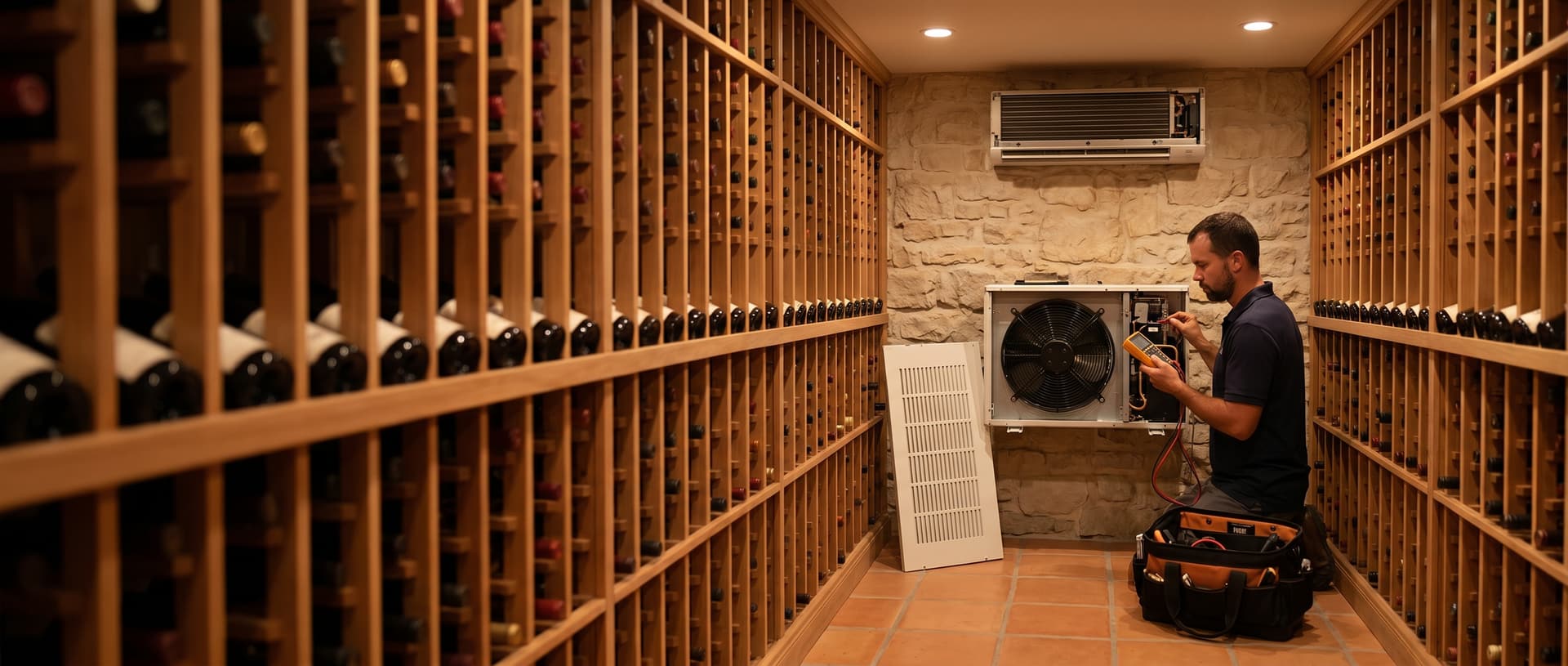
Wine Cellar Repair in Newport Beach
WhisperKOOL Extreme · CellarPro VSx · Wine Guardian · Breezaire WKL · Vinotheque · Vinotemp · US Cellar Systems. Harbor humidity vs Newport Coast Santa Ana wind expertise. Irvine branch dispatching 15–20 minutes into Newport Coast, Corona del Mar, Pelican Hill, and Balboa Island. $120 diagnostic, waived with repair.
01, About this service
Newport Beach wine cellars live in two distinct micro-environments, and one Irvine dispatch.
Newport Beach has one of the densest concentrations of serious wine cellars in Orange County, and the build mix runs the full spectrum. Harbor Island and Lido Isle bayfront estates have 1,500-to-3,500 bottle cellars built into hillside basements or first-floor walk-ins, almost always running CellarPro VSx splits, WhisperKOOL Extreme 8000, or Wine Guardian ductless. Balboa Island and the older Bay Shores properties lean toward more compact 600-to-1,500 bottle cellars in remodeled rooms, often on Breezaire WKL or smaller WhisperKOOL Platinum chassis. Newport Coast and Pelican Hill estates run the largest Newport cellars we work on, 3,000-to-7,000 bottle rooms with WhisperKOOL Extreme 15000 tii or CellarPro 6200VSxi at the heart. Big Canyon and Spyglass Hill sit between those poles. Corona del Mar splits the difference depending on which side of PCH the property sits on.
What distinguishes Newport Beach from every other cellar market we cover is that it has two environmental stress profiles stacked into one zip code. Harbor-side Newport (Harbor Island, Lido Isle, Balboa Island, Bay Shores, the bayfront sections of Corona del Mar) is a marine-basin micro-environment: lower-velocity wind but much higher overnight humidity than open-ocean coast, and salt that condenses onto metal surfaces rather than blowing past them. The hillside Newport Coast and Pelican Hill side sits higher in elevation and more inland, with a different stress profile, moderate coastal influence layered on top of Santa Ana wind events, where October and December throw 30-to-40-degree ambient swings at a cooling system in a 24-hour window. Boat-slip-adjacent properties on Lido Isle, Harbor Island, and the Balboa Peninsula sit at the extreme end of the harbor profile: cellar-wall RH regularly hits 95% overnight, and the air carries fine droplets of salt water rather than just salt aerosol.
This is fundamentally different from a Malibu wine cellar, even though both are technically coastal. Malibu's exposure is open-Pacific wind-driven salt aerosol, concentrated salt particles attack cabinet hardware and door gaskets aggressively, and the wind dries equipment between salt-deposit cycles. Newport's harbor exposure ages the internal mechanicals, compressor, condenser coil, evaporator, control board, noticeably faster, even though Malibu cabinet hardware corrodes faster externally. Different stressors, different failure timelines, different service schedules.
We dispatch from our Irvine branch, typical reach time runs 15 to 20 minutes for inland Newport (Big Canyon, Newport Coast inland of the ridge, Eastbluff, Spyglass Hill) and 18 to 25 minutes for harbor and coastal lots. That advantage matters specifically on cellar work, where a fault caught in the first six hours often resolves cheaper than the same fault caught at 24 hours. Compare with our Malibu cellar calls, where our nearest LA-county branch dispatches roughly 45 to 75 minutes through PCH or Topanga. We carry the most-needed WhisperKOOL, CellarPro, Wine Guardian, and Breezaire parts on the Irvine truck because Newport is the brand-density market that justifies a denser inventory. EPA 608 Universal certified (#1346255700410), BHGS #A49573 licensed for refrigerant work; we keep R-410A and R-134a on the truck for Newport calls.
02, The failure tree
Wine Cellar Failures We See in Newport Beach.
Inland cellar failure trees emphasize compressor age, control electronics, and gasket wear on a long timeline. Newport Beach cellars hit those same failure modes plus a Newport-specific cluster driven by harbor humidity, boat-slip proximity, and Santa Ana wind events on the hillside side. We diagnose cheapest-to-resolve to most-expensive, but Newport homeowners should know the full picture going in.
1. Harbor moisture in the condenser fin pack
This is the failure that distinguishes Newport Beach from every other cellar market we cover. Harbor humidity carries fine salt particles that condense overnight on cellar-cooling condenser coils and bond with airborne dust into a paste-like film on the aluminum fins. Heat-exchange efficiency drops long before the homeowner notices warmer cellar temperatures. By the time the unit visibly fails to hold setpoint, the compressor has been running at design-limit duty cycle for months. We see this on WhisperKOOL Extreme 4000/8000 cabinet units and CellarPro 1800QTx through-the-wall installations across Harbor Island, Lido Isle, and Bay Shores particularly, six-month coil cleaning is the answer, twelve-month is too long for harbor-adjacent installs.
2. Boat-slip humidity extremes
A cellar within roughly fifty feet of an active boat slip, the situation on most Lido Isle, Harbor Island, and Balboa Peninsula bayfront properties, sees a humidity profile no manufacturer service interval was modeled around. Overnight RH at the cellar wall regularly hits 95%; the air carries fine droplets of salt water rather than just salt aerosol. Drain-line salt-deposit buildup restricts drainage quarterly. Evaporator coil corrosion is visible at the leading edge by year 4-5. Control-board connector pin oxidation causes intermittent display reads on year-3 cabinet units. Slip-adjacent cellars are their own service category and we treat them that way.
3. Santa Ana wind events on Newport Coast and Pelican Hill
The hillside Newport side has a stressor the harbor doesn't. Santa Ana events twice or three times a year push outdoor humidity to single digits and ambient temperatures to 95-100°F over 24-48 hours, a 30-40°F swing from baseline coastal conditions. The cooling system handles that ambient load while vapor-barrier integrity matters more than usual. We see compressor short-cycling right after Santa Ana events, and on cellars with marginal humidification we see RH drop into the 40s. A late-September check catches issues before the November and December events do real damage.
4. Evaporator coil corrosion on harbor installations
Open-coast Malibu cellars see condenser-side wear faster than evaporator-side. Newport harbor cellars reverse that ratio, the evaporator coil, sitting inside the cellar handling humid air every cooling cycle, corrodes at its leading edge faster on harbor exposure because harbor air carries dissolved salt that the coil pulls out of the air with the moisture on every cycle. We see leading-edge fin pitting on year 5-7 harbor cellars where inland equipment would be at year 8-10. Coil cleaning while corrosion is reversible; coil replacement ($480-$780 parts and labor on a WhisperKOOL Extreme 8000 or CellarPro 4200VSx) when it's not.
5. Door gasket and line-set seal degradation
Salt air, harbor humidity, and UV break down rubber and silicone faster on Newport coastal installs than on inland equivalents. Door gaskets on cabinet units (Vinotheque, Vinotemp, larger Breezaire WKL) crack at year 4-6 instead of year 8-10. Refrigerant line-set flares on split systems oxidize and develop slow leaks at year 6-8. The signs are subtle, a half-pound annual refrigerant top-up usually traces back to a flare seal the homeowner didn't know was leaking, and on a Pelican Hill estate split that flare lives in a remote mechanical room where a slow leak runs for months before it's noticed.
6. Condensation control failures
Two patterns. Pattern A: visible condensation on glass cellar doors, ceilings, or interior walls, almost always a vapor barrier defect on the warm side of the insulation, a construction problem rather than a cooling unit problem. Newport's harbor humidity makes vapor-barrier defects show up more dramatically than inland conditions. Pattern B: cellar humidity dropping below 55% RH despite the cooling unit running normally, typically the unit over-corrects because intake air is more humid than the cellar interior, condenses aggressively on the evaporator, and dumps the cellar dry. Wines age dry, corks shrink, ullage rises. The fix on B is calibration, not hardware.
7. Control board moisture damage
Cellar cooling unit control boards assume a relatively dry electrical environment. On Newport harbor-adjacent cellars where humidity penetrates cabinet seams or mechanical-room enclosures, moisture migrates onto the control board and bonds with airborne salt into a conductive film. Symptoms: intermittent display readings, ghost-temperature drift, unexplained relay chatter, eventual board failure. We see this most often on CellarPro 1800QTx cabinets and WhisperKOOL Extreme 4000 units in garage chases on Lido Isle, Harbor Island, and Bay Shores. Catching it during semi-annual service, wiping the board, applying conformal coating, extends board life by years.
8. Salt-aerosol fin damage and harbor traffic vibration
Two harbor-specific items that don't show up on inland calls. First: salt aerosol over multi-year exposure pits aluminum condenser fins faster than coil cleaning alone can keep up with, at year 6-8 we sometimes find fins damaged badly enough that no cleaning recovers original capacity. Second: vibration from harbor boat traffic transmits through dock structures into adjacent mechanical rooms and accelerates compressor-mount rubber breakdown on units installed close to bayfront walls. We isolate compressor mounts proactively on slip-adjacent installs.
03, Brands and models
Wine Cellar Cooling Systems We Repair in Newport Beach.
Six brand families cover roughly 95% of the Newport Beach cellar service mix. Each runs a different parts chain and a different characteristic failure profile under harbor exposure or Santa Ana hillside conditions.
WhisperKOOL
Extreme 4000 · Extreme 8000 · Extreme 15000 tii · Platinum Mini · Twin · Quantum · ceiling-mount splits
Most-specified brand in Newport Beach across the mid-to-large cellar range. Extreme 4000 covers 300-700 bottle cellars on Balboa Island and older Corona del Mar; Extreme 8000 fits 700-1,500 bottles across Newport Coast and Bay Shores; Extreme 15000 tii is the workhorse on 1,500-3,500+ bottle Pelican Hill and Big Canyon ducted-split builds. Coastal-typical service: condenser fan motor at year 5-7 on harbor exposure, drain-pan and line maintenance every six months, control board approaching year 9-10.
CellarPro
1800QTx · 3200VSx · 4200VSx · 6200VSxi · ducted splits
Strong presence in Newport Coast, Big Canyon, and Pelican Hill. 1800QTx is the most-serviced model on through-the-wall harbor failures across Lido Isle and Harbor Island. The 4200VSx evaporator-freeze pattern hits Newport harbor cellars more often than inland because of vapor-barrier load. 6200VSxi is the large-format split on estate-scale builds. Variable controls show moisture-damage symptoms on coastal control boards somewhat earlier than fixed-speed equivalents. Direct parts chain; 1-2 day lead.
Wine Guardian
Ductless · Ducted split · D025 · D050 · D088 · D200 · D300
Dominates the larger Newport cellars (3,000+ bottles) on Pelican Hill, Newport Coast, and the larger Big Canyon estates with the cooling unit concealed in a remote mechanical room. Humidification module options matter on the hillside side where Santa Ana events drive the cellar dry, we install humidification add-ons proactively. Common service: condensing-unit fan at year 8-10, line-set flares at year 6-8 on coastal exposure, air-handler coil cleaning, humidity calibration.
Breezaire WKL
WKL 2200 · WKL 3000 · WKL 4000 · WKL 6000 · WKL 8000
Through-the-wall self-contained units on smaller and older Newport cellars (often pantry conversions on Balboa Island, Lido Isle, and older Bay Shores properties). Cabinet exposed to harbor air on both sides, exterior fasteners corrode, exhaust-grille fins discolor, compressor mounts harden faster. Service: condenser cleaning, drain maintenance, fan motor at year 8-10. Parts well-stocked. On units past year 12 with a major fault, replacement economics typically win.
Vinotheque, Vinotemp, US Cellar Systems
Vinotheque cabinet · Vinotemp Wine-Mate split · Vinotemp cabinet · US Cellar Systems SC series · CM cabinet · custom builds
Vinotheque and Vinotemp cabinet wine units appear in Newport primarily as supplemental storage rather than primary cellars. Service tree resembles wine cooler repair, door gasket, thermistor, control board, occasional compressor. Vinotemp Wine-Mate splits are common on mid-2000s Newport Coast installations. US Cellar Systems shows up on a small but consistent share of custom builds; we identify the underlying OEM platform on diagnostic since some US Cellar Systems chassis share parts with WhisperKOOL or CellarPro. Send a photo of the data plate when you call.
04, Harbor vs hillside
Newport Beach Wine Cellars: Harbor vs Hillside.
Harbor-side Newport, marine environment, extreme humidity. Harbor Island, Lido Isle, Balboa Island, Bay Shores, and the bayfront sections of Corona del Mar sit at sea level inside a marine basin. Overnight humidity routinely climbs into the 90-95% range and rarely drops below 70% during summer days. Salt aerosol settles on equipment 24 hours a day. Boat-slip-adjacent properties (Lido Isle bayfront, Harbor Island bayfront, Balboa Peninsula bayfront) sit at the extreme end of this profile, RH at the cellar wall regularly hits 95% overnight, and the air carries fine droplets of salt water. Service cadence: every six months for general harbor exposure, every four months for slip-adjacent. Emphasis: condenser coil cleaning, drain-line flush, evaporator leading-edge inspection, control-board moisture check, gasket integrity, line-set flare inspection.
Hillside Newport, moderate coastal, Santa Ana cycles. Newport Coast above the ridge, Pelican Hill, Big Canyon, Spyglass Hill, and the inland portions of Eastbluff sit at higher elevation with overnight humidity profiles closer to coastal SoCal than to a marina. The hillside side sees one stress the harbor doesn't: Santa Ana wind events twice or three times a year, where hot dry desert air pushes outdoor humidity to single digits and ambient temperatures to 95-100°F, a 30-40°F swing from baseline coastal conditions in 24 hours. Units with marginal humidification can dump cellar RH into the 40s during a 48-hour event. Service cadence: annual baseline plus a Santa Ana season check in late September. Emphasis: humidification module verification, vapor-barrier integrity, refrigerant charge verification (high-ambient stress of Santa Ana days reveals slow leaks that would otherwise stay hidden), line-set flare inspection.
Different schedules, different priorities. A Lido Isle bayfront WhisperKOOL Extreme 8000 and a Pelican Hill ridge-top WhisperKOOL Extreme 8000 are physically the same equipment, but the service plans should not look the same. Harbor-side cellars get six-month visits with condenser, drain, and control-board emphasis. Hillside cellars get annual visits with humidification, vapor-barrier, and pre-Santa Ana refrigerant emphasis. Slip-adjacent cellars get four-month visits plus quarterly drain-line flush. We adjust the program to the actual address.
Irvine branch dispatch advantage. Whichever Newport micro-environment your cellar sits in, our Irvine branch reaches it in 15-25 minutes on a typical weekday, versus 45-75 minutes from our nearest LA-county branch into Malibu through PCH or Topanga. On a cellar emergency, that response gap is the difference between catching a slow refrigerant leak before it becomes a compressor failure versus arriving after the compressor has been running over-pressure for an hour. Newport Beach is the cellar-density market that justifies a dedicated dense inventory at Irvine, and that inventory is what makes one-visit repairs the norm rather than the exception.
05, Recent repairs
Recent Newport Beach Wine Cellar Repairs.
Four representative Newport Beach service calls, model, neighborhood, symptom, diagnosis, repair, and cost. Names and addresses omitted; the technical scenarios are typical of what we see on harbor-side and hillside Newport cellar work.
CellarPro 4200VSx, Harbor Island bayfront cellar
Symptom: 1,400-bottle bayfront cellar drifting from 56°F to 63°F over a 36-hour window. Owner caught it on the wireless monitor before wine was at risk.
Diagnosis: Classic 4200VSx evaporator freeze-over, accelerated by harbor humidity migrating through a marginal vapor barrier (moisture meter confirmed). Coil iced, airflow blocked. Drain pan draining but slowly, early salt-deposit restriction. Humidity setpoint left at 70% RH was over-driving condensation given harbor intake.
Repair: Full coil thaw, cleared drain pan, flushed drain line of salt deposits, recalibrated humidity setpoint to 65% RH, verified pull-down to setpoint. Wrote a referral note recommending vapor-barrier inspection by a qualified contractor. Added cellar to our four-month slip-adjacent maintenance program.
Cost & time: $295. Same-day, about 3 hours on-site (most of which was the thaw cycle).
WhisperKOOL Extreme 15000 tii, Pelican Hill estate ducted split
Symptom: 4,200-bottle ducted-split cellar drifting from 56°F target to 60°F over 48 hours, within a week after a major late-October Santa Ana event.
Diagnosis: Refrigerant low, slow leak at the line-set flare on the suction side at the condensing unit in the mechanical room. The Santa Ana high-ambient stress (96°F outdoor, single-digit RH) revealed a flare seal that had been seeping for months. Condensing-unit coils also showing 8-month dust accumulation.
Repair: Recovered remaining refrigerant, re-flared the suction line, vacuum and pressure-tested, recharged R-410A to spec. Cleaned condensing-unit coils. Inspected all accessible line-set junctions; passed. Recommended late-September Santa Ana season check; added to our annual hillside maintenance program.
Cost & time: $1,150 total. Diagnostic same-day, return next morning for re-flare and recharge.
Breezaire WKL 4000, Newport Coast ridge cellar
Symptom: Cabinet unit running constantly, cellar holding setpoint but humidity reading 47% RH on the wall sensor. Owner concerned about cork health on a 700-bottle Bordeaux-heavy cellar.
Diagnosis: Humidity over-correction layered on top of mild Santa Ana season dryout. Wall sensor reading was accurate; cellar was genuinely dry. No mechanical fault. Underlying cause was lack of any humidification on a hillside cellar where Santa Ana events plus winter dryness push cellar RH below 55%.
Repair: Recalibrated cooling setpoint differential to reduce over-cooling per cycle. Installed a small in-cellar humidifier sized to volume, discharge positioned away from the cooling unit intake. Re-checked humidity at three bottle-level locations after 48 hours; cellar held 64-66% RH. Added to our annual hillside maintenance program.
Cost & time: $410 (humidifier hardware plus calibration labor). Two visits.
WhisperKOOL Extreme 8000, Corona del Mar bayfront cellar
Symptom: Water pooling on the floor adjacent to the cabinet unit, intermittent over two weeks, getting worse. Cellar was holding setpoint, no temperature complaint.
Diagnosis: Drain pan salt-deposit restriction. Year 6 of the install, full bayfront exposure, no maintenance program since installation. Pan producing normal condensate volume but the drain line was restricted by accumulated salt deposits and the pan was overflowing on long cooling cycles. Compressor and refrigerant healthy; evaporator coil showed early leading-edge oxidation but still serviceable.
Repair: Removed and cleaned drain pan, flushed line of salt deposits, verified gravity termination at proper fall. Applied protective treatment to evaporator leading edge. Added unit to our six-month harbor maintenance program.
Cost & time: $235. Same-day, about 90 minutes on-site.
06, Pricing
Wine Cellar Repair Costs in Newport Beach.
Diagnostic is $120 for residential calls, applied toward the repair when you approve work. Labor and parts are quoted in writing before any work begins. These ranges reflect typical 2025-2026 wine cellar repair pricing across the brands and component types we service most often in Newport Beach.
Diagnostic is residential only. Estate-scale ducted-split work on Pelican Hill and Big Canyon often quotes higher than the bands above when refrigerant volume, line-set length, and labor access are factored in, the on-site diagnostic catches those variables and we adjust the written estimate accordingly. Boat-slip-adjacent maintenance runs the four-month interval at the same per-visit cost; the schedule is denser, not the per-visit price. After-hours and weekend emergency dispatch carries a modest premium quoted before we dispatch. Premium-brand parts uplift on Wine Guardian and Vinotheque components is real and we tell you the brand-specific cost differential before you authorize repair.
07, FAQ
Wine Cellar Repair, Newport Beach FAQ.
How fast can you reach Newport Beach from your Irvine branch?
Typical dispatch from our Irvine branch runs 15 to 20 minutes door-to-door for Newport Coast, Corona del Mar, Big Canyon, and Eastbluff. Pelican Hill, Lido Isle, and Bay Shores run 18 to 25 minutes depending on PCH and Jamboree traffic. Harbor Island and Balboa Island are special cases, bridge crossings or the ferry queue add 10 to 15 minutes on summer weekends. The dispatch advantage matters: a cellar drifting from 56°F target to 65°F over 12 hours is at the start of a collection-at-risk window, and a 20-minute response from Irvine versus a 45-to-75-minute slog from an LA dispatch point through PCH changes whether we catch the issue before bottle temperature itself moves. We carry the most-needed WhisperKOOL, CellarPro, Wine Guardian, and Breezaire parts on the Irvine truck precisely because Newport is the cellar-density market the inventory is built around.
Do you do same-day or after-hours dispatch into Newport Beach?
Yes on both. Our Irvine branch covers Newport Beach 7am-9pm Monday through Friday, 8am-7pm Saturday, and 9am-5pm Sunday on standard residential service. After-hours and overnight emergency dispatch is available for active cellar failures with collection-at-risk; we charge a modest after-hours premium quoted before dispatch, and we ask for cellar temperature when you call so we can match the right technician and parts to the call. On a typical weekday we can be on a Newport Coast or Corona del Mar driveway within 25 minutes. Call (213) 401-9019 anytime, voicemail rolls to the on-call dispatcher outside standard hours.
How does harbor humidity differ from open-ocean exposure for a wine cellar?
Open-ocean exposure (the Newport Coast cliffs facing the Pacific, Crystal Cove, the outer Corona del Mar bluffs) is high-velocity wind-driven salt aerosol, concentrated salt particles arrive on the air, attack cabinet hardware and door gaskets, and the wind dries things out between salt-deposit cycles. Harbor exposure (Harbor Island, Lido Isle, Balboa Island, Bay Shores) is the opposite physics: lower-velocity but much higher-humidity salt. Salt sits in the air longer, condenses overnight on metal, and migrates aggressively into condenser fin packs, evaporator coils, and control-board enclosures. On a cellar cooling unit, harbor exposure ages the internal mechanicals, compressor, coil, control board, noticeably faster than open-ocean exposure, even though Malibu cabinet hardware corrodes faster externally. That's why we run six-month maintenance on Newport harbor-adjacent cellars and twelve-month on inland Newport Coast or Pelican Hill above the ridge.
Why do Pelican Hill and Newport Coast cellars need different service intervals than Harbor Island cellars?
The micro-environment is genuinely different. Harbor-side Newport sits at sea level inside a marine basin where overnight humidity routinely climbs into the 90-95% range. Newport Coast and Pelican Hill above the ridge sit higher, get more wind exposure, and have overnight humidity profiles closer to inland coastal SoCal than to a marina. The hillside side sees one stress the harbor doesn't: Santa Ana wind events twice or three times a year, where hot dry desert air pushes outdoor humidity to single digits and ambient temperatures to 95-100°F, a 30-40°F ambient swing in 24 hours. Different stress profiles, different cadences: harbor every six months, hillside annually with a specific Santa Ana-season check in late September.
Do you service WhisperKOOL, CellarPro, Wine Guardian, Breezaire WKL, Vinotheque, Vinotemp, and US Cellar Systems?
Yes to all of them. WhisperKOOL Extreme 4000/8000/15000 tii and CellarPro 1800QTx/3200VSx/4200VSx/6200VSxi are the two most-specified brands in Newport Beach and we keep their common parts on the Irvine truck. Wine Guardian ductless and ducted split systems are common on Pelican Hill and larger Newport Coast cellars where the cooling unit is concealed in a remote mechanical room. Breezaire WKL is the workhorse on smaller and older Newport cellars (Balboa Peninsula, older Corona del Mar). Vinotheque and Vinotemp cabinet refrigeration appears as supplemental storage. US Cellar Systems shows up on a small share of custom builds, we identify the underlying OEM platform on diagnostic. Send us a photo of the data plate when you call and we'll confirm parts availability before we dispatch.
What about boat-slip-adjacent cellars on Lido Isle and Harbor Island, do they need anything special?
Yes, and we treat them as their own service category. A cellar within roughly fifty feet of an active boat slip sees a humidity profile no manufacturer service interval was modeled for: overnight RH at the cellar wall regularly hits 95% and the air carries fine droplets of salt water rather than just salt aerosol. We see condenser coil fouling on a 4-month cycle, drain-line salt-deposit buildup that restricts drainage if not flushed quarterly, evaporator coil corrosion at year 4-5, and control-board connector pin oxidation at year 3. Our protocol: quarterly drain-line flush, four-month coil cleaning, twice-yearly full-service visit, control-board conformal-coating refresh on every visit, and a proactive line-set flare re-do on split systems approaching year 7. More service than a typical Newport cellar, but it preserves the equipment and the collection.
What does wine cellar repair cost in Newport Beach?
Diagnostic is $120, applied toward the repair when you approve work. Typical cost bands: minor repairs (door gasket, sensor, drain line clearing, control calibration) $180-$320; control board replacement on CellarPro 1800QTx, WhisperKOOL Extreme 4000, or Wine Guardian residential cabinets $380-$680; compressor work on ducted splits and larger cabinet units $580-$1,200 covering compressor, capacitor, line-set evacuation and recharge; full unit replacement $1,800-$4,500+ depending on unit class. Our coastal maintenance program runs $280-$420 per visit, semi-annual on harbor and coastal installations, annual on Pelican Hill, Big Canyon, and inland Newport Coast. Written estimate before any work begins; diagnostic fee gets credited.
Repair or replace? When does it make sense to replace a Newport Beach cellar cooling unit?
We recommend replacement when (1) the unit is past 12 years old AND has a major refrigerant or compressor failure, (2) cumulative repair cost approaches 50% of replacement value, or (3) parts are no longer available through OEM distribution (older Breezaire WKL chassis and discontinued Vinotemp models). Below those thresholds repair is almost always the right call, a properly-maintained WhisperKOOL Extreme or CellarPro VSx will run reliably for 10-15 years even on Newport coastal exposure, and a $400 fan motor on a 7-year-old unit is not a replacement decision. The Newport harbor wrinkle: we do see some 9-to-11-year-old slip-adjacent cellars where coil corrosion is past recovery and the economics push toward replacement earlier. The diagnostic gives you a clear repair-vs-replace recommendation with cost ranges for both paths.
Wine cellar down in Newport Beach? Same-day from our Irvine branch.
$120 diagnostic, applied toward the repair. WhisperKOOL, CellarPro, Wine Guardian, Breezaire, Vinotheque, Vinotemp, US Cellar Systems, coastal-trained on the brands Newport estate cellars actually run. EPA 608 certified for refrigerant work. Harbor Island, Lido Isle, Balboa Island, Bay Shores, Newport Coast, Pelican Hill, Big Canyon, Spyglass Hill, Corona del Mar, typical reach 15-25 minutes.