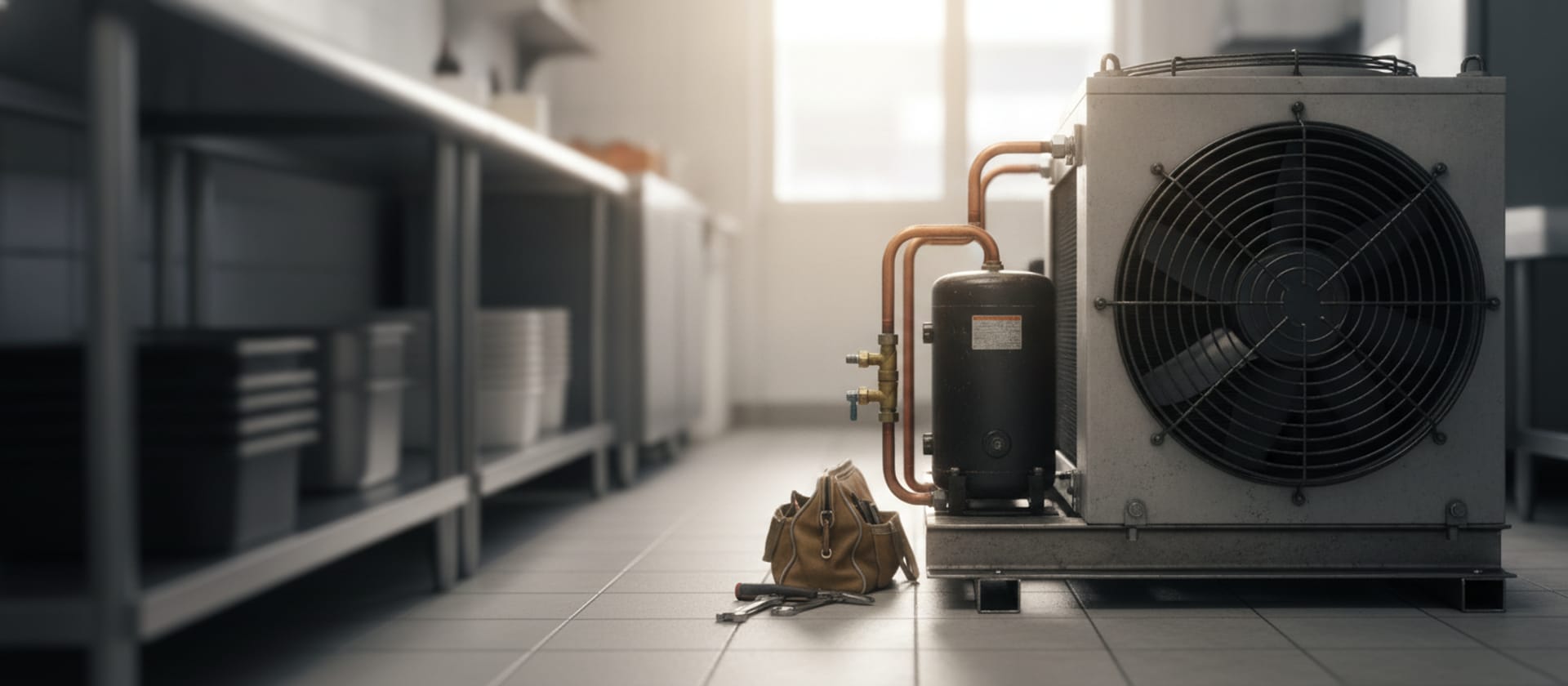
Heatcraft Condensing Unit Repair
Heatcraft, Bohn & Larkin Condensing Unit Repair
Same-day Heatcraft, Bohn, and Larkin condensing unit and evaporator repair for Southern California walk-ins and refrigeration. EPA 608 certified techs.
AI Diagnostic · free · about a minute
Not sure what's wrong?
Describe it in your own words — get the likely causes and a repair cost range before you book.
Our Branches
10 service territories across Southern California
Where we work
Local branches across Southern California
Ten branches covering Los Angeles, Orange, Ventura, Santa Barbara, San Bernardino, and Riverside counties. Same-day visits when a technician is available.
Los Angeles
Brentwood, Bel Air, Pacific Palisades, Santa Monica, Westwood, Century City, Culver City, Westside, Long Beach
What we fix on Heatcraft, Bohn, and Larkin equipment
When a Heatcraft-family walk-in goes down in an LA kitchen, three failures account for most of the calls our techs at Same Day Appliance Repair run: a defrost fault on the Bohn evaporator (burned heater element, failed termination thermostat, or a timer that lost its program) that ices the coil and lets a freezer drift warm; a condenser fan motor or high-head safety trip on the Larkin condensing unit, usually a condenser coil clogged thick with grease and dust on a Koreatown or Valley strip-mall rooftop; and a refrigerant leak at a flare fitting that Santa Ana wind and thermal cycling worked loose. We diagnose the refrigeration loop end to end, restaurant walk-ins, grocery cold storage, hotel and commissary boxes, and quote in writing: a Bohn evaporator fan motor runs $280–$520, a Larkin condensing-unit fan motor $380–$650, a contactor or capacitor $220–$420, and a Copeland or Tecumseh compressor swap $1,800–$3,800 depending on HP. Commercial diagnostic is $120, waived with the repair, EPA 608 Universal certified (#1346255700410), CARB Title 17 compliant.
The first thing our techs tell a new customer on a Heatcraft call: your walk-in is at least two brands, and usually three. The panels around the box are one brand, Kolpak, Master-Bilt, Nor-Lake, U.S. Cooler, or a custom build. The condensing unit on the roof is usually a different brand, and in a meaningful share of LA restaurants that condensing unit is Larkin or Climate Control, both Heatcraft-owned. The evaporator hanging inside the walk-in ceiling is a third brand, and in that same meaningful share, it's Bohn, also Heatcraft-owned. When the manager says "the Heatcraft isn't working," the real failure is somewhere on that condensing unit or that evaporator, and the Heatcraft page on this site is the one that covers it.
Our trucks carry the parts that fail most on Heatcraft-family gear: evaporator fan motors in the common Bohn sizes, condenser fan motors for the Larkin HP ranges we see weekly in LA, expansion valves sized for R-22, R-404A, R-448A, and R-449A service, defrost heater elements, defrost termination thermostats, mechanical and electronic defrost timers, contactors, and filter-driers. Our manifold sets carry R-22, R-404A, R-448A, R-449A, and R-290 hoses. Our techs are EPA 608 certified (the certification numbers are on file and available to any AHJ that asks) and trained on CARB Title 17 refrigerant management program requirements for LA County.
Condensing unit vs evaporator, what goes wrong and how we diagnose
The refrigeration loop on a walk-in is a closed circuit with four distinct stations. Knowing which station has failed is 80% of the repair, the wrong diagnosis leads to the wrong part on the truck and a second trip. Our techs diagnose in this order:
Across the Heatcraft-family calls our techs run in LA, the failures cluster in a consistent order. Defrost problems on the Bohn evaporator are the number-one cause of a warm box, a burned heater element, a failed termination thermostat, or a defrost timer that lost its program. Evaporator fan-motor failures come second. On the Larkin condensing unit, condenser fan-motor bearing failure after an LA heat wave leads, followed by a high-head safety trip from a grease-clogged condenser coil, then a burned compressor contactor and run-capacitor drift. The compressor itself is the last place we look, a Copeland or Tecumseh compressor usually protects itself before it fails, so a dead compressor almost always means something else, a charge problem, a stuck contactor, a blocked coil, killed it first. Reading suction and discharge pressures against the superheat target tells our techs which station actually failed before any part comes off the truck.
Station 1, the evaporator (Bohn) inside the walk-in
Hanging from the ceiling (most common) or on a wall. Finned coil with two or three fans moving box air through it. Low-pressure liquid refrigerant enters through an expansion valve, absorbs heat from the box air, and leaves as low-pressure gas. Common failures in order: defrost system (heater, termination thermostat, timer) , causes ice slab on coil, freezer drifts warm, compressor works harder; evaporator fan motor, frost stalls the blade or bearings fail; expansion valve, hunting, undersized, or blocked filter-drier upstream; refrigerant leak at the coil brazed joints (rare on newer Bohn coils, common on 20-plus-year units).
Station 2, the suction line from evaporator to condensing unit
Copper line running from the evaporator outlet across the walk-in ceiling, through the roof or wall, and into the condensing unit. Should be cold to the touch and insulated. Failures: leaks at flare fittings where the line crosses the roof (thermal cycling and Santa Ana wind stress loosen them); crushed insulation from rodent activity or rooftop foot traffic; undersized line if the system was modified.
Station 3, the condensing unit (Larkin or Climate Control) on the roof
Assembly containing the compressor (Copeland or Tecumseh), condenser coil (finned heat exchanger facing out to ambient air), condenser fan, receiver tank, filter-drier, high- and low-pressure switches, and often a time- delay relay. Common failures in order: condenser fan motor bearing failure after an LA heat wave; high-head safety trip from a clogged condenser coil (grease + dust, especially in Koreatown and Valley strip malls); compressor contactor burning out; compressor itself (last place we look, compressors usually protect themselves before they fail, so if the compressor is dead, usually something else killed it first); refrigerant leak at Schrader valves or service valves.
Station 4, the liquid line from condensing unit back to evaporator
Copper line carrying high-pressure liquid refrigerant back to the expansion valve at the evaporator. Should be room-temperature to slightly warm, not hot. Failures: leaks at joints (same thermal-cycling issue as suction line); filter-drier plugged with contamination; expansion valve screen clogged. Reading the pressures at suction and discharge against the superheat target for the refrigerant in use tells us which station is the actual problem, that's the first thing our techs do before touching a part.
Refrigerant transitions, R-22 phase-out, R-448A / R-449A / R-290 retrofits
The EPA completed the R-22 production and import phase-out on January 1, 2020. R-22 is still legal to use in existing equipment and to service with reclaimed refrigerant, but reclaim pricing pushed past $300 per pound during the phase-out and has stayed high. For an LA restaurant with a Heatcraft condensing unit from the 2005-to-2015 era, the math on a retrofit has flipped, it's now usually cheaper to retrofit than to keep topping off R-22 after a leak.
The two common retrofit targets on Heatcraft walk-in and refrigeration gear are R-448A (Solstice N40) and R-449A (Opteon XP40). Both are HFO / HFC blends designed as drop-in-ish replacements for R-22 in medium- and low-temperature commercial refrigeration, the compressor usually stays, the expansion valve is swapped to a size matched to the new blend's pressure-temperature relationship, the oil usually stays (POE was already the standard on most 2005-plus condensing units), and the system is evacuated, charged by weight, and labeled. R-290 (propane) shows up on small self-contained equipment where the factory built the unit around it, not typical on Heatcraft walk-in gear but common on some specialty refrigeration lines.
Our process on every retrofit: confirm the condensing unit and compressor are suitable for the target refrigerant (almost all 2005-plus Heatcraft units are); recover the R-22 into an EPA-compliant recovery cylinder; swap the TXV at the evaporator; replace the filter-drier; evacuate to deep vacuum, hold the vacuum to confirm the system is leak-free; charge with the new refrigerant by weight; verify superheat and subcooling against the target; update the nameplate label; file the refrigerant record with LA County; leave the customer a copy of the work order, refrigerant quantities, and certification numbers. Retrofit time on a typical walk-in system is a single visit, roughly 3 to 5 hours depending on system size.
Heatcraft sub-brands we service, Bohn, Larkin, Climate Control, Russell, Kysor / Warren
The Heatcraft brand family covers the full refrigerated-box component stack. Customers usually know the sub-brand on their equipment better than they know "Heatcraft" as the parent. We service the full roster:
Bohn, evaporators
The evaporator inside most LA walk-ins is Bohn-branded. Low-profile, center-mount, and end-mount coils across the full tonnage range. Defrost heater, termination thermostat, fan motor, and expansion valve work dominates Bohn service calls. Coil cleaning and refrigerant-charge verification round out the top of the list.
Larkin, condensing units
The rooftop condensing unit on many LA walk-ins is Larkin-branded. Factory-assembled with Copeland or Tecumseh compressors, condenser coil, condenser fan, receiver, filter-drier, and safety switches. Fan motor and contactor work are the most frequent calls; compressor swaps on units 12-plus years old.
Climate Control, commercial refrigeration
Heatcraft's commercial refrigeration and beverage systems line. Less common than Bohn or Larkin in LA restaurant walk-ins but shows up in larger commissary and cold-storage operations. Same repair fundamentals as Larkin; Climate Control units often run larger tonnage.
Russell, refrigeration / air handlers
Heatcraft's refrigeration and air-handler line, used in commercial and industrial cold storage. Not a residential brand despite the name overlap with some residential HVAC equipment. Standard refrigeration service , fan motors, expansion valves, defrost controls, applies.
Kysor / Warren, specialty refrigeration
Heatcraft's supermarket and display-case refrigeration line. Shows up at LA grocery chains and independent markets, less so at restaurants. Similar service approach, refrigeration components, defrost, case lighting and anti-sweat heater circuits are the common calls.
Compressor integration, Copeland and Tecumseh
The compressor inside a Larkin or Climate Control condensing unit is almost always Copeland, sometimes Tecumseh on smaller tonnage. Copeland ownership note below, the parts network and service fundamentals didn't change in the 2023 Emerson-to-Blackstone transaction, but some older documentation still references Emerson.
Copeland compressor integration, the most common Heatcraft pairing
Copeland compressors show up inside the vast majority of medium- and high-tonnage Larkin and Climate Control condensing units. That pairing is the factory default and the common LA field configuration. Copeland makes scroll, semi-hermetic reciprocating, and in smaller tonnage, hermetic recip compressors, all of which appear in Heatcraft-family condensing units depending on the application and vintage.
Ownership clarification our techs catch customers on regularly: Copeland was an Emerson-owned brand for decades, and a lot of service manuals, third-party pages, and parts catalogs still say "Emerson Copeland." Emerson sold Copeland to Blackstone in 2023. The brand name didn't change, the factory didn't move, the parts network is the same, but ownership is now Blackstone, not Emerson. For a repair this makes zero practical difference, we order the same Copeland part through the same distributor channel, but on a service report you might see "Copeland" with no parent-company reference and that's the current correct form.
Common Copeland failures on Heatcraft condensing units: contactor burnout (easy repair, frequent); run capacitor drift on single-phase units (quick diagnostic, easy swap); high-head trip from a clogged condenser coil (clean the coil, reset, verify charge); compressor motor failure on semi-hermetic units over 15 years old (compressor swap); liquid slugging damage after a system modification or bad charge (compressor swap). On Tecumseh-equipped smaller units, the failure patterns are similar, contactor, fan motor, capacitor, then the compressor itself.
LA County refrigerant permits and EPA 608 compliance
Two compliance layers apply to refrigeration work in LA County. At the federal level, EPA Section 608 governs who can service equipment containing refrigerant, how recovered refrigerant must be handled, and the recordkeeping requirements on any system containing more than 50 pounds of refrigerant. Our techs carry current EPA 608 Universal certification (#1346255700410); the numbers are on file and available to any AHJ inspector who asks.
At the state and county level, California Air Resources Board (CARB) Title 17 Refrigerant Management Program (RMP) sets the leak-inspection, service-practice, and reporting requirements specific to California. Systems over 50 pounds of refrigerant charge require annual leak inspections and service-log reporting; systems over 200 pounds require calibrated leak inspections on a shorter cycle. On any Heatcraft retrofit or major refrigerant addition we file the required records with LA County and leave the owner a copy for the facility file. On minor refrigerant top-offs below reporting thresholds we document in our service report and skip the county filing to keep paperwork proportional to the work.
For owners running mixed refrigerant systems across a property, say a supermarket with R-22 (legacy), R-448A (retrofitted walk-ins), and R-290 (small self-contained), we document which system holds which refrigerant, which ones have crossed CARB reporting thresholds, and which ones are near threshold. Keeps the compliance picture legible for the owner and the inspector both.
What Heatcraft repair typically costs
Parts and labor vary heavily with refrigeration tonnage (the HP rating of the condensing unit) and the refrigerant in use. Common repair bands:
| Service | Typical Range | Notes |
|---|---|---|
| Commercial diagnostic | $120 | Flat, waived if repair is authorized same visit |
| Bohn evaporator fan motor | $280 – $520 | Common sizes on truck |
| Bohn defrost heater element | $320 – $560 | Freezer-side evaporators |
| Defrost termination thermostat / timer | $240 – $420 | Mechanical or electronic |
| Larkin condensing-unit fan motor | $380 – $650 | Common HP sizes on truck |
| Condensing-unit contactor / capacitor | $220 – $420 | Quick diagnostic, easy swap |
| Expansion valve replacement / resizing | $420 – $720 | Includes evacuation and recharge |
| Filter-drier replacement | $240 – $380 | Typically paired with TXV work |
| R-22 → R-448A / R-449A retrofit | $950 – $1,850 | TXV swap + recovery + recharge + label + filing |
| Copeland / Tecumseh compressor swap | $1,800 – $3,800 | HP- and refrigerant-dependent |
| Larkin 1/2 HP condensing-unit replacement | $1,800 – $2,800 | Prep cooler or small walk-in |
| Larkin 2 HP condensing-unit replacement | $3,200 – $4,800 | Medium walk-in |
| Larkin 5 HP rooftop condensing-unit replacement | $4,800 – $6,800 | Larger walk-in or combo |
| Larkin 10+ HP condensing-unit replacement | $7,500+ | Commissary or large operation |
| CARB Title 17 annual leak inspection | $220 – $380 | Per system, over 50 lb charge |
Full cost ranges by repair type are in our walk-in cooler repair pricing and walk-in freezer repair pricing guide. Condensing-unit replacement quotes come as a written scope including tonnage match, refrigerant spec, electrical verification, and LA County filing.
Service areas, where our Heatcraft calls come from
Central LA
Downtown · Arts District · Koreatown · Mid-City · Beverly Blvd · Silver Lake · Hollywood · West Hollywood
Westside
Beverly Hills · Century City · Brentwood · Santa Monica · Culver City · Venice · Marina del Rey
Southeast LA
Boyle Heights · East LA · Huntington Park · South Gate · Bell · Cudahy · Lynwood · Maywood
San Fernando Valley
Sherman Oaks · Studio City · Van Nuys · Encino · Tarzana · Woodland Hills · Burbank · Glendale
San Gabriel Valley
Pasadena · South Pasadena · San Marino · Alhambra · Monterey Park · Arcadia
South Bay / Long Beach
Long Beach · Torrance · Redondo · Manhattan Beach · El Segundo · Carson · San Pedro
Orange County
Irvine · Newport Beach · Costa Mesa · Anaheim · Huntington Beach · Tustin · Santa Ana
Ventura County
Thousand Oaks · Westlake Village · Ventura · Oxnard · Camarillo · Simi Valley
County coverage: Los Angeles County, plus Orange, Ventura, Santa Barbara, San Bernardino, Riverside, and San Diego counties on same-day dispatch.
Related walk-in and refrigeration pages
Heatcraft repair, frequently asked
What's the difference between a condensing unit and an evaporator on a walk-in?
Two components on opposite ends of the refrigerant loop. The condensing unit sits outside the walk-in, usually on the roof, rarely in a back alley, and it's the assembly that contains the compressor, condenser coil, condenser fan, receiver, and filter-drier. It takes low-pressure gas from the walk-in and turns it back into high-pressure liquid. The evaporator is inside the walk-in ceiling (sometimes on a wall), and it's the finned coil plus fans that absorbs heat from the box air and boils the refrigerant back into gas. In a typical LA restaurant walk-in, Heatcraft builds the condensing unit (often Larkin-branded) and the evaporator (often Bohn-branded); a Copeland or Tecumseh compressor lives inside the condensing unit; the panels around the whole thing are Kolpak or Master-Bilt or U.S. Cooler.
My Bohn evaporator is icing up, is that a fan, a defrost, or a refrigerant problem?
The diagnostic order we run on any Bohn icing call: check the defrost sequence first, fan operation second, refrigerant charge third. Defrost failures, a burned heater element, a failed termination thermostat, a mechanical timer that lost its program, are the number-one cause of ice slabs on a Bohn coil in an LA walk-in freezer. Fan problems (evaporator fan motor failure, frost buildup stalling the blade) are second. Refrigerant charge issues are third and usually show up as frost on the suction line at the compressor, not on the coil face itself. Our tech will run all three checks before touching a refrigerant gauge.
Do you retrofit older Heatcraft units from R-22 to R-448A / R-449A?
Yes, this is a weekly routine. EPA 608 certified across the team. Heatcraft condensing units manufactured before about 2015 frequently ship with R-22, and the 2020 R-22 production phase-out pushed reclaim refrigerant pricing past $300 per pound. At that price, retrofit math pencils out for most LA restaurants. Process: recover the R-22 to an EPA-compliant cylinder, swap the expansion valve at the evaporator to a size matched to the new blend, evacuate to deep vacuum, charge with R-448A or R-449A by weight, update the nameplate label with new refrigerant type and charge, and file the refrigerant record with LA County. The Copeland or Tecumseh compressor typically stays. For smaller self-contained equipment we also retrofit to R-290 (propane) where the unit was designed for it, though that's less common on Heatcraft walk-in gear.
Can you integrate a Copeland compressor with a Heatcraft condensing unit?
Copeland compressors are already inside most Heatcraft condensing units, it's the default pairing from the factory for the medium- and high-tonnage Larkin lineup, along with Tecumseh on some ranges. When a compressor swap is needed and we're specifying the replacement, we size the Copeland to match the original tonnage and refrigerant, verify the electrical service matches (voltage, phase, amp draw), and confirm oil compatibility with the refrigerant in use. Worth noting: Copeland was an Emerson brand for decades, and Emerson sold Copeland to Blackstone in 2023, the compressor is still labeled Copeland, the parts network is still intact, but ownership is now Blackstone, not Emerson. Most online content still says 'Emerson Copeland,' and that's out of date.
Is Heatcraft the same company as Lennox?
Heatcraft Refrigeration Products is the commercial refrigeration division of Lennox International. Same parent company, different side of the business. Lennox on the residential HVAC side (the brand you see at a home HVAC supply store) is separate from Heatcraft on the commercial refrigeration side (the equipment inside your walk-in). Heatcraft's manufacturing and brand roster, Bohn, Larkin, Climate Control, Russell, Kysor / Warren, Chandler, all sit under the Heatcraft umbrella within Lennox International.
Do you pull LA County refrigerant permits and file records?
Yes. On any retrofit or refrigerant-addition work that crosses LA County reporting thresholds, we file the required records with the county and leave you a copy for your file. On Title 17 CARB refrigerant management program work, annual leak inspections on systems over 50 pounds, calibrated leak inspections on systems over 200 pounds, we document and file. On minor refrigerant top-offs below thresholds, we document in our service report and skip the county filing. Our techs are EPA 608 certified and the certification numbers are on file if your AHJ ever asks.
What does a Heatcraft condensing-unit replacement cost in LA?
Commercial diagnostic is $120, waived with authorized repair. Condensing-unit replacement pricing varies heavily with tonnage and refrigerant: a small 1/2 HP Larkin unit for a prep cooler runs $1,800–$2,800 installed; a medium 2 HP walk-in condensing unit $3,200–$4,800; a larger 5 HP rooftop unit $4,800–$6,800; and 10 HP and above generally clears $7,500 before options. Common repair work (before full replacement) lands lower: fan motor $380–$650, contactor $220–$420, expansion valve $420–$720, compressor swap $1,800–$3,800 depending on HP. Full cost ranges are in our walk-in refrigeration pricing guide linked below.
Why does my Larkin condensing unit keep shutting off on a hot LA afternoon?
That's almost always a high-head safety trip, and the usual cause is a condenser coil clogged with grease and dust, which we see constantly on Koreatown and Valley strip-mall rooftops. When the coil can't reject heat, head pressure climbs until the high-pressure switch cuts the compressor to protect it. The other hot-weather culprit is a condenser fan motor with failing bearings that slows or stops after an LA heat wave. Our techs clean the coil, confirm the fan motor pulls correct amps, reset the safety, and verify the refrigerant charge and superheat before leaving. Copeland and Tecumseh compressors usually protect themselves this way, so catching it at the coil or fan stage avoids a far costlier compressor swap. Same Day Appliance Repair, $120 commercial diagnostic, waived with repair.
How much does it cost to replace a Bohn evaporator fan motor or defrost heater?
On Heatcraft-family evaporators the common Bohn parts run: evaporator fan motor $280–$520, defrost heater element $320–$560 on freezer-side coils, and a defrost termination thermostat or timer $240–$420 whether it's mechanical or electronic. Our trucks carry the common Bohn fan-motor and heater sizes, so most of these are a single-visit repair. If the coil iced because of a defrost fault, our techs fix the root cause, not just thaw it, otherwise the ice comes back within the week. Same Day Appliance Repair, $120 commercial diagnostic, waived with repair.
Heatcraft, Bohn, or Larkin down? Call the branch closest to you.
Same-day across Los Angeles, Orange, Ventura, Santa Barbara, San Bernardino, Riverside, and San Diego counties. Commercial diagnostic $120, waived with repair.