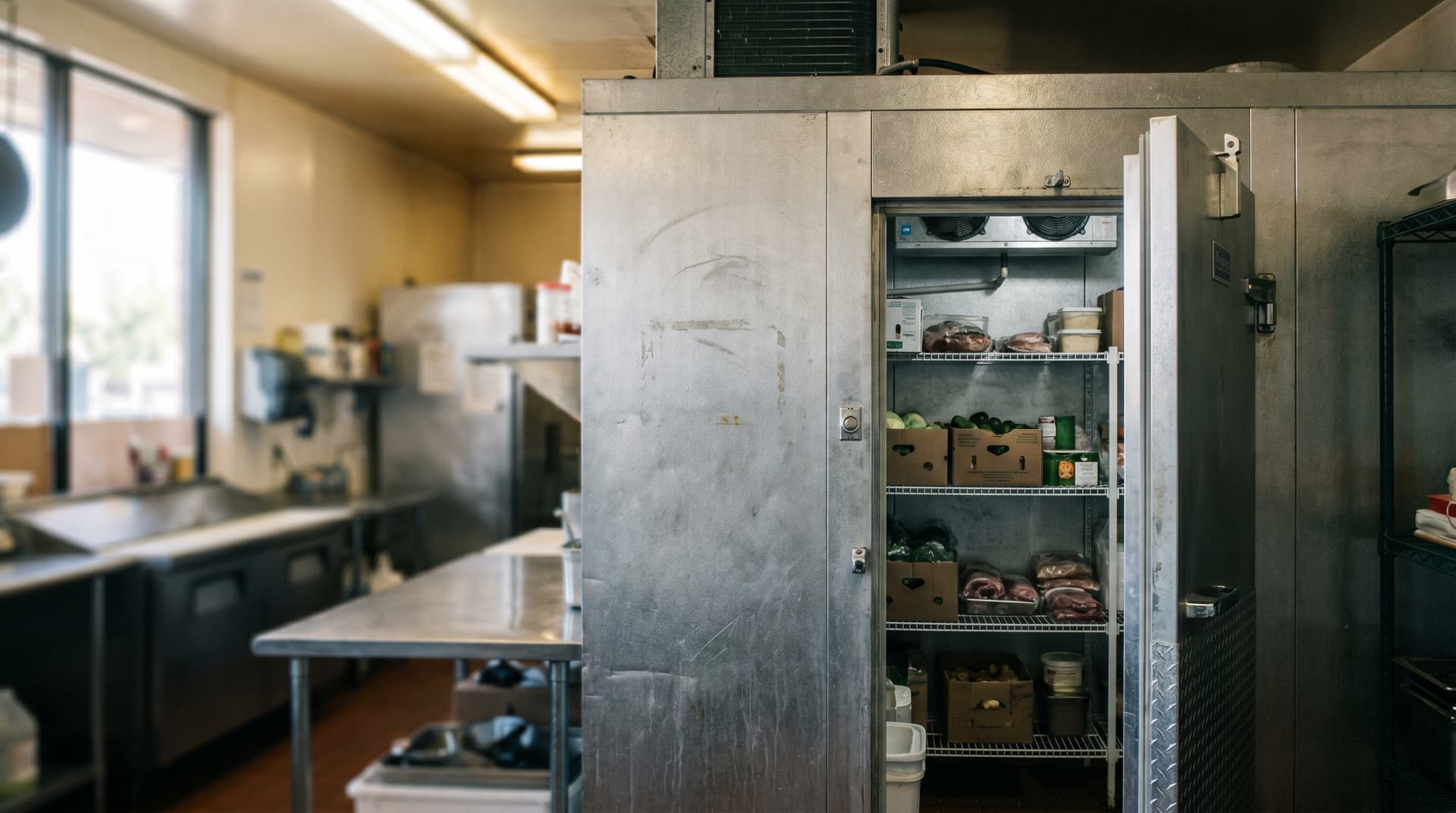
Commercial Kitchen · Walk-In Cooler Refrigeration · Restaurant + Grocery + Ghost Kitchen · Same Day
Commercial Walk-In Cooler Repair
Temperature rising, ice building up, motor won't stop running — every hour counts when your inventory is at stake. Same-day repair for restaurants, grocery stores, hotels, breweries, ghost kitchens, agricultural cold storage, and healthcare facilities across Southern California. EPA 608 certified technicians, parts for True and Turbo Air on the van.
AI Diagnostic · free · about a minute
Not sure what's wrong?
Describe it in your own words — get the likely causes and a repair cost range before you book.
Our Branches
10 service territories across Southern California
01 — About This Service
A walk-in cooler failure is an emergency with a precise financial countdown.
When a commercial walk-in cooler climbs above the 41°F FDA threshold, our techs at Same Day Appliance Repair trace it to one of three patterns first, with $5,000 to $15,000 of inventory on a 4-hour clock across LA restaurants, groceries, and ghost kitchens. (1) Not holding temperature, usually a refrigerant leak (the system runs but can't reach setpoint, EPA 608 requires we find and repair the leak before recharge), heavily frosted evaporator coils, or a dirty condenser causing the compressor to overheat and trip. (2) Excessive ice and frost from a defrost-system failure, the defrost heater, timer, or termination thermostat fails and frost builds until airflow stops. (3) A door that won't seal, a compressed gasket or failed door heater that lets warm humid air in, runs the system constantly, and can freeze the door shut. $199 commercial diagnostic, waived with repair. We treat walk-in calls as our highest-priority commercial dispatch, hold EPA 608 Universal certification for the sealed-system work, carry True and Turbo Air parts on the van, and document temperature recovery for your LA County DPH file.
A well-stocked walk-in cooler holds $3,000 to $15,000 in perishable inventory depending on the size and type of business. Once the interior temperature climbs above 41°F — the FDA food safety threshold — you're on a clock. Most proteins become unsafe within 4 hours above that threshold. For a Hollywood restaurant in the middle of a prep day, a Beverly Hills hotel banquet kitchen with a wedding that night, a DTLA market with deli case + cooler combo, a Long Beach seafood market display, a Westside catering operation, a Pasadena grocery walk-in, a Santa Monica beach restaurant facing high-humidity condensation challenges, a ghost kitchen facility running three delivery brands, or an Oxnard agricultural packer mid-season, the math is immediate and brutal. Operators searching "walk in cooler repair near me" or "commercial walk in cooler repair near me" in LA expect a same-day tech, not next-business-day routing.
We treat walk-in cooler calls as the highest priority commercial service we dispatch across all seven Southern California counties — Los Angeles, Orange, Ventura, Santa Barbara, San Bernardino, Riverside, and San Diego. Call early and we're typically there same day when a technician is available. If you're calling because the temperature is already rising, describe the situation clearly when you call — we'll give you first-response guidance over the phone while a technician is being routed to you. The "walk in cooler service near me" + "walk in cooler repair near me" search intent in LA is real — kitchens with $5K-$15K inventory at risk can't wait for service companies that don't dispatch from local territories.
Our technicians are EPA 608 certified for refrigerant handling, the federal certification required to open a sealed refrigeration system. We carry parts for True, Turbo Air, and Beverage-Air specifically because these are the three brands running most Southern California restaurant coolers. For Hoshizaki, Traulsen, Master-Bilt, and Norlake, parts are sourced same-day through our commercial parts distributors.
Walk-in cooler (this page) keeps product at 35–41°F for restaurants, grocery, agricultural, and pharma cold chain. Walk-in freezer (sibling page) holds –10°F to 10°F for protein, ice cream, and frozen distribution. Same refrigeration architecture, different temperature setpoints and defrost behavior. → Walk-In Freezer Repair.
Repair is our core scope, with bi-annual preventive maintenance contracts available for multi-unit operators. When a walk-in is too far gone to repair economically — typically 20+ years on a poorly maintained system, or a fire/water-damaged box — we install the replacement walk-in. We give you an honest repair-vs-replace recommendation in writing on the diagnostic visit.
41°F is the line. If you're above it: (1) stop opening the door — every open door adds 20–30 minutes of recovery time; (2) move your highest-value proteins to a backup cooler or reach-in if available; (3) document the temperature with a photo — you may need this for your health department records (LA County DPH, OC Health Care Agency, Ventura County Environmental Health, San Bernardino DEHS, or Riverside County DEH); (4) call us: (424) 325-0520. We prioritize calls where inventory is at immediate risk.
02 — Common Failures
What our technicians diagnose most often in LA walk-in coolers
Across the walk-in cooler calls our techs run in LA, the work clusters predictably. About 30 percent not-holding-temperature (refrigerant leak, frosted evaporator, or failing compressor). 20 percent defrost-system ice and frost buildup. 15 percent door gasket and door-heater seal failure. 10 percent condenser fouling and compressor running constantly. 10 percent blocked condensate drain and water on the floor. 10 percent evaporator or condenser fan motor. 5 percent thermostat drift. The detail below walks each.
Not Holding Temperature
The most common call. Three primary causes: refrigerant leak (the system runs but can't reach set temperature), heavily frosted evaporator coils blocking airflow, or a failing compressor that can no longer maintain pressure. LA's warm ambient temperatures accelerate all three — a marginal system that holds 38°F in January may not hold 41°F on a July afternoon.
Excessive Ice / Frost Buildup
Ice coating the evaporator coils or frost on the interior walls means the defrost system isn't running. The defrost heater melts frost off the evaporator coils on a schedule — when the heater, defrost timer, or defrost thermostat fails, frost accumulates until airflow is blocked entirely. A door seal failure admitting humid air continuously is the secondary cause.
Compressor Running Constantly
A compressor that never cycles off is working against a thermal load it can't overcome — refrigerant leak, frosted evaporator, dirty condenser, or a door that won't seal. Beyond temperature risk, a compressor that never cycles off is consuming significantly more electricity and wearing itself out. On LA's hot summer days, this is an accelerated failure pattern.
Water on the Floor Inside
Water pooling inside the cooler box usually means the condensate drain line is blocked — ice or debris preventing water from exiting during defrost cycles. If left unaddressed, trapped water refreezes and can cause structural damage to the floor insulation. In LA's dusty environment, drain lines block more frequently than in cleaner-air markets.
Door Won't Seal / Frozen Shut
A compromised door gasket allows warm, humid outside air to enter continuously — forcing the refrigeration system to work harder and causing frost to build up around the door frame. When the door heater (the wire that prevents frost from sealing the door closed) fails, the door can freeze shut entirely. We carry gaskets for the major cooler panel brands.
Unusual Noises
A rattling or squealing evaporator fan motor is often the first audible warning sign before airflow failure. A hissing sound from the refrigeration lines can indicate a refrigerant leak. A loud clicking near the compressor suggests the compressor is trying and failing to start — often a failed start relay, which is a quick fix if caught before the compressor overheats.
03 — System Components
Every component we diagnose and repair
A walk-in cooler has more interdependent components than a residential refrigerator. We test each systematically before recommending parts.
The heart of the refrigeration system — compresses refrigerant gas to begin the cooling cycle. Expensive to replace but often long-lived when the rest of the system is maintained.
Inside the cooler box — absorbs heat from the air and circulates cold air through the space. The first component to ice over when the defrost system fails.
Outside the cooler box — rejects heat from the refrigerant cycle to the ambient environment. In LA's warm, dusty conditions, condenser coils clog with debris faster than in most markets.
Three components working together: defrost heater (melts frost off evaporator), defrost timer or controller (initiates cycle), defrost thermostat (limits heater temperature).
The gasket seals the cooler when closed. The door heater (a low-wattage wire in the door frame) prevents frost from bonding the door seal. Both degrade over time in high-traffic coolers.
Monitors the box temperature and signals the refrigeration system to cycle on and off. A drifted thermostat causes the unit to cycle at the wrong temperature — product at risk without obvious signs.
Carries condensate water from the evaporator out of the cooler box during defrost cycles. In LA's dusty environments, drain lines accumulate debris and block regularly.
R-404A and R-448A are the most common refrigerants in LA commercial walk-in coolers. Refrigerant work requires EPA 608 certification — we carry both certifications and handle all refrigerant types in use.
03.5 — Floor & Subfloor
Walk-in cooler floor repair — the panel most operators forget is refrigerated too
A walk-in cooler floor is an insulated panel like the walls and ceiling — a foamed core between metal skins — and it takes the hardest daily abuse in the box: pallet jacks, loaded carts, dropped product, standing water, and wash-down chemicals. When it fails, it tends to show up in a few ways. A rusted-through or corroded floor skin, from years of spills and cleaning water pooling at low spots, breaks the food-safe surface and lets moisture into the insulation. Soft or spongy spots underfoot mean the foam core has been crushed by traffic or water-saturated — and a wet core loses its R-value, sweats, ices, and drives the compressor harder. Delaminated seams and lifted floor-to-wall coving open gaps where water and bacteria collect. On floorless walk-ins that sit directly on the building slab, the culprit is usually moisture wicking up through the concrete, a failed vapor barrier, or a rotted sub-frame at the door threshold.
Our approach depends on how far it's gone. Localized rust or a punctured skin in one lane gets a sectional patch or floor-skin repair plus reinforcement — diamond-plate or aluminum tread laid in the high-traffic path so the fix doesn't just fail again in the same spot. Delaminated coving and open seams get re-sealed with NSF-compliant food-safe sealant so the box passes inspection. When the insulation core is water-saturated across a large area, we give you an honest read on whether a panel-section replacement or a full floor replacement is the better economic call — and we fix the source, whether that's a door threshold letting water in, a blocked floor drain, or a slab moisture problem, so it doesn't come straight back. $199 commercial diagnostic, waived with repair.
04 — What's At Stake
The real cost of a walk-in cooler failure in Los Angeles
A walk-in cooler failure isn't just a repair bill — it's everything that walks out the door with it
The repair cost of a walk-in cooler failure is rarely the most expensive part. A typical LA restaurant walk-in holds $5,000–$15,000 in perishable inventory. A grocery store or food distributor may hold multiples of that. Once the interior temperature exceeds 41°F and stays there, the LA Department of Public Health (LADPH) requires that temperature-abused food be discarded — there's no option to "save it later." And if the failure is discovered during a health inspection rather than by your staff, you're looking at potential temporary closure alongside the inventory loss.
The businesses that recover fastest are the ones that caught the failure early — slightly warm, compressor running constantly, subtle frost buildup — rather than walking into a completely warm box. That's exactly what preventive maintenance catches. We've seen the difference between a $400 maintenance call and a $12,000 inventory loss at the same restaurant.
05 — Industries We Serve
Every Southern California business that depends on cold storage
🍜 Restaurants
Full-service, fast casual, Koreatown BBQ, Westside farm-to-table, OC coastal seafood, Inland Empire steakhouse — walk-in down during service is a crisis call.
👻 Ghost Kitchens
DTLA, Lincoln Heights, Anaheim, Riverside facilities — multiple brands, one cooler, no backup. Our highest-urgency dispatch category.
🛒 Grocery & Markets
Koreatown supermarkets, OC specialty markets, Inland Empire ethnic grocers — walk-in is the highest-value inventory location in the building.
🍺 Bars & Breweries
Keg coolers, tap-system cold rooms, craft brewery cold storage from DTLA Arts District to Temecula wine country — temperature precision matters for product quality.
🌸 Flower Shops
Cut flower coolers have a shorter spoilage window than food. We treat flower cooler calls with the same urgency as restaurant refrigeration.
🏨 Hotels & Catering
Banquet kitchen cold storage, event catering facilities, resort kitchens in Newport Beach, Pasadena, Thousand Oaks — high-volume, time-sensitive inventory.
🌾 Agricultural / Produce
Ventura citrus packers, Oxnard strawberry coolers, San Bernardino dairy operations, Riverside avocado packing — peak-season cold storage failures are existential.
🏥 Healthcare & Hospitals
Hospital food service walk-ins, dietary department cold storage, lab specimen rooms — health-code documentation requirements are stricter and the failure tolerance lower.
💊 Pharma Cold Chain
Pharmaceutical distribution cold rooms, vaccine storage, biotech sample coolers across LA biomed corridor and OC's research-park belt. Temperature excursion = batch loss.
🎓 Schools & Universities
K-12 cafeteria walk-ins, university dining halls, college Greek-row catering kitchens — high-volume turnover, summer-shutdown maintenance windows we book ahead.
🥪 Convenience Stores
7-Eleven, Circle K, AM/PM, independent gas-station markets — beer cave + grab-and-go food walk-ins running 24/7. Calls answered 24/7, same-day dispatch when refrigeration drops.
🚚 Food Distribution
Wholesale produce distributors, meat purveyors, seafood importers — DTLA produce district, OC food-service warehouses, Inland Empire distribution hubs.
All commercial repair documentation satisfies LA County DPH, OC Health Care Agency, Ventura County Environmental Health, San Bernardino DEHS, and Riverside County DEH inspector requirements. NSF 7 commercial refrigeration standards observed on all repairs.
05.5 — Coverage
Walk-in cooler repair near you — Los Angeles and all seven counties
When an operator searches "walk in cooler repair near me" or "walk-in cooler repair Los Angeles," the answer is really a dispatch question — and we answer it from ten branches, not one address, which is how same-day stays realistic across a region this size. West Hollywood, Beverly Hills, and our Los Angeles branch cover the urban core: the Hollywood and Sunset restaurant corridors, DTLA markets and ghost kitchens, Koreatown supermarkets, and the Westside from Santa Monica to Culver City. Pasadena runs the San Gabriel Valley and East LA grocery. Thousand Oaks covers Ventura County produce packers along the 101. Irvine handles Orange County hospitality and coastal seafood. Rancho Cucamonga and Temecula reach the Inland Empire distribution hubs and Riverside County. Whichever branch is closest takes the call, so a walk-in cooler holding $5,000 to $15,000 of inventory gets a technician routed fast — same-day across LA, Orange, Ventura and the Inland Empire. Phones answered 24/7, $199 commercial diagnostic, no emergency surcharge.
06 — Preventive Maintenance
Most walk-in cooler failures are preventable. Here's what we check.
Twice a year minimum in LA — once before summer heat peaks, once before the holiday high-load season. Every visit includes:
Condenser Coil Cleaning
In LA's dusty environment, condenser coils accumulate debris faster than standard. Dirty coils cause compressor overheating — the single most preventable failure mode.
Door Gasket Inspection
Check seal integrity around all door frames. A 1/8" gap in the gasket can increase energy consumption by 25% and introduce humidity that feeds frost buildup.
Refrigerant Level Check
Verify suction and discharge pressures against design spec. Early refrigerant loss is nearly invisible — a slow leak costs you efficiency for months before it causes a temperature failure.
Temperature Calibration
Verify thermostat accuracy against a calibrated reference thermometer. A drifted controller reading 38°F while the box is actually 44°F is a health code violation waiting to happen.
Drain Line Clearing
Flush and clear condensate drain lines. Blocked drains cause water accumulation and floor ice — structural damage to the insulated floor panels follows in months, not years.
Defrost System Test
Manually trigger the defrost cycle and verify all three components — heater, timer, thermostat — are functioning. Most evaporator frost failures show warning signs on a maintenance call before they become emergency calls.
07 — Brands We Service
Every walk-in cooler brand in Los Angeles commercial kitchens
All refrigerant work performed by EPA 608 certified technicians. OEM parts for True and Turbo Air carried on service vehicles.
08 — Recent Repairs
What our technicians actually fixed recently
"Walk-in was at 48°F when we came in for morning prep — overnight failure"
Compressor thermal overload trip caused by severely clogged condenser coils. The condenser — located in the kitchen exhaust area where cooking grease accumulates — had built up a heavy layer of grease and dust that was preventing heat rejection. The compressor overheated, tripped its safety, and sat off for approximately 6 hours overnight.
"Temperature slowly creeping up over two weeks — now at 45°F"
Refrigerant leak in the evaporator coil — a slow leak that had been losing charge over weeks, producing the classic gradual temperature drift presentation. The compressor was running nearly continuously by the time we arrived, unable to maintain temperature with reduced refrigerant charge. No acute failure, just a slow decline. Coastal salt-air corrosion at fitting joints is the dominant failure pattern we see along the Newport-Huntington-Laguna restaurant row.
"Ice completely blocking the back wall — door barely closes"
Complete defrost system failure — defrost heater had burned out, and over approximately three weeks frost had accumulated on the evaporator coils until it extended to the back wall. Three delivery brands sharing the cooler hadn't noticed the progressive temperature drift because they were checking individual shelves, not the back of the unit. By the time we arrived the ice mass was over 4 inches thick in places.
"Water flooding the floor inside — drain must be blocked"
Blocked condensate drain line — a combination of food debris, organic growth, and a small piece of packaging material had completely sealed the drain. Every defrost cycle was depositing water that had nowhere to go. The pooling water had been there long enough to start seeping under the floor panels — early stage structural risk. The store had been mopping it up daily for two weeks rather than calling, which is the most common pattern we see on slow-developing drain failures.
09 — Pricing
Transparent pricing. Written estimate before any work begins.
All commercial repairs include a 90-day warranty on parts and labor. Multi-unit operators can discuss priority service agreements and maintenance contracts — call to discuss your equipment list and locations.
10 — Frequently Asked Questions
Walk-in cooler repair — what LA operators ask us
How much does walk-in cooler repair cost in Los Angeles?
Commercial diagnostic is $199, applied to the repair if approved. Most walk-in cooler repairs run between $200 and $600. Defrost system, evaporator fan, door gasket, or drain clearing is toward the lower end. Compressor replacement or refrigerant work runs higher — we provide a full written estimate before any work begins, including an honest repair vs. replace assessment.
My walk-in cooler is not holding temperature — what should I do right now?
Check the door seal first — a compromised gasket is the most common cause. If the unit is above 41°F, move your most temperature-sensitive inventory immediately. Document the temperature with a photo. Then call us at (424) 325-0520 — refrigeration failures are our highest-priority commercial call.
Why does my walk-in cooler keep icing up inside?
Excessive ice inside the cooler almost always means the defrost system isn't running — defrost heater, timer, or thermostat failure. A door seal failure admitting humid air continuously is the secondary cause. We test all three defrost components before recommending replacement.
My walk-in cooler motor is running constantly — what does that mean?
The system is fighting a thermal load it can't overcome — refrigerant leak, frosted evaporator, dirty condenser coils, or a door that won't seal. In LA's summer heat, these failures accelerate. A compressor running without cycling is also wearing out faster and driving energy costs higher.
How often should a walk-in cooler be serviced in Los Angeles?
Twice a year minimum — before summer (peak load) and before the holiday season. High-use operations like ghost kitchens and Koreatown restaurants should consider quarterly service. Each visit includes condenser coil cleaning, gasket inspection, refrigerant check, drain clearing, and temperature calibration.
Should I repair or replace my walk-in cooler?
Walk-in coolers last 15–20 years with proper maintenance. Under 10 years old, repair almost always makes sense. Over 15 years with compressor failure, we'll give you an honest remaining-life assessment. The cost of new walk-in installation far exceeds most repair scenarios.
Do you repair all walk-in cooler brands?
Yes. True, Turbo Air, Beverage-Air, Hoshizaki, Traulsen, Master-Bilt, Norlake, Kolpak, and most others. EPA 608 certified for refrigerant handling on commercial systems.
What temperature should a walk-in cooler hold?
A commercial walk-in cooler should hold 35 to 41°F, with 41°F the FDA Food Code and California Retail Food Code maximum for cold-held food. Above 41°F most proteins become unsafe within about 4 hours, and LA County DPH requires temperature-abused food to be discarded. If your cooler is drifting up, document the temperature, move your highest-value product, and call us — we verify against a calibrated reference thermometer (a drifted controller reading 38°F while the box is at 45°F is a common and dangerous failure) and document recovery for your records.
How fast can you get my walk-in cooler back in service?
We treat walk-in cooler failures as our highest-priority commercial dispatch because of the inventory clock — call early and we're typically there same day when a technician is available, dispatching from the closest of our Southern California branches. Many failures are a same-visit fix: condenser cleaning, a defrost component, a door gasket, an evaporator fan motor, or a compressor capacitor, with True and Turbo Air parts on the van. A refrigerant leak repair or a major component can take longer, but we'll give first-response guidance over the phone while a tech is routed and help protect product in the meantime.
11 — Specialty Brands
Specialty walk-in brands we also service across LA
Beyond the main Ali Group and U.S. Cooler panel systems, a handful of niche walk-in manufacturers show up on specific LA dispatch routes. A DuckDuckGo crawl of "Thermalrite walk-in repair Los Angeles," "Amerikooler walk-in repair Los Angeles," and "Polar King walk-in repair Los Angeles" turns up zero LA appliance repair companies that name these brands in their descriptions — which matches what our techs see in the field. We service these brands without running dedicated brand pages for them: the volume doesn't warrant the inventory, but the equipment does land on our trucks when the use case fits.
Thermalrite — beer-cave and liquor-store walk-ins
Thermalrite is the Sacramento, California family-owned panel builder (since 1982) that specialized into glass-door merchandiser walk-ins — the "beer cave" format you see behind a liquor store or inside a convenience chain. Their LA footprint is thin outside that niche, but when we do get a Thermalrite call it's usually a craft brewery cold room along the Arts District / Eagle Rock / Silver Lake corridor (think operators in the Angel City Brewery, Arts District Brewing Co., and Eagle Rock Brewery tier), or a 7-Eleven / Circle K / independent liquor store walk-in that needs a failed LED strip driver, a cracked glass display panel, or a split-system evaporator replaced. Glass panel replacement on the display door, heated frame work to prevent condensation on the glass, and refrigeration-side evaporator service are the three common repair types. Our techs run these calls the same way they run any Bohn or Larkin evaporator — the Thermalrite part is the cabinet, not the refrigeration.
Amerikooler — Hispanic-market walk-ins with Spanish service docs
Amerikooler is the Miami-based Cuban-American family business that built its walk-in business on fiberglass-panel construction with bilingual (English/Spanish) service documentation — a real operational detail that matters to owner-operators who didn't learn refrigeration terminology in English. In LA we run Amerikooler calls along the Avenida César Chávez / Whittier Blvd paleteria corridor, at concherías and carnicerías across Boyle Heights and East LA, in the Huntington Park and South Gate restaurant strip, and north into the Pacoima and Sylmar Hispanic-market clusters. The failure pattern our techs see: panel edge seal separation where Florida-spec fiberglass meets LA sun-UV degradation (the foam shrinks at a different rate than the fiberglass skin under 100-degree rooftop conditions), and condenser issues on outdoor condensing-unit configurations the Miami factory specs for coastal humidity. We dispatch Spanish-speaking techs on these calls by default, no surcharge, and the parts side runs the same Copeland / Tecumseh / Bohn channels as every other walk-in we service.
Polar King — outdoor one-piece fiberglass walk-ins
Polar King, out of Fort Wayne Indiana (since 1981), builds seamless one-piece outdoor fiberglass walk-ins — the box arrives as a monolithic structure, no field assembly, and drops onto a prepared pad. We see them in LA at outdoor catering commissaries tucked into Culver City studio-row back-lots, at hillside restaurant satellite kitchens in Malibu, Pacific Palisades, and the Hollywood Hills where permit-constrained indoor expansion made an external walk-in the only option, and at event-rental storage facilities serving the venue circuit (weddings on Mulholland, corporate events at downtown hotels, film-set craft services). The unique thing about servicing a Polar King is that the fiberglass shell essentially doesn't fail — what fails is the internal refrigeration system (Heatcraft or Russell condensing unit, Bohn evaporator, Danfoss or Ranco controls), which is standard commercial refrigeration work our techs run daily. The shell-is-a-non-issue part actually simplifies diagnosis: if the box is drifting warm, it's refrigeration, not structural.
12 — Other Commercial Services
Complete commercial appliance repair across Southern California
Counties We Serve
7 counties · 10 service territories. Same-day commercial dispatch from the closest branch.
Walk-in cooler repair across Southern California — same-day priority dispatch
7 counties · EPA 608 certified · BHGS #A49573. True, Turbo Air, Hoshizaki, Traulsen, Master-Bilt, Kolpak. $199 diagnostic, 90-day warranty. Maintenance contracts available.