IHOP — Lake Elsinore
October 2026
Walk-in freezer
ProblemThe walk-in freezer was not working.
What we didOur technician found the start device on the condensing unit broken and replaced the start device assembly.
✓ Repaired
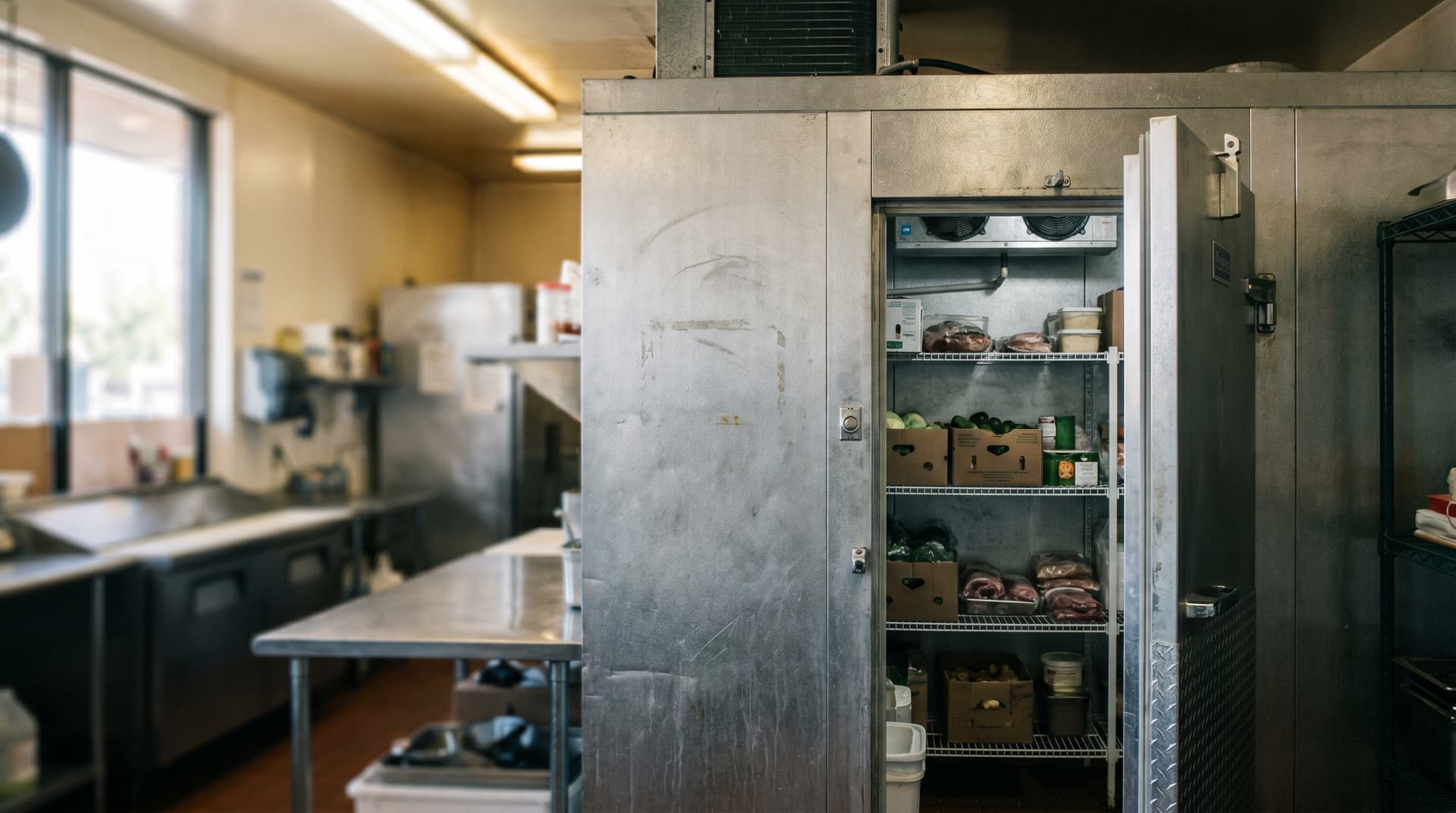
Commercial Kitchen · Walk-In Freezer Refrigeration · 0°F Floor Heater + Defrost Diagnostic · Same Day
Temperature climbing above 0°F means product is thawing right now. EPA 608 certified — we dispatch commercial freezer calls as the highest priority on our schedule across Los Angeles, Orange, Ventura, Santa Barbara, San Bernardino, Riverside & San Diego counties.
AI Diagnostic · free · about a minute
Not sure what's wrong?
Describe it in your own words — get the likely causes and a repair cost range before you book.
10 service territories across Southern California
01 — About This Service
When a commercial walk-in freezer climbs above 0°F, our techs at Same Day Appliance Repair trace it to one of three patterns first, on a faster clock than a cooler, frozen proteins and seafood thaw within 2 to 4 hours and ice cream within 1 to 2, across LA restaurants, seafood markets, and ghost kitchens. (1) Temperature rising, a refrigerant leak (EPA 608 requires we find and repair it before recharge), a fully frosted evaporator from a defrost-system failure (heater, timer, or termination thermostat), or a dirty condenser overheating the compressor, all accelerated by Southern California summer ambient against the 0°F differential. (2) Freezer-specific heater faults coolers never have, a failed floor drain heater that lets condensate freeze into a floor ice mass, or a failed anti-sweat door-frame heater that bonds the door shut. (3) A compressor running constantly or wet insulation panels dragging thermal performance. $199 commercial diagnostic, waived with repair. We dispatch freezer calls ahead of other commercial work, hold EPA 608 Universal certification for R-404A and R-448A, carry True and Hoshizaki parts on the van, and document temperature recovery for your health-department file.
When an LA operator searches walk in freezer repair near me at 5 AM with the temp alarm sounding, the math is already running against them. A walk-in cooler failure at 41°F gives you several hours before food safety becomes critical. A walk-in freezer failure at 0°F gives you significantly less — frozen proteins and seafood begin to thaw within 2–4 hours of the temperature rising above 0°F, and ice cream is effectively lost within 1–2 hours in an LA kitchen environment. The urgency is different, and we treat it that way.
Walk-in freezers also have components that walk-in coolers don't need: floor drain heaters that prevent condensate from freezing at floor level, anti-sweat heaters around door frames that prevent ice from sealing the door, and refrigeration systems working against a much larger temperature differential from ambient — a 0°F freezer in a 90°F equipment room is working against a 90-degree differential, while a cooler in the same space works against a 50-degree differential. That's why Southern California's summer heat (especially Inland Empire 110°F+ days) is harder on walk-in freezers than on coolers.
We're EPA 608 certified for refrigerant handling on R-404A and R-448A — the two refrigerants running most commercial walk-in freezers across Southern California. We carry parts for True, Hoshizaki, and Traulsen specifically, and source parts for Master-Bilt, Norlake, and Kolpak same-day through our commercial distributors.
0°F is the threshold. Above it, product is thawing. (1) Don't open the door — every opening costs recovery time; (2) move ice cream, seafood, and high-value proteins to backup cold storage first; (3) photograph the current temperature display for your health department records; (4) call (424) 325-0520 immediately. We dispatch freezer calls ahead of other commercial calls.
02 — Freezer vs. Cooler Repair
The components, failure modes, and urgency differ significantly. A technician who works primarily on coolers doesn't automatically know freezer-specific systems. For walk-in cooler-specific diagnostics and failure patterns, see our walk-in cooler repair page. The LA install base ranges across Beverly Hills steakhouse meat-storage walk-ins, DTLA seafood market long-term frozen seafood inventory, Long Beach catering kitchen ice cream and dessert overflow, Hollywood restaurant frozen prep storage, Westside hotel banquet kitchen event overflow, Pasadena grocery store ice cream display backup units, and Culver City film production catering operations running walk-in freezers for crew meals — every segment has its own urgency profile when commercial walk in freezer repair near me becomes the search.
03 — Common Failures
Across the walk-in freezer calls our techs run in Southern California, the work clusters predictably. About 25 percent temperature rising above 0°F (refrigerant leak, frosted evaporator, or failing compressor). 20 percent defrost-system failure freezing the evaporator over. 15 percent floor drain heater and floor ice. 15 percent anti-sweat door heater and door frozen shut. 10 percent door gasket. 10 percent condenser fouling and compressor running constantly. 5 percent insulation panel moisture. The detail below walks each.
Compressor failure, refrigerant leak, completely frosted evaporator coils, or a door seal compromised enough to admit warm air faster than the system can reject it. In Southern California's summer ambient (Inland Empire pushes 110°F+), any of these failure modes are accelerated — the system works against a larger differential and has less margin for degraded performance.
A freezer-specific failure: the floor drain heater has failed. Walk-in freezers have electric resistance heaters embedded under the floor to prevent condensate from freezing and blocking the drain. When the heater fails, water from defrost cycles accumulates and freezes at floor level. Left unaddressed, floor ice causes structural damage to insulation panels.
Defrost system failure — heater, timer, or thermostat — allows frost to accumulate on the evaporator until airflow is blocked. In a freezer, this process is faster and more severe than in a cooler because the frost is harder and denser at 0°F. A fully frosted evaporator on a walk-in freezer can take 6–8 hours of manual defrosting to clear.
Anti-sweat heater failure allows ice to form at the door frame gasket contact area, bonding the door closed. This is a freezer-specific failure — walk-in coolers operating above freezing don't experience this. We carry anti-sweat heater wire and door frame heater assemblies for the major brands.
The system is fighting a 0°F target against a large ambient differential and losing — refrigerant leak being the most common cause. In a walk-in freezer, "running constantly" is harder to notice because freezer compressors naturally run more frequently than cooler compressors. But a compressor that never cycles off in a freezer is a warning sign that demands attention.
Walk-in freezer panels that have been penetrated by water (from floor ice, blocked drains, or condensation) develop wet insulation — dramatically reducing thermal performance. A panel with wet insulation feels normal on the surface but allows significant heat transfer. We assess panel condition on every walk-in freezer call.
04 — Southern California Summer & Walk-In Freezers
Walk-in freezers across Southern California face a challenge that freezers in most US regions don't: a 100°F+ ambient in an unconditioned equipment room during summer heat events (Inland Empire — San Bernardino, Riverside, Temecula — regularly exceeds 110°F; even coastal Orange and Ventura counties hit 100°F during heat waves). The compressor must reject heat from 0°F product into a 100°F+ environment — a 100-degree differential that pushes every component to its design limit simultaneously.
The result: condensers that are clean in December are clogged by August because the system runs harder and longer, pulling more debris through. Compressors that were marginal in spring fail outright in July. Refrigerant leaks that were slow all year become acute failures when the system is under load 24 hours a day with no recovery time.
This is why we recommend scheduling one annual service specifically in April or May — before Southern California's heat events begin — to catch condenser buildup, verify refrigerant levels, and test all safety components before the system faces its hardest months. It's the single most cost-effective maintenance investment for a walk-in freezer in Southern California.
05 — Who We Serve
Full-service kitchens across Koreatown, Hollywood, Echo Park, Wilshire corridor. Frozen protein and prep inventory — highest-urgency category.
Ice cream shops, gelaterias, boba shops with frozen ingredient storage — among the fastest inventory loss profiles when a freezer fails.
Southern California Asian seafood markets — Koreatown, Monterey Park, San Gabriel (LA), Garden Grove and Westminster (OC), Inland Empire ethnic-market clusters — carry high-value frozen seafood with very short thaw windows.
Frozen section inventory — meats, seafood, prepared foods. Walk-in freezer failure in a grocery store is a health code event, not just a repair call.
DTLA, East LA, Lincoln Heights facilities — multiple brands sharing one freezer. Failure affects all revenue streams simultaneously.
Warehouse freezer storage for distribution operations. Often larger units with higher refrigerant charges — EPA certification required for all work.
05.5 — Coverage
When an operator searches "walk in freezer repair near me" or "walk-in freezer repair Los Angeles," the clock is already running against thawing product — so the answer is a dispatch question, and we answer it from ten branches, not one address. West Hollywood, Beverly Hills, and our Los Angeles branch cover the urban core: Hollywood and Wilshire-corridor kitchens, DTLA and East LA ghost kitchens, Koreatown and San Gabriel seafood markets, and the Westside dessert and ice-cream shops. Pasadena runs the San Gabriel Valley. Thousand Oaks covers Ventura County along the 101. Irvine handles Orange County — Garden Grove and Westminster seafood, coastal hospitality. Rancho Cucamonga and Temecula reach the Inland Empire distribution freezers and Riverside County. Whichever branch is closest takes the call, so a freezer drifting toward the 0°F floor gets a technician routed fast — same-day across LA, Orange, Ventura and the Inland Empire. Phones answered 24/7, $199 commercial diagnostic, no emergency surcharge.
06 — Preventive Maintenance
Twice a year minimum — with one visit specifically timed for April/May before Southern California's heat season begins.
The most critical maintenance item across Southern California. Dirty coils cause compressor overheating — the most common preventable walk-in freezer failure.
Verify pressures against spec for the operating temperature. Early refrigerant loss is invisible until the system can no longer hold 0°F.
Manually trigger defrost cycle, verify heater, timer, and thermostat all function. Defrost failure leads to the slowest-building but most severe freezer failures.
Verify floor drain heater and anti-sweat door frame heaters are operational. Freezer-specific — not part of a standard cooler maintenance checklist.
Check door gasket compression and seal integrity. A compromised gasket lets warm air in continuously — accelerating frost buildup and raising the freezer load.
Verify controller accuracy against a calibrated reference. A drifted thermostat reading 0°F while the box is actually 8°F is a health code violation in progress.
Check for moisture intrusion in floor, wall, and ceiling panels. Wet insulation is invisible from the surface — we probe critical areas with a moisture meter.
Clear condensate drain lines and verify floor drain heater function. Blocked drains combined with a failed floor heater create accelerating ice damage.
07 — Brands We Service
EPA 608 certified for R-404A and R-448A refrigerant work. OEM parts for True and Hoshizaki carried on service vehicles.
08 — Recent Repairs
Defrost system failure — defrost heater had burned out, and frost had been accumulating on the evaporator coils over approximately two weeks. The system had been working harder to compensate, masking the progressive performance loss until the evaporator was fully blocked and temperature began rising rapidly overnight. Classic slow-build failure that accelerated to a crisis at the end.
Floor drain heater failure — the resistance heating element under the floor had failed, causing condensate from defrost cycles to freeze at floor level over several weeks. The ice had built up to approximately 2 inches across most of the floor surface, creating a serious slip hazard and beginning to stress the floor insulation panels at the edges. Classic freezer-specific failure with no equivalent in walk-in coolers.
Refrigerant leak on a Traulsen G20000 — slow R-404A leak at a suction line fitting had been losing charge over approximately 6 weeks. The system was cycling but unable to pull down to set temperature with reduced refrigerant charge. In Beverly Hills' warmer ambient environment compared to coastal areas, the reduced charge became critical faster than it would have elsewhere.
Anti-sweat heater failure — the door frame heating element had failed, allowing ice to accumulate at the gasket contact area and bond the door closed overnight. The market opens at 7am; the door had been bonded shut since approximately 3am. High-value frozen seafood inventory inside — every hour mattered given the potential for thawing if the situation had compromised the seal integrity.
09 — Pricing
All commercial repairs include a 90-day warranty on parts and labor. Multi-unit operators can discuss priority service agreements and maintenance contracts.
A real job from our service records, named with the business owner’s permission.
October 2026
ProblemThe walk-in freezer was not working.
What we didOur technician found the start device on the condensing unit broken and replaced the start device assembly.
✓ Repaired
10 — Frequently Asked Questions
Commercial diagnostic is $199, applied to the repair if approved. Walk-in freezer repairs typically run between $250 and $700. Door gasket, evaporator fan, floor heater, defrost component is toward the lower end. Compressor or refrigerant system work runs higher. Written estimate before any work begins.
All seven Southern California counties: Los Angeles, Orange, Ventura, Santa Barbara, San Bernardino, Riverside, and San Diego. We dispatch from 10 service territories so the technician on your commercial call is coming from the closest one. Walk-in freezer failures are our highest-urgency commercial dispatch category across all 7 counties. When operators search walk in freezer repair near me or commercial freezer repair near me from DTLA, Beverly Hills, West Hollywood, Hollywood, Santa Monica, Pasadena, Long Beach, Culver City, or anywhere in the Inland Empire heat zone, the same 24/7 line routes through the same priority queue.
Walk-in freezers should be at 0°F or below. Once above 0°F, frozen products begin to thaw. Move high-value frozen inventory to backup cold storage immediately, document the temperature with a photo, then call us at (424) 325-0520. We dispatch freezer calls ahead of other commercial calls.
Floor ice means the floor drain heater has failed. Walk-in freezers have electric resistance heaters under the floor to prevent condensate from freezing during defrost cycles. When the heater fails, water accumulates and freezes at floor level — a freezer-specific failure that coolers don't experience.
Freezers operate at 0°F vs. 35–38°F for coolers. Freezers have floor drain heaters and anti-sweat door heaters that coolers don't need. They work against a larger temperature differential from ambient — in Southern California's summer, that's 90–110 degrees (Inland Empire pushes higher). They also have a faster product-loss clock when they fail. The repair approach and components are different.
Twice a year minimum, with one visit specifically in April/May before Southern California's heat season. Summer is when freezer systems work hardest and failures peak. Each visit includes condenser coil cleaning, refrigerant check, defrost system test, floor and door heater verification, and temperature calibration.
Walk-in freezers last 15–20 years with proper maintenance. Under 10 years old, repair almost always makes sense. Over 15 years with compressor failure or panel deterioration, we give you an honest remaining-life assessment before recommending a major repair. New walk-in installation cost is substantial — repair is usually right. When replacement is the right call, we install the new walk-in.
Yes. True, Hoshizaki, Traulsen, Turbo Air, Master-Bilt, Norlake, Kolpak, and most others. EPA 608 certified for R-404A and R-448A refrigerant work.
A walk-in freezer door frozen shut is a freezer-specific failure: the anti-sweat heater in the door frame has failed, so ice forms at the gasket contact area and bonds the door closed (coolers running above freezing don't have this). We free the door with controlled heat to the gasket area — no force that could damage it — then replace the anti-sweat door-frame heater assembly and check gasket compression. Often the product inside is still fully frozen because the seal held temperature even while externally iced. We carry anti-sweat heater wire and door-frame heater assemblies for the major brands.
A commercial walk-in freezer should hold 0°F or below. Above 0°F frozen product begins to thaw, and the FDA considers food that has thawed and refrozen potentially unsafe, so the clock is shorter than a cooler's: proteins and seafood within 2 to 4 hours, ice cream within 1 to 2. If your freezer is climbing, move the highest-value frozen inventory to backup storage, photograph the temperature for your records, and call us. We verify against a calibrated reference thermometer (a controller reading 0°F while the box is at 8°F is a health-code violation in progress) and document recovery.
11 — Other Commercial Services
Counties We Serve
7 counties · 10 service territories. Same-day commercial dispatch from the closest branch.
7 counties · 10 service territories · BHGS #A49573 · EPA 608 certified. True, Hoshizaki, Traulsen, Master-Bilt. $199 diagnostic, 90-day warranty. Maintenance contracts available. Operators searching walk in freezer repair near me from DTLA, Beverly Hills, West Hollywood, Hollywood, Santa Monica, Pasadena, Long Beach, or Culver City reach the same 24/7 phone line — freezer calls jump the priority queue ahead of standard commercial service.