Pacific Palisades · The Riviera · Huntington Palisades · Castellammare
Wine Cellar Repair in Pacific Palisades
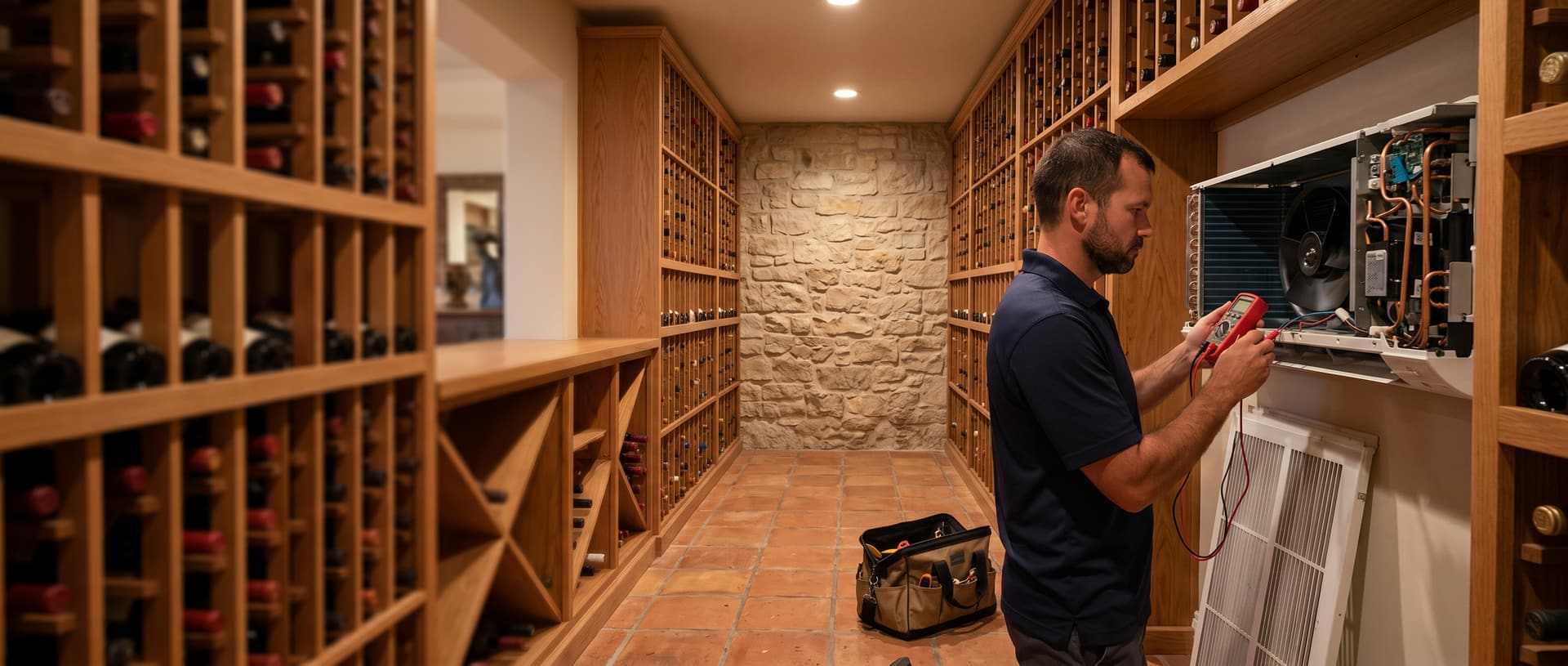
WhisperKOOL · CellarPro · Wine Guardian · Breezaire · Sub-Zero · Vinotheque. Coastal-influence cellars run a different failure tree, marine-layer thermal cycling, basement humidity, salt-air corrosion at 1-2 miles inland. $120 diagnostic, same-day from LA.
Our Branches
8 service territories across Southern California
01, About this service
Pacific Palisades wine cellars sit in a coastal-influence climate that's nothing like Malibu and nothing like Beverly Hills.
The Palisades wine-cellar landscape spans more variation than the zip code might suggest. The Riviera, the slope of estate homes around Riviera Country Club and the upper canyons, has 2,500-to-5,000-bottle cellars running WhisperKOOL Extreme 8000 or 15000 tii units in dedicated wine rooms, often built below grade in finished basements. Huntington Palisades, the flat grid south of Sunset, leans toward 1,500-to-3,000-bottle cellars in modernized basements and main-floor walk-ins, with WhisperKOOL Platinum, CellarPro 4200VSx, and Wine Guardian ductless equipment in regular service. Castellammare, perched on the bluffs above PCH, has a higher proportion of compact cellars and converted-pantry builds running Breezaire WKL through-the-wall and CellarPro 1800QTx cabinets. The Highlands has the newest stock, post-2010 builds with current-spec cooling, frequently Wine Guardian ducted splits or CellarPro 6200VSxi systems on larger estates. Upper Palisades and El Medio Bluffs round out the residential mix with a blend of mid-size dedicated cellars and Sub-Zero wine storage on dual-zone kitchen builds. The Santa Monica Canyon adjacency picks up overflow from both Palisades and Santa Monica service.
What ties all of this together is the climate. The Palisades sits 1-2 miles inland from the Pacific in most of its residential zones, close enough that marine-layer mornings bring 85-95% relative humidity into garages and mechanical rooms five to seven days a week through the marine-layer season, and salt aerosol from the prevailing onshore flow reaches every cellar in the area. Far enough inland that afternoon temperatures climb into the 80s by 2pm in summer once the marine layer burns off, sometimes hotter on the upper slopes of The Riviera and the Highlands where afternoon sun load is heavier. The result is a daily thermal cycle that the rest of coastal LA, Malibu's near-constant marine influence and Beverly Hills's dry inland conditions, simply doesn't experience the same way. Palisades cooling systems fight humidity in the morning and heat load in the afternoon, every day, year-round.
This page is for Pacific Palisades wine cellars specifically. If you're truly oceanfront, Malibu Colony, Carbon Beach, Point Dume, see our Malibu wine cellar repair page; the failure tree there leans harder on salt and constant humidity. If you're inland of the 405, Beverly Hills, Bel Air, Holmby Hills, see our Beverly Hills wine cellar repair page; that climate is dry and the failure tree shifts toward electronics and mechanical wear. If you're not sure which category fits your installation, call us at (424) 325-0520, the model number on your unit's data plate and the address tell us everything in 30 seconds.
02, The coastal-influence failure tree
Coastal Wine Cellar Failures: What Marine Layer and Salt Air Do to Cooling Systems
Inland failure trees emphasize compressor age, control-board electronics, and gasket wear on a long, predictable timeline. Pacific Palisades cellars hit those same failure modes plus seven environment-driven ones that run on a faster clock, and that look measurably different from pure-Malibu coastal patterns. We diagnose cheapest-to-resolve to most-expensive, but Palisades homeowners should know the full picture going in.
1. Daily marine-layer-to-afternoon-heat thermal cycling
The signature Palisades failure mode and the one that's most often missed by service techs unfamiliar with the local climate. The cellar's cooling unit is fighting a high-humidity-cool-air load from 5am to 10am, marine-layer outside air around 60°F at 88% RH, and a lower-humidity-warm-air load from 1pm to 6pm, outside air around 82°F at 55% RH. Systems specified for one profile end up short-cycling or over-correcting on the other. We see this most clearly on CellarPro VSx variable-speed units that were programmed at a generic Southern California speed-curve and on WhisperKOOL Extreme cabinets running tight cooling differentials. The fix is calibration, not parts: a 48-hour cycle log, a recalibrated differential, sometimes a speed-curve remap. Inland Beverly Hills and Bel Air cellars don't experience this cycle and don't need this calibration.
2. Condensation control failures (humidity higher than inland)
Palisades cooling units produce more condensate than inland equivalents because the air being cooled carries more moisture, especially during the marine-layer season. Drain pans designed for 1-2 cups per day of condensate often see 3-5 cups during summer marine-layer mornings. Salt deposits accumulate on drain-line walls as condensate evaporates between cycles, restricting flow over time. The result: drain pan overflow, water pooling at cabinet bases on through-the-wall units, water staining on basement subfloors under split-system air handlers. We see this on every brand, WhisperKOOL, CellarPro, Wine Guardian, Breezaire, and it's the second-most-common Palisades cellar service complaint we field.
3. Evaporator coil corrosion from coastal moisture
Aluminum evaporator fins on coastal-influence cellars develop a corrosion profile that's distinct from inland equivalents. The mechanism: humid air carrying trace salt aerosol passes across the cold coil, condenses onto the fin surfaces, and the resulting moisture-plus-salt film accelerates electrochemical corrosion of the aluminum. Heat-exchange efficiency drops first; the unit compensates with longer run times; eventually the fin pack itself shows pitting. On Palisades cellars at 1-2 miles from the coast we see this at year 7-9 versus year 4-6 in Malibu and year 12-15 inland. Semi-annual coil cleaning slows the rate substantially; sealant treatment on accessible coils extends life further.
4. Door seal mold and gasket degradation
The combination of coastal humidity and the cool surface of cellar door seals creates conditions where mold colonizes gasket folds, and the same humidity-plus-UV-plus-thermal-cycling stack accelerates the rubber and silicone breakdown. We see visible mold on the warm-side fold of cellar door gaskets in Palisades cellars at year 3-5, often before the gasket itself has failed mechanically. Inland Beverly Hills cellars rarely show mold on gaskets. Treatment: gasket cleaning with appropriate antimicrobials at every service visit, full gasket replacement at year 5-7 instead of the manufacturer's 8-10 year recommendation. On glass-doored display cellars common in Highlands and Upper Palisades builds, gasket integrity is also visible to homeowners and matters cosmetically as well as functionally.
5. Control board moisture damage
Cellar cooling control boards assume a relatively dry electrical environment. On Palisades cellars where humidity penetrates cabinet seams or mechanical-room enclosures, moisture migrates onto the board and bonds with airborne salt to create a conductive film. Symptoms: intermittent display readings, ghost-temperature drift, unexplained relay chatter, eventual board failure. We see this most often on CellarPro 1800QTx and WhisperKOOL Extreme 4000 cabinets installed in basement mechanical chases (where below-grade humidity is constant), and on Wine Guardian condensing units in exterior or attic enclosures where coastal-influence air infiltrates the housing. Catching it during semi-annual service, wiping the board, applying conformal coating where appropriate, extends board life by years.
6. Refrigerant line corrosion at fittings
Salt-laden coastal-influence air degrades the brass and copper hardware at refrigerant flare fittings on split-system installs. The flare seal itself oxidizes, the fitting threads corrode, and slow leaks develop at fittings that were perfectly tight at install. We see this on Palisades ducted-split systems at year 7-10 versus year 12-15 inland. Symptoms: gradual cellar temperature drift (half a degree a week, then a degree, then more), longer cooling cycles, eventual setpoint failure. A half-pound annual refrigerant top-up usually traces back to a flare seal the homeowner had no idea was leaking. EPA 608 Universal certified (#1346255700410), BHGS #A49573 licensed work on all the brands we service; we re-flare and re-seal the connection rather than just topping off the charge.
7. Above-grade thermal infiltration
Palisades cellars built into above-grade rooms or over garages see afternoon heat load that basement cellars don't. The cellar floor or shared wall conducts afternoon heat directly into the conditioned space; cooling units sized for design ambient end up running 50-65% duty cycle in summer afternoons when a properly-positioned cellar should run 30-40%. We address this with thermal-break inspection at the cellar perimeter, sealing of garage-to-cellar penetrations (recessed lights, HVAC chases, electrical conduit), and on replacement specs we size cooling at 1.2-1.4x the published BTU calculation rather than 1.0x. Castellammare bluff homes with cellars on the upper floor are particularly exposed; The Riviera estates with basement cellars are the easiest configurations to keep stable.
03, Brands and models
Wine Cellar Cooling Systems We Repair in Pacific Palisades
Seven brand families cover roughly 95% of the Pacific Palisades service mix. Each runs a different parts chain, a different characteristic failure profile under coastal-influence conditions, and a different replacement-economics calculation when repair stops making sense.
WhisperKOOL
Extreme 4000 · Extreme 8000 · Extreme 15000 tii · Platinum series
The most-specified brand across The Riviera, Huntington Palisades, and the Highlands. Extreme 4000 covers compact cellars (300-700 bottles); Extreme 8000 fits 700-1,500 bottles; Extreme 15000 tii is the workhorse on 1,500-3,500-bottle ducted-split estate builds. Coastal-influence service items: condenser fan motor at year 7-10, evaporator coil cleaning twice yearly, drain pan and line maintenance, compressor at year 11-13 on heavy-duty-cycle installs. Common parts on the LA truck; less common items 2-3 day OEM lead.
CellarPro
1800QTx · 3200VSx · 4200VSx · 6200VSxi · ducted split configurations
Strong presence in custom Highlands and Upper Palisades installations. 1800QTx (cabinet) is the most-serviced model on through-the-wall coastal-influence failures. 3200VSx and 4200VSx are split systems on mid-size cellars; 6200VSxi handles estate-scale builds. Variable-speed compressor design extends life on properly calibrated installs but speed-curve mapping needs Palisades-specific tuning to handle the daily thermal cycle. CellarPro parts chain is direct, typically 2-4 day lead on uncommon components.
Wine Guardian
Ductless residential · Ducted split residential · D series · DS series
Wine Guardian's ducted residential systems are common on larger Palisades estate builds (3,000+ bottles), particularly in The Riviera and the Highlands where mechanical rooms can be sited remote from the cellar. Common service items: condensing-unit fan at year 8-10, line-set flares at year 7-10 (coastal-accelerated versus inland), air-handler coil cleaning, control-module humidity calibration for the local marine-layer profile. Wine Guardian has authorized service requirements on warranty work; we coordinate accordingly when units are still in coverage.
Breezaire WKL
WKL 2200 · WKL 3000 · WKL 4000 · WKL 6000 · WKL 8000
Through-the-wall self-contained units on smaller and mid-size Palisades cellars, especially Castellammare and El Medio Bluffs converted-pantry and closet conversions. Simpler than split systems with fewer failure modes, but the cabinet exterior face is exposed to coastal-influence air. Service items: condenser cleaning, drain pan and line maintenance, fan motor replacement at year 8-10, capacitor at year 9-11. Parts well-stocked through the LA-area distributor; we keep the most common WKL fan motors and capacitors on the truck.
Sub-Zero wine storage
427 series · 424 series · designer-line wine storage · integrated dual-zone
Sub-Zero wine storage units appear in newer Palisades builds and rebuilt-after-2018 homes, frequently as kitchen-adjacent or butler's-pantry installations rather than dedicated cellars. Build quality is excellent; service intervals are long; when failures do occur, parts come through Sub-Zero authorized distribution and we coordinate accordingly. Common service items at year 8-12: thermistor, evaporator fan, control board, door gasket. Sub-Zero certified service available through our team.
Vinotheque
Cabinet refrigeration · custom-built integrations · Vinotheque-spec cooling
Furniture-style cabinet wine units appear in the Palisades primarily as supplemental storage (a Vinotheque in a dining room or library alongside a separate dedicated cellar). Service tree resembles wine cooler repair more than dedicated cellar repair, door gasket, thermistor, control board, occasional compressor. Coastal-influence accelerated wear on the same components but smaller-scale parts cost. We service them on the same calls when both systems are in the home.
Vinotemp and other cabinets
Vinotemp Wine-Mate · Eurocave residential · KoolSpace · Cellar Cool · custom builders
Vinotemp and Wine-Mate split systems appear in mid-2000s and later Palisades cellar builds. We identify the underlying OEM source on diagnostic before quoting because Vinotemp shares parts platforms with several manufacturers and the right replacement isn't always obvious from the nameplate. Eurocave residential cabinets show up in higher-end European-spec installations alongside Fondis or Sub-Zero. Send us a photo of the data plate and we'll usually identify the OEM in one call.
04, Why Palisades is different
Why Pacific Palisades Wine Cellars Need Specialist Repair
Daily marine-layer-to-afternoon-heat thermal cycling. The single biggest reason Palisades cellars fail in ways their owners don't expect. Pure-coastal Malibu cellars sit in a relatively constant high-humidity envelope; pure-inland Beverly Hills cellars sit in a relatively constant dry envelope. Palisades cellars cycle between the two profiles every 24 hours, and cooling systems specified or calibrated as if Palisades were either pure-coastal or pure-inland end up over-correcting in one direction or the other. We tune for the actual cycle, measured over 48 hours on your cellar, rather than a generic Southern California baseline.
Salt air from ocean proximity at 1-2 miles inland. Less aggressive than Malibu's oceanfront exposure but materially more aggressive than Beverly Hills or Bel Air. Salt aerosol drifts inland on the prevailing onshore flow and reaches every cellar within roughly two miles of the coastline. The deposition rate is slower than Malibu (10-month visible film versus 4-6) but faster than inland (where 18-24 month intervals are normal). Castellammare bluff homes and the El Medio Bluffs see slightly higher rates than Huntington Palisades or The Riviera further inland. Service cadence calibrates against this, every 4-6 months on the bluffs, 6-8 months further inland in the Palisades zip code.
Basement-cellar humidity profile. Many Palisades estates, particularly in The Riviera and the larger Huntington Palisades lots, have wine cellars built below grade. The basement environment runs cooler ambient (helps the cooling unit) but also carries higher passive humidity from ground moisture migrating through foundation walls and slabs. We see basement cellars passively holding 70-78% RH, which means the cooling system is dehumidifying constantly to bring the room to the 60-70% target. Condensate volume runs 2-3x what an above-grade cellar produces; drain pans and lines wear faster; condensate pumps often replace gravity drainage on retrofits. Service approach factors all of this in.
Post-2018-fire rebuilt homes with newer climate-control infrastructure. Palisades homes rebuilt or substantially renovated after 2018-2019 typically have current-spec insulation, vapor barriers, and HVAC routing, and we see meaningfully lower failure rates on these builds in their first 5-7 years than on pre-2010 stock. The downside: rebuilt homes sometimes have cooling units sized for cubic-footage-only without accounting for actual perimeter-wall heat load, and ducted-split refrigerant lines occasionally route through attic spaces that produce flare-fitting stress over time. We inspect both during the diagnostic on rebuild-era cellars.
Service every 4-6 months versus 12 inland. The shorter cadence isn't conservative, it's calibrated to the actual rate at which the failure modes on this page develop. A WhisperKOOL Extreme 8000 serviced every 12 months in Bel Air will accumulate predictable wear over each interval and that's fine; the same unit in Castellammare or Huntington Palisades on a 12-month schedule will accumulate the same wear plus three to four additional months of coastal-influence degradation that doesn't show up inland. Coastal maintenance pays for itself in extended equipment life.
05, Recent repairs
Recent Pacific Palisades Wine Cellar Repairs
Four representative Pacific Palisades service calls, model, neighborhood, symptom, diagnosis, repair, and cost. Names and addresses are not published; the technical scenarios are typical of what we see on coastal-influence cellar work in each area.
WhisperKOOL Extreme 15000 tii, The Riviera basement cellar
Symptom: 3,200-bottle below-grade cellar drifting from 56°F target to 61°F over a 4-day window. Owner caught it on the cellar's monitoring app before the wines were affected. Last service was 14 months prior.
Diagnosis: Two issues compounding. Refrigerant slow leak at the suction-line flare on the condensing unit in the garage mechanical room, coastal-influence corrosion of the flare seal at year 8 of the install. Condensing-unit condenser fins also showing 14-month accumulation of salt-and-dust film reducing heat exchange to roughly 75% of design capacity. Compressor and control board tested healthy.
Repair: Recovered remaining refrigerant, re-flared the suction-line connection, vacuum and pressure-tested the system, recharged with R-410A to manufacturer spec. Cleaned condensing-unit coils. Inspected line-set at all accessible junctions and discharge-line flare on liquid side; both passed. Verified setpoint hold over a 3-hour run cycle. Added the unit to our 6-month coastal maintenance program.
Cost & time: $1,140 total. Same-day diagnostic and recovery; return visit next morning for re-flare and recharge.
CellarPro 4200VSx, Huntington Palisades basement build
Symptom: Through-the-wall cabinet running constantly, cellar humidity reading 76% RH on the wall sensor, owner concerned about visible moisture forming on the inside of the glass display door. 1,600-bottle cellar in a finished basement.
Diagnosis: Two-part. The 4200VSx was running its standard cooling differential against a basement environment that was passively delivering 80%+ RH air through foundation-wall infiltration; the unit was dehumidifying continuously but couldn't keep ahead of the load. Drain pan was overflowing intermittently because the condensate volume exceeded the gravity-drain capacity on humid mornings. Glass-door condensation was dew-point related, warm humid basement air outside the cellar door, cold cellar interior, not a unit fault.
Repair: Installed a properly-sized condensate pump with backup float switch to replace the gravity drainage. Recalibrated humidity setpoint to 65% RH and adjusted cooling differential. Added antimicrobial treatment to the door gasket. Recommended foundation-wall vapor-seal inspection by a contractor (referred out, outside our scope). Re-checked humidity over 72 hours; cellar held 64-66% RH on the new configuration.
Cost & time: $580 (condensate pump hardware, install labor, calibration). Two visits.
Wine Guardian ducted split, Castellammare bluff estate
Symptom: Owner reported the cooling system "sounded different" over the past month and noticed the cellar drifting half a degree warm by afternoon. 4,500-bottle cellar with the air handler in a mechanical chase and the condensing unit on a bluff-side terrace facing the Pacific.
Diagnosis: Condensing-unit condenser fan motor in advanced bearing wear, running but airflow visibly reduced and motor temperature elevated. Coil also showing meaningful salt-driven corrosion; fin pack still functional but heat exchange measurably degraded. Cellar was below the cooling system's recovery capability during peak afternoon load only. Year 9 of the install, exposed bluff-side condensing unit position is the most aggressive coastal-influence environment in our Palisades service mix.
Repair: Replaced condensing-unit fan motor (Wine Guardian OEM, 3-day lead from distribution). Cleaned the condenser coil, applied corrosion-inhibitor treatment to accessible fin surfaces, inspected line-set flares and pressures (both held). Verified setpoint hold over a 2-hour run cycle on a peak-afternoon test. Added to 4-month maintenance interval given the bluff exposure.
Cost & time: $720 total. Two visits over a 4-day window.
Breezaire WKL 4000, Upper Palisades guesthouse cellar
Symptom: Through-the-wall unit no longer cooling. Owner reset the breaker twice; unit ran briefly each time then stopped.
Diagnosis: Compressor start-relay failure with secondary symptoms from coastal-influence corrosion on the relay contacts and connector pin headers. Year 11 of the install, full coastal-influence exposure on the exterior cabinet face, no maintenance program in place. Compressor itself tested healthy on direct continuity check; capacitor in spec.
Repair: Replaced start relay and overload, cleaned and treated the connector pin headers, applied conformal coating to the control board where appropriate, verified cooling cycle through a full pull-down to setpoint. Discussed cabinet-level maintenance going forward, drain pan service, exterior salt clean-down twice yearly, gasket replacement scheduled for year 13, and signed the homeowner onto the coastal maintenance program.
Cost & time: $245. Same-day, completed on the diagnostic visit.
06, Pricing
Wine Cellar Repair Costs in Pacific Palisades
Diagnostic is $120 for residential calls, applied toward the repair when you approve work. Labor and parts are quoted in writing before any work begins. These ranges reflect typical 2025-2026 wine cellar repair pricing across the brands and component types we service most across the Palisades.
Diagnostic is residential only. Estate-scale ducted-split work in The Riviera and Castellammare often quotes higher than the bands above when refrigerant volume, line-set length, and labor access are factored in, the on-site diagnostic catches those variables and we adjust the written estimate accordingly. Coastal maintenance is the single highest-value spend in the Palisades climate: it preserves equipment investment, catches the failure modes on this page before they become emergencies, and on most Palisades cellars pays for itself in extended unit life. Semi-annual cadence is recommended; bluff-exposure homes (Castellammare, El Medio Bluffs) often benefit from a 4-month interval.
07, FAQ
Wine Cellar Repair, Pacific Palisades FAQ
Why does my Pacific Palisades wine cellar swing temperature so much between morning and afternoon?
This is the most common Palisades cellar complaint we hear and it traces to the marine-layer-meets-afternoon-heat cycle that defines the local climate. From roughly 5am to 10am the marine layer keeps outdoor air in the 58-64°F range at 85%+ humidity; by 2pm the sun has burned through, and the same air mass is sitting at 78-86°F with humidity in the 50s. Your cooling unit fights two different problem profiles in the same 24 hours, high-humidity-cold-load in the morning, low-humidity-warm-load in the afternoon, and systems specified as if Palisades were pure-coastal or pure-inland end up over-correcting in one direction. The fix depends on the system. On WhisperKOOL Extreme units we recalibrate the cooling differential to a wider band so it doesn't short-cycle through the morning. On CellarPro VSx variable-speed systems we adjust the speed-curve mapping to favor longer, slower cycles. On ducted Wine Guardian splits we rebalance discharge airflow. On Breezaire WKL through-the-wall units we sometimes add a thermal break at the cabinet penetration. We measure for 48 hours before we touch anything, the only way to size the right correction is to see the actual cycle on your cellar.
We're 1.5 miles from the ocean, do we really need to worry about salt air the way Malibu does?
Less aggressively than Malibu, but yes. Salt aerosol drifts inland on the prevailing onshore flow, and at 1-2 miles from the Pacific you're still inside the active deposition zone. The difference is rate: a Malibu Colony cooling unit accumulates a visible salt-and-dust film on the condenser fins in 4-6 months; a comparable unit in The Riviera or Huntington Palisades shows the same film in 7-10 months. Door gaskets that fail at year 4-6 in Malibu typically reach year 6-8 in the Palisades before showing the same wear. Refrigerant line-set flares oxidize on a similar curve, slightly slower than Malibu, materially faster than Beverly Hills or Brentwood inland of the 405. The Castellammare bluffs and homes along the El Medio Bluffs see slightly higher salt exposure than Huntington Palisades or the Highlands because they sit closer to the coastline and higher on the bluff where the onshore flow lifts. We service Palisades cellars on an 8-month cadence rather than 6 (Malibu) or 12 (inland), calibrated to the actual rate of coastal wear we measure on the equipment.
My cellar is in the basement, does that change how it should be serviced?
It changes the humidity profile significantly. Many Palisades estates, especially through The Riviera and the larger Huntington Palisades lots, have wine cellars built below grade in finished basements. Below-grade rooms run cooler ambient year-round (which helps the cooling unit) but they accumulate ground moisture migrating through the foundation slab and walls. We often see basement cellars holding 70-78% RH passively, meaning the cooling unit is dehumidifying constantly to bring the room to the 60-70% target, and condensate volume runs 2-3x what an above-grade cellar produces. That drives faster wear on drain pans, faster salt-and-mineral buildup in drain lines, and earlier control board moisture damage. Service approach: we inspect foundation seal and vapor-barrier integrity on the first visit, verify the drain pan and line are sized for the actual condensate volume, and on systems running heavy condensate we recommend a condensate pump retrofit rather than gravity drainage. Basement cellars are often quieter and more thermally stable than above-grade builds, but they ask more of the dehumidification side.
Our home was rebuilt after the 2018 Woolsey-era fire damage, does that affect our wine cellar?
It usually helps. Palisades homes rebuilt or substantially renovated after 2018-2019 typically went in with newer climate-control infrastructure, better insulation specs, modern vapor barriers, properly-engineered HVAC routing, and cooling units that were sized using current Palisades-specific load calculations rather than generic coastal-Southern-California assumptions. We see meaningfully lower failure rates on post-2018-rebuild cellars in their first 5-7 years versus pre-2010 builds. That said, two issues to watch on rebuilt homes specifically. First, builders sometimes specify cooling units that are technically correct for the cubic-footage but undersized for the actual heat load through the cellar's perimeter walls, especially when the cellar shares a wall with an attached garage or a south-facing exterior. Second, ducted-split systems installed during a rebuild are sometimes routed through attic spaces or chases that weren't optimized for refrigerant-line geometry, which produces flare-fitting stress points that fail earlier than they would on a clean install. We'll inspect both during the diagnostic and recommend remediation if either is in play.
I keep finding water around the base of my cellar cooling unit, what's wrong?
On Palisades cellars this is almost always a condensate management failure driven by the marine-layer humidity profile. The evaporator coil condenses water from the air every cycle; that water exits through a drain pan and a directed line. Three failure paths in order: the drain pan accumulates debris, salt deposits, and biological growth over 2-4 years on coastal installs and overflows during long cooling cycles; the drain line restricts as salt and mineral deposits build up on the walls, especially when installed with insufficient fall (1/8-inch per foot versus the 1/4-inch spec); or gravity termination can't keep up with condensate volume on a humid marine-layer morning. On WhisperKOOL Extreme 4000/8000/15000 tii units our diagnostic checks all three; about 65% of Palisades calls resolve with drain pan cleaning and line flush. The rest need a new drain pan, a new line, or a condensate pump retrofit because the original gravity install no longer fits the actual condensate load.
What brands do you actually service in the Palisades?
WhisperKOOL Extreme 4000, 8000, and 15000 tii covers most mid-to-large Palisades cellars (the workhorse brand in The Riviera and Huntington Palisades). CellarPro 1800QTx, 3200VSx, 4200VSx, and 6200VSxi appear frequently in custom Highlands and Upper Palisades builds. Wine Guardian ductless and ducted systems are common on larger estate cellars with remote mechanical rooms. Breezaire WKL (2200 through 8000) shows up on smaller and converted-pantry cellars across Castellammare and El Medio Bluffs. Sub-Zero wine storage units appear in dual-zone kitchen-adjacent installations on newer rebuilds. Vinotheque shows up in dining-room and library installations as supplemental storage. Vinotemp covers the broader cabinet and small-cellar market. We carry common WhisperKOOL and CellarPro parts on the LA truck; Wine Guardian and Sub-Zero parts come through OEM distribution (2-3 day lead); Breezaire stocks well locally; Vinotheque and Vinotemp are case-by-case.
How often should a Pacific Palisades cellar be serviced?
Every 4-6 months for coastal-influence Palisades installs, calibrated against where in the Palisades you sit and what your cellar configuration is. Castellammare bluff homes and El Medio Bluffs estates closest to the coastline run on the 4-month side because the salt-air rate is meaningfully higher. The Riviera, Huntington Palisades, and Upper Palisades estates 1.5-2 miles inland run on the 6-month side. Basement cellars get pulled toward the shorter interval regardless of location because the condensate volume drives faster drain-system wear. Our coastal maintenance program covers two visits per year as the standard package, condenser coil cleaning and inspection, drain pan and line flush, refrigerant pressure verification, control-board moisture inspection, door and gasket integrity check, calibration of the cellar sensor against an independent meter, and salt-residue clean-down on cabinet exteriors. For estate cellars over 2,500 bottles or with ducted-split systems running multiple zones, we recommend the same cadence with a longer site visit because the line-set and air-handler inspection adds time. Inland equivalents (Brentwood east of the 405, Bel Air, Beverly Hills) we service annually.
What does Pacific Palisades wine cellar repair cost?
Diagnostic is $120 for residential calls, applied toward the repair when you approve work. Typical cost bands: minor repairs (door gasket, temperature sensor, drain line clearing, control calibration, capacitor) run $180-$320; control board replacement on units like CellarPro 1800QTx, WhisperKOOL Extreme 4000, or Wine Guardian residential cabinets runs $380-$680 depending on board complexity; compressor work on ducted splits and larger cabinet units runs $580-$1,200 covering the compressor, capacitor, line-set evacuation and recharge; full unit replacement when repair economics no longer make sense runs $1,800-$4,500+ depending on unit class, a self-contained Breezaire WKL replacement at the lower end through a ducted Wine Guardian or WhisperKOOL Extreme 15000 tii at the upper end with installation and refrigerant work additional on the ducted side. Our Palisades coastal maintenance program, twice-yearly visits with the full inspection checklist, runs $280-$420 annually depending on cellar size and system type. Written estimate before any work begins; the diagnostic fee gets credited toward the approved repair.
Can you reach Pacific Palisades from your LA branch quickly?
Yes, same-day in nearly every case. Our LA branch dispatches to the Palisades through Sunset Boulevard or Pacific Coast Highway depending on where you sit and what traffic looks like. Typical reach time runs 25-45 minutes from dispatch, longer in afternoon PCH traffic. We carry the most common WhisperKOOL, CellarPro, Wine Guardian, and Breezaire service parts on the truck, fan motors, thermistors, capacitors, control boards on the high-frequency models, drain pan replacements, gasket kits, so a typical Palisades cellar repair finishes on the diagnostic visit. For active cellar emergencies where temperature is climbing on a high-value collection, we'll reprioritize the route and dispatch within 30 minutes when we have a technician available. Call (424) 325-0520, give us the model number on the cooling unit's data plate, current cellar temperature, and the cellar address, and we'll quote the dispatch window before we leave.
Should I keep my cellar running year-round in the Palisades climate?
Yes, year-round, at the same setpoint. Palisades winters are mild enough that homeowners sometimes wonder whether the cellar can free-cycle through January and February, the answer is no. Coastal humidity doesn't take a winter break, and a January marine-layer storm system delivers 90%+ RH air to your cellar without the temperature differential that drives the cooling unit to dehumidify on its own. We've worked on Palisades cellars that were idled through winter and came out of February with mold visible on cork tops and basement-cellar wall efflorescence that wasn't there in October. Run the cooling year-round at the standard 55-58°F setpoint; the unit will cycle less in winter (that's expected and healthy) but it will still pull excess humidity out of the air on every cycle and keep the cellar in the right window. If your cellar has been off-duty over the winter, run a 48-hour recovery cycle before you re-evaluate setpoint, and have us out for a humidity check to make sure nothing started growing in the drain pan while the system was idle.
Pacific Palisades wine cellar acting up? Same-day coastal-aware service.
$120 diagnostic, applied toward the repair. WhisperKOOL, CellarPro, Wine Guardian, Breezaire, Sub-Zero wine storage, Vinotheque, Vinotemp, coastal-influence trained on the brands Palisades cellars actually run. EPA 608 certified for refrigerant work. Dispatched from LA.