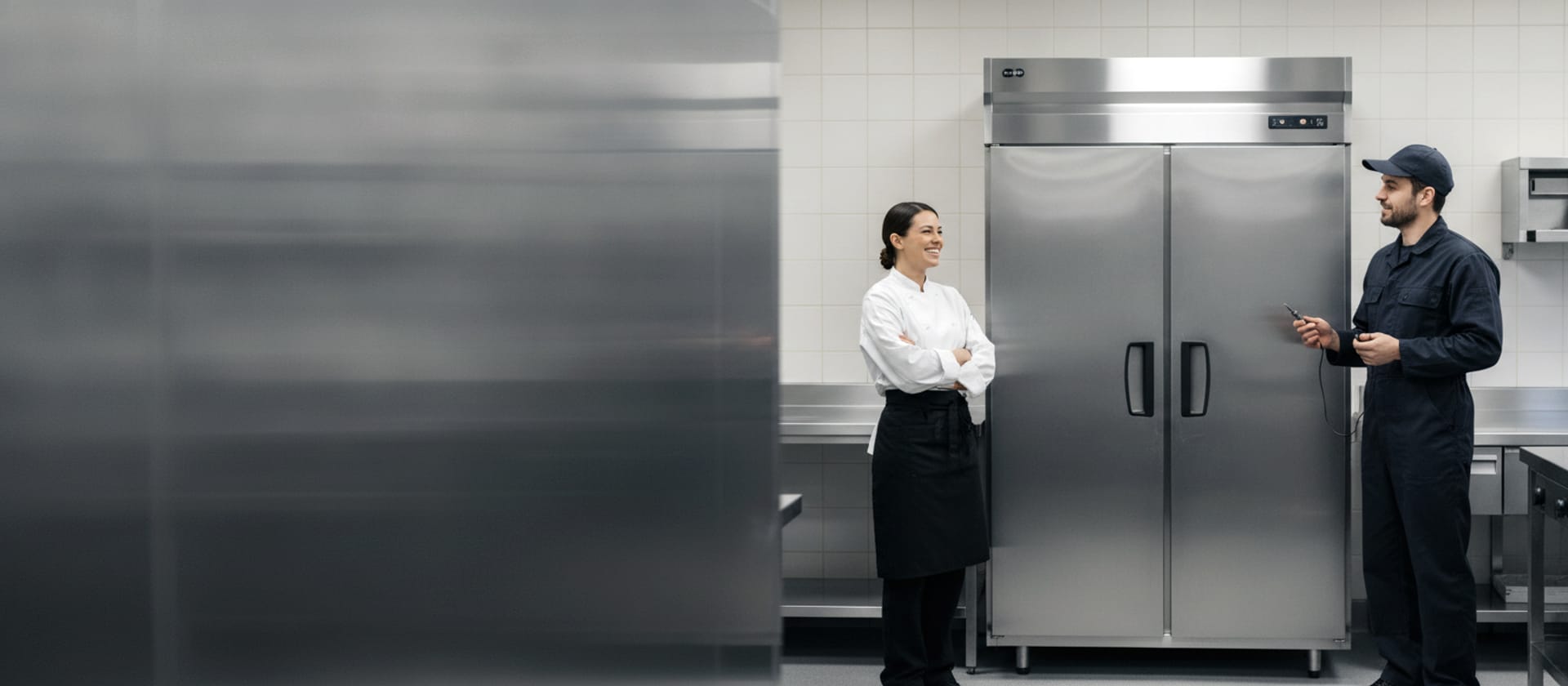
Commercial Kitchen · Delfield Refrigeration Troubleshooting · Welbilt (Ali Group) · Same Day
Delfield Commercial Refrigeration Repair in Los Angeles
Expert service for Delfield N-series reach-ins, refrigerated prep tables, mega tops, drop-in cold pans, salad bar units, and ingredient bins throughout Los Angeles, Orange County, and Southern California. Institutional specialists.
AI Diagnostic · free · about a minute
Not sure what's wrong?
Describe it in your own words — get the likely causes and a repair cost range before you book.
Delfield Repair in Southern California, the Institutional Food Service Standard
When a Delfield reach-in or prep table fails in an institutional kitchen, our techs at Same Day Appliance Repair treat it as a HACCP priority and trace it to one of three patterns first across LAUSD cafeterias, hospital food service, and stadium concessions. (1) Pan rail or cabinet running warm, usually a condenser loaded with institutional kitchen particulate (cleaning often fixes it with no parts) or a thermostat probe drifting in the cold pan section, anything above 41°F is a critical-control-point event. (2) Door gasket compression, institutional traffic of 400-plus open cycles per service compresses gaskets within 12 to 18 months, two to three times faster than restaurant duty. (3) Defrost and evaporator faults, a failed defrost system lets frost block airflow, and on open-top salad bars and ingredient bins a debris-seized evaporator fan motor. $120 commercial diagnostic, waived with repair. Delfield is a Welbilt brand (Ali Group acquired Welbilt in 2022), built for high-volume institutional duty, and we provide HACCP temperature-log documentation, diagnose remote-condensing drop-in cold pans most shops can't, and hold EPA 608 Universal certification.
Delfield occupies a specific and underserved position in Southern California's commercial refrigeration market. While True Manufacturing and Traulsen dominate restaurant kitchens, and Hoshizaki owns the ice machine market, Delfield is the brand of choice for the institutional food service sector, which is the segment that feeds the most people per day in Southern California. LAUSD school cafeterias serving 650,000 student meals daily. UCLA and USC campus dining feeding 30,000 students. Cedars-Sinai and Kaiser hospital cafeterias running three meal services. SoFi Stadium and Kia Forum concession prep areas operating on event days. These operations run Delfield because the brand delivers the high-volume throughput, HACCP compliance architecture, and total cost of ownership that institutional operators need.
The service dynamics in institutional Delfield work are different from restaurant service. A prep table temperature exceedance in a restaurant means a food safety risk for dozens of covers. In a school cafeteria serving 800 students, the same failure is a critical control point (CCP) event with HACCP reporting implications. When we service Delfield equipment in institutional settings, we provide temperature log documentation appropriate for HACCP compliance records, because institutional operators need that paper trail.
The other factor that sets Delfield service apart: the drop-in cold pan and modular cold food table segment. These integrated systems, where the refrigeration unit is remote or under-counter and the cold surface is built into a serving line, are outside the capability of most general appliance companies. Diagnosing a drop-in cold pan failure requires understanding the remote condensing circuit, the refrigerant line run, and the cold pan airflow distribution, not just thermostat replacement.
BHGS #A49573, EPA 608 Universal certified #1346255700410. Welbilt parts network access. $120 commercial diagnostic applied to repair. Same-day response. Call (424) 325-0520.
Delfield Equipment We Service
Across the Delfield service calls our techs run in Southern California institutional kitchens, the work clusters predictably. About 30 percent pan rail or cabinet temperature failure (dirty condenser plus high ambient, a HACCP priority). 20 percent door gasket compression from institutional door traffic. 15 percent thermostat or probe drift. 15 percent defrost system and evaporator icing. 10 percent drop-in cold pan remote-condensing and refrigerant-distribution faults. 10 percent salad bar and ingredient bin fan motor or drain issues. The equipment below covers each line and its common failure modes.
N Series, Reach-In Refrigerators and Freezers
Models: N8132NP, N8160NP, N8100NP · N8132NF, N8160NF (freezers) · 6000 Series equivalents
Delfield's N series reach-in refrigerators are the workhorse of institutional food service: the reach-in behind every cafeteria line, in every hospital kitchen, in every school lunch program throughout Southern California. Built to Welbilt-portfolio engineering standards, the N series runs a robust refrigeration circuit designed for high-frequency access in self-service and cafeteria-line environments. In institutional settings, these units see 400 to 600 door-open cycles per service, significantly more than restaurant reach-ins. The common failure modes reflect institutional use intensity: door gasket compression failure from constant traffic, thermostat drift from thermal cycling, and condenser coil loading from institutional kitchen environments.
Common Southern California failure modes:
- Door gasket compression failure: 400+ daily open cycles compress gaskets within 12 to 18 months
- Thermostat drift: analog thermostat overcools or undercools in high-use institutional environments
- Condenser coil loading: institutional kitchen air carries more particulate than restaurant kitchens
- Evaporator icing: defrost system failure from extended open-door periods in cafeteria service
Refrigerated Prep Tables and Mega Tops
Models: 4448N-12, 4460N-16, 4472N-18 (standard) · 4448N-30M, 4460N-36M (mega top) · SSRPH series
Delfield's refrigerated prep tables and mega tops are the centerpiece of high-volume food production kitchens: cafeteria lines, stadium concession prep, event venue kitchens, and hospital meal assembly operations. The mega top design extends the refrigerated pan rail area to nearly the full top surface, providing more cold pan capacity than standard prep tables. In Southern California's institutional settings (LAUSD school kitchens, UCLA dining, the Crypto.com Arena and SoFi Stadium concession prep areas), Delfield mega tops run 8 to 12 hours daily at full capacity. HACCP compliance requires these units to maintain 41°F or below in the pan rail at all times, including during peak service with the rail open. When a prep table fails during institutional service, the food safety implications are immediate.
Common Southern California failure modes:
- Pan rail temperature failure: dirty condenser plus high-ambient institutional kitchen pushes pan rail above 41°F
- HACCP non-compliance: temperature log shows pan rail above CCP threshold during health inspection
- Cutting board deterioration: HDPE mega top surfaces develop cracks from heavy institutional use
- Thermostat probe failure: probe in cold pan section drifts, causing temperature alarm
Drop-In Cold Pans and Cold Food Tables
Models: 18699 series drop-ins · Cold food tables · CF-series · Modular cold pan units
Delfield drop-in cold pans and cold food tables are standard in Southern California's cafeteria service lines: school lunch programs, hospital patient food service, corporate cafeterias, and event venue buffet lines. Unlike reach-in refrigerators or prep tables, drop-in cold pans integrate directly into a custom serving counter, with the refrigeration system often remotely located in a mechanical room or under-counter space. When a drop-in cold pan fails, diagnosing the issue requires understanding the remote condensing unit or the under-counter compressor arrangement, plus the plumbing to the cold pan itself. Most general appliance companies aren't equipped to diagnose these integrated systems.
Common Southern California failure modes:
- Remote condensing unit failure: compressor or fan in mechanical room fails, pan warms slowly
- Refrigerant line restriction: long refrigerant runs to remote condenser develop restrictions
- Cold pan temperature uniformity failure: pan cold in center, warm at edges from airflow issue
- Drain pan overflow: institutional use clogs drain pan faster than restaurant use
Ingredient Bins and Salad Bar Units
Models: DB series ingredient bins · SB salad bar units · Hot-cold combination bars
Delfield ingredient bins and salad bar refrigeration units are found in LAUSD school cafeterias, Sodexo and Aramark-managed institutional dining facilities, and corporate campus food service operations throughout Southern California. These units hold 33 to 41°F in a self-service format where the customer or server is accessing the cold food constantly, with continuous cold air loss through the open top. The refrigeration system has to work harder than an enclosed reach-in. In Southern California summer heat, an ingredient bin or salad bar unit in an institutional kitchen without adequate HVAC becomes a food safety risk quickly. We service these units with HACCP compliance documentation for institutional operators who need temperature records.
Common Southern California failure modes:
- Temperature rise in summer: open-top design with Southern California ambient heat strains refrigeration circuit
- Evaporator fan failure: fan in cold section fails, pan temperatures rise unevenly
- Thermostat overcooling: salad bar overcools outer pans, freezes lettuce at edges
- Drain line clogging: constant food debris in open-top bins clogs drain lines rapidly
Delfield in Context, Welbilt Portfolio and the Institutional Market
Delfield is part of the Welbilt portfolio. Welbilt was acquired by Ali Group in 2022, which makes Delfield a sister brand to Beverage-Air, Scotsman, and Ice-O-Matic at the Ali Group corporate level. Within Welbilt directly, Delfield's siblings include Garland (commercial cooking), Frymaster (fryers), Manitowoc Ice (ice machines), Lincoln Foodservice (conveyor ovens), Convotherm (combi ovens), and Cleveland Range (steam equipment). This corporate structure matters for service: the Welbilt parts and service network is well-developed and OEM parts availability is generally strong, including for older Delfield units.
Note that Delfield is not part of ITW Food Equipment Group. ITW owns Traulsen, Hobart, and Vulcan, which is a separate corporate family. We service ITW brands as well, but the parts pipelines, service portals, and engineering documentation are distinct from Welbilt's.
Delfield's market position targets high-volume, cost-sensitive institutional operations: school districts, contract food service companies (Sodexo, Aramark, Compass Group), healthcare system cafeterias, and stadium and venue food service. These are operations that prioritize reliability, HACCP compliance, and total cost of ownership over premium features. Traulsen serves a different market segment (fine dining and premium institutional), which is one reason the two brands developed separate ownership trajectories.
In Southern California, this translates to a Delfield service market centered on LAUSD facilities, UC and CSU campus dining, Cedars-Sinai and Kaiser cafeterias, and the institutional food service operations at venues like SoFi Stadium, Kia Forum, and Dodger Stadium. When Delfield equipment fails in these environments, the food safety compliance and service continuity implications are significant, since institutional food service operators can't simply close the line while waiting for a part.
HACCP Cold Holding Requirements
California Retail Food Code requirements for cold-holding equipment:
We provide temperature log documentation with every institutional service call for HACCP compliance records.
Recent Delfield Service Calls
"Mega top prep table, pan rail at 47°F, LAUSD school kitchen"
📍 Los Angeles Unified School District facility
Delfield mega top called in at 7am with school lunch service beginning at 11am. Pan rail reading 47°F, 6 degrees above the HACCP CCP threshold. Condenser coil completely loaded from the school kitchen environment. Institutional fryers and steamer equipment nearby had deposited grease on the condenser over 4 months without cleaning. Cleaned the condenser, confirmed pan rail at 39°F within 45 minutes. School had time to prepare documentation before inspection. HACCP temperature log provided for the morning's CCP exceedance. Set facility on quarterly PM contract, 3 Delfield units in this kitchen.
School cafeteria prep table: quarterly condenser cleaning is not optional. A HACCP event before lunch service is correctable; during service is critical.
"N8160NP reach-in, not cooling, hospital cafeteria"
📍 LA County hospital cafeteria
Delfield N-series reach-in in a hospital cafeteria, running at 52°F before breakfast service. Thermostat had drifted and the defrost heater had failed, allowing frost to accumulate on the evaporator coil over several weeks. The frost was blocking airflow entirely. Manually defrosted the coil, replaced the defrost heater assembly with OEM Delfield parts, replaced the thermostat assembly. Confirmed 38°F within 60 minutes. Provided temperature log documentation for the hospital's maintenance records and HACCP file. The defrost failure had been developing gradually over weeks; a quarterly maintenance inspection would have caught it before the CCP exceedance.
Hospital cafeteria reach-ins: defrost system inspection should be part of every PM visit. Gradual frost buildup isn't visible from outside.
"Drop-in cold pan, warm on one side, corporate cafeteria Century City"
📍 Century City corporate campus cafeteria
Delfield drop-in cold food table, right section running at 48°F while left section held 38°F. Remote condensing unit located in the mechanical room below the serving line. Diagnosed uneven cooling: the refrigerant distribution orifice feeding the right-side evaporator had partially restricted, reducing refrigerant flow to that section while left section maintained normal operation. Cleared the orifice restriction, verified even refrigerant distribution across both sections. Pan temperatures equalized to 38°F across the full unit. Most companies that service Delfield reach-ins don't have experience with remote condensing drop-in systems; the diagnosis requires understanding the full refrigerant circuit layout.
Drop-in cold pans: uneven temperature across sections usually indicates refrigerant distribution issue, not thermostat. Requires full circuit diagnosis.
"Salad bar unit, temperature alarm, SoFi Stadium concession"
📍 SoFi Stadium, Inglewood
Delfield salad bar unit in a SoFi Stadium concession prep area, temperature alarm triggered 2 hours before a sold-out event. Evaporator fan motor had seized. Open-top salad bar design had allowed food debris to accumulate around the fan motor shaft over a season of event use. Without fan circulation, the open-top unit couldn't maintain temperature against the stadium kitchen ambient temperature (the kitchen runs warm on event days). Replaced the evaporator fan motor, cleared the debris from the fan housing, confirmed temperature recovery. Concession prep area was operational 90 minutes before the event. Provided post-service PM recommendation for end-of-season fan motor inspection.
Open-top salad bar and ingredient bins: fan motor debris accumulation is the primary failure mode. Inspect and clean after every high-volume event period.
Delfield Commercial Service, FAQ
Do you service all Delfield commercial models including drop-in cold pans?
Yes, the full Delfield commercial line: N series reach-in refrigerators and freezers, refrigerated prep tables and mega tops, drop-in cold pan and cold food table systems (including remote condensing configurations), ingredient bins, and salad bar units. Drop-in and modular systems are a specialty; most general appliance companies aren't equipped for remote condensing diagnostics. Call (424) 325-0520.
My Delfield prep table pan rail is above 41°F. Is this a food safety issue?
Yes, immediately. 41°F is the HACCP critical control point (CCP) for cold holding in California's food safety code. A prep table pan rail above 41°F means food in the rail is in the temperature danger zone. The most common causes in Southern California institutional kitchens: dirty condenser coils (especially in summer heat), thermostat probe failure, or the lid being left open for extended periods without the refrigeration system being sized for that load. We treat prep table temperature calls as HACCP emergencies and dispatch same-day. We provide temperature log documentation appropriate for HACCP compliance records.
Do you service Delfield equipment in school cafeterias and institutional settings?
Yes. Institutional food service is where Delfield is concentrated: LAUSD facilities, UC/CSU campus dining, hospital cafeterias, contract food service operations. We work with institutional facility managers and food service directors on PM programs and emergency response. Healthcare and education institutional calls include documentation for maintenance records and HACCP compliance files.
Who owns Delfield, and how does that affect parts availability?
Delfield is part of the Welbilt portfolio. Ali Group acquired Welbilt in 2022, so Delfield's ultimate parent is Ali Group, with Welbilt as the immediate subsidiary. Sister brands within Welbilt include Garland, Frymaster, Manitowoc Ice, Lincoln Foodservice, Convotherm, and Cleveland Range. At the Ali Group level, Delfield is also a sister brand to Beverage-Air, Scotsman, and Ice-O-Matic. Delfield is not part of ITW Food Equipment Group (which owns Traulsen, Hobart, and Vulcan, a separate corporate family). For service, this means Delfield parts come through Welbilt's parts network, which is well-developed for OEM availability across the full Welbilt brand family.
What is your diagnostic fee for Delfield commercial equipment?
$120 commercial diagnostic, applied directly to the repair cost when you proceed. No hidden trip charge throughout Southern California. BHGS #A49573, EPA 608 Universal certified #1346255700410.
How often should Delfield institutional equipment be maintained?
More frequently than restaurant equipment. Institutional food service volumes (school lunch programs serving 500 to 2,000 students daily, hospital cafeterias running three meal services) put significantly more use on equipment than restaurant settings. Prep table condenser coils should be cleaned quarterly, reach-in door gaskets inspected every 6 months (institutional door traffic is 2 to 3x restaurant levels), and thermostat calibration verified annually. We provide PM contracts for institutional operators with maintenance documentation appropriate for HACCP records.
Why is my Delfield reach-in not cooling?
On a Delfield N-series reach-in that won't cool in an institutional kitchen, the two most common causes are a condenser coil loaded with kitchen particulate (institutional air carries more than a restaurant) and a failed defrost system letting frost block the evaporator coil, frost buildup develops gradually over weeks and isn't visible from outside. A drifting analog thermostat is the third suspect. Door gaskets also matter: 400-plus open cycles per service compress them within 12 to 18 months. We clear the cause, confirm recovery below 41°F, and provide HACCP temperature-log documentation for the morning's records. Same Day Appliance Repair, $120 commercial diagnostic, waived with repair.
Why is one side of my Delfield drop-in cold pan warm?
On a Delfield drop-in cold pan or cold food table, one section warm while the other holds temperature usually points to a refrigerant-distribution issue, not the thermostat, the orifice feeding that section's evaporator has partially restricted, cutting refrigerant flow to that side. These integrated systems run a remote or under-counter condensing unit, so diagnosis requires understanding the full refrigerant circuit and line run, which most general appliance companies aren't equipped for. We clear the restriction, verify even distribution across all sections, and document the service for your HACCP file. Same Day Appliance Repair, $120 commercial diagnostic, waived with repair.
Delfield Equipment Down? We Respond Today.
Same-day emergency service for Delfield reach-ins, prep tables, mega tops, drop-in cold pans, and salad bar units throughout Los Angeles, Orange County, and Southern California. HACCP documentation provided. BHGS #A49573, EPA 608 Universal certified.
Also servicing: Hoshizaki · True Manufacturing · Traulsen · Beverage-Air · Perlick