LG Microwave Not Heating · Diagnostic Guide · Same Day Southern California
LG Microwave Runs But Won't Heat? It's the HV Circuit
An LG that lights up and turns but leaves food cold has a failed magnetron or high-voltage part — on NeoChef inverter models, the inverter board. A microwave's HV parts can hold a lethal charge even unplugged. Never open it.
AI Diagnostic · free · about a minute
Microwave acting up?
Describe it in your own words — get the likely causes and a repair cost range before you book.
Our Branches
10 service territories across Southern California
01 · The short answer
Runs but won't heat = the magnetron or high-voltage circuit.
When an LG microwave lights up, turns the plate, and counts down but the food stays cold, the fault is in the high-voltage circuit that makes the microwaves: the magnetron, the high-voltage diode, and — on conventional models — the capacitor and transformer. On LG's NeoChef and other inverter microwaves, an inverter board takes the transformer's place, and a failed inverter board is a common no-heat cause there. A door interlock switch that won't confirm a shut door will also stop heating. The only thing you can safely rule out is the door and your cook settings; everything else is inside, and the inside of a microwave is technician-only for a serious safety reason (below). For a countertop LG, replacement is often cheaper than the repair; for an over-the-range or built-in, the repair is usually worth it. $89 residential diagnostic, waived with repair.
⚠ Never open a microwave. A microwave's high-voltage capacitor (or inverter circuit) can hold a lethal electrical charge even after it's been unplugged for a long time. This is the one appliance you never open at home — full safety detail in the next section.
02 · The one appliance you never open
A microwave's high-voltage parts can kill — even unplugged.
This is the microwave's version of a gas line: a hazard that overrides any DIY instinct. Inside every microwave is a high-voltage stage — a capacitor on conventional models, an inverter board on NeoChef units — that stores electrical energy. Unlike almost every other appliance, where unplugging it makes the inside safe to work in, a microwave's high-voltage capacitor can hold a dangerous, potentially lethal charge for a long time after the unit is unplugged. The magnetron circuit also runs at thousands of volts.
The rule is simple and absolute: never remove the cabinet or reach inside a microwave, plugged in or not. A trained technician discharges the high-voltage components safely with the right tool before touching any internal part. There is no homeowner-safe way to test the magnetron, diode, capacitor, transformer, or inverter board. If the fault is internal, it is a technician job — every time, no exceptions.
That's why this page's "what you can check" list stays entirely on the outside — the door, the settings, a power-cycle. If those don't fix it, don't go further; call.
03 · Why an LG won't heat
The internal causes — all technician-only.
Magnetron (most common)
The tube that generates the microwaves. When it fails, the unit runs normally but makes no heat — the classic "runs but won't heat." Technician replacement after safely discharging the high-voltage stage.
Inverter board (NeoChef / inverter models)
Replaces the transformer on LG inverter units and drives the magnetron. A failed inverter board is a common no-heat cause on NeoChef microwaves — and a pricier part, which matters for repair-vs-replace. Technician-only.
High-voltage diode
Feeds the magnetron. A failed diode stops heating. Technician diagnosis after discharge.
Capacitor / transformer (conventional models)
On non-inverter LG units, the capacitor stores the lethal charge and the transformer steps voltage up to the thousands the magnetron needs. Either failing stops heat. Technician-only, discharged first.
Door interlock switches
Several switches must confirm the door is shut before the magnetron powers. A worn switch or warped door leaves the unit running fan and light but never heating — the one no-heat cause that starts at the (safe) door.
04 · What you can safely check (outside only)
Rule these out — then call, don't open it.
- Confirm the door shuts fully and latches firmly, with nothing caught in the seal and no warp — the interlock switches must sense a closed door to heat.
- Check the power level — a low setting heats slowly and can feel like "not heating." Set full power and retest.
- Rule out demo mode and do a two-minute power-cycle: unplug for a minute, plug back in.
- Test with a cup of water, not a cold-spot-prone plate, so you're judging real heating.
⚠ Where to stop — and this one is absolute: the door and the settings are the entire safe list. Do not remove the cabinet or reach inside for any reason, plugged in or not. The high-voltage stage is a lethal hazard. If the outside checks don't fix it, it's a technician call.
05 · Repair or replace?
Countertop vs. over-the-range — and the inverter factor.
Countertop LG — often replace
Basic countertop microwaves are inexpensive, so a magnetron or high-voltage repair can approach the price of a new one. We'll tell you honestly when replacing is the smarter money.
Over-the-range or built-in LG — usually repair
OTR and built-in units are expensive and integrated into cabinetry and venting, so a magnetron or diode repair is usually well worth it versus replacing the whole unit.
The inverter-board factor
On a NeoChef inverter model, the inverter board can be a pricier part, which nudges a cheap countertop unit toward replacement. Our tech identifies the exact part first, then gives you the numbers.
06 · When to call us
Door and settings fine, still cold? It's the HV circuit.
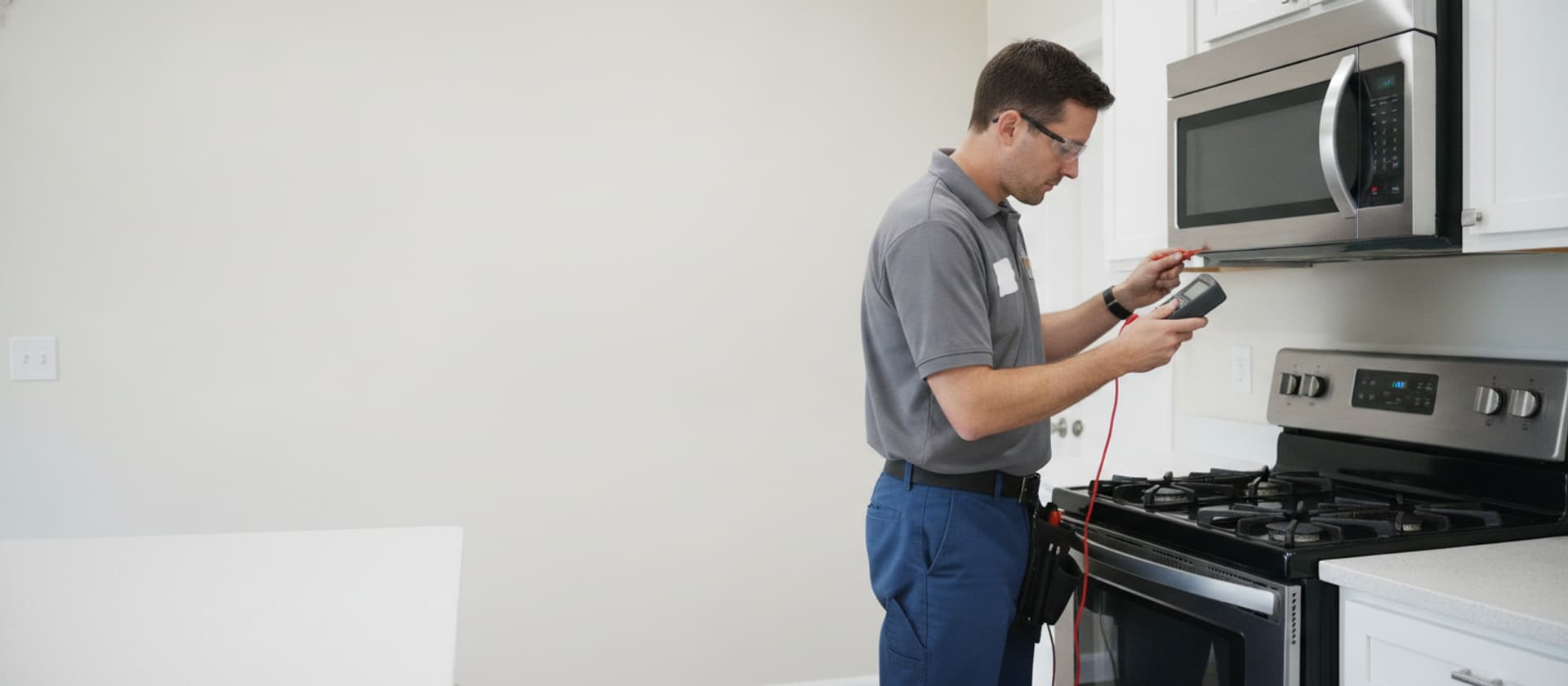
When the door latches cleanly, the power level is full, and the LG still won't heat, the fault is the magnetron, the high-voltage circuit, or the inverter board — technician-only work. Our techs safely discharge the high-voltage stage first, then test the magnetron, diode, capacitor, transformer, or inverter board with a meter and replace the failed part, on OTR, built-in, and countertop units.
More help: the general microwave not heating guide, the same fault on Samsung microwaves, and if the unit is completely dead, microwave no power. Same-day across Los Angeles, Beverly Hills, and Pasadena in most cases. Book online or call (424) 325-0520.
07 · FAQ
LG microwave not heating: common questions.
Why does my LG microwave run but not heat?
When an LG microwave lights up, turns the plate, and counts down but the food stays cold, the fault is in the high-voltage circuit that makes the microwaves — most often the magnetron, along with the high-voltage diode and, on conventional models, the high-voltage capacitor and transformer. On LG's NeoChef and other inverter models, an inverter board replaces the bulky transformer, and a failed inverter board is a common no-heat cause on those. A door interlock switch that isn't confirming a shut door will also stop heating. None of these are DIY: a microwave's high-voltage parts can hold a dangerous, even lethal, charge long after it's unplugged, so the inside is technician-only. You can safely rule out the door and your settings, then call. $89 residential diagnostic, waived with repair.
Is it safe to open an LG microwave to fix it?
No — never open a microwave, LG or any brand. Inside is a high-voltage capacitor (on conventional models) or inverter circuit that can hold a lethal electrical charge even after the unit has been unplugged for a long time, and the magnetron circuit runs at thousands of volts. This is the one appliance where unplugging it does not make the inside safe to touch. Every internal part — magnetron, diode, capacitor, transformer or inverter board, door switches — is a job for a technician who safely discharges the high-voltage components first. There is no homeowner-safe way to test them.
What is an LG inverter (NeoChef) microwave and does it change the repair?
LG's NeoChef and other inverter microwaves use an inverter board instead of the traditional heavy high-voltage transformer, which gives steadier low-power cooking. For a no-heat fault it changes which part fails but not the safety rule: instead of a transformer-and-capacitor pair, a failed inverter board is the common high-voltage culprit, and it still carries a dangerous charge and is still technician-only. It also affects the repair-vs-replace math a bit — an inverter board can be a pricier part — which is exactly why our tech identifies the exact failed component before quoting, so you know whether repair or replacement makes sense.
What can I safely check on an LG microwave that won't heat?
Only the outside. Confirm the door closes fully and latches firmly with nothing caught in the seal — the interlock switches must sense a shut door before it heats. Check the power level isn't set low (a 30% setting heats slowly and feels like 'not heating'), rule out demo mode, and do a two-minute power-cycle by unplugging for a minute. Test with a cup of water so you're judging real heating rather than a cold spot. If it still won't heat after all that, the fault is in the high-voltage circuit — do not open the cabinet; call a technician.
Is an LG microwave worth repairing if it won't heat?
It depends on the type. A countertop LG microwave is inexpensive, so a magnetron or inverter-board repair can approach the price of a new one — for a basic countertop unit, replacement is often the sensible call, and we'll say so. An over-the-range or built-in LG is expensive and integrated into the cabinetry and venting, so a magnetron or diode repair is usually well worth it versus replacing the whole unit. On an inverter model the board cost matters, so our tech diagnoses the exact failed part first, then gives you the real repair-vs-replace numbers.
LG microwave won't heat? Leave the HV circuit to us.
$89 diagnostic waived with repair. Same-day across LA, OC, Ventura. Phones answered 24/7.