Food Trucks · LP Cooking · Refrigeration · Ice · Same Day
Food Truck Equipment Repair Los Angeles
Griddles, fryers, fridges and ice machines running on propane and generator power. We meet the truck at the commissary or wherever it's parked. $120 diagnostic, waived with repair.
AI Diagnostic · free · about a minute
Not sure what's wrong?
Describe it in your own words — get the likely causes and a repair cost range before you book.
Our Branches
10 service territories across Southern California
01 · The food truck day
Before sunrise the commissary lots in Vernon and Boyle Heights are full of trucks loading up. By lunch, one of them has a griddle that won't light.
Our guys see the food truck day from the service end. Trucks roll out of commissaries in Vernon and Boyle Heights early, park on a curb or in an office-park lot by eleven, and by evening they're running off a generator at a brewery, a street fair or a private event. The equipment inside is the same equipment a restaurant runs: a flat-top griddle, a fryer or two, an undercounter fridge, a refrigerated prep table, sometimes an ice machine. What changes is everything around it.
A restaurant kitchen sits still on a slab, gets steady utility power and natural gas from the street. A truck kitchen is bolted to a chassis that shakes over every pothole between the commissary and the lunch spot. It burns propane from a cylinder. It runs on a generator that dips every time a compressor kicks on. And it lives in a steel box that gets hotter on a summer afternoon than most restaurant lines ever do.
That's why a food truck call is its own kind of call. The part that failed is usually ordinary: a thermocouple, a fan motor, a water valve. The reason it failed usually isn't. If we swap the part and ignore the reason, the truck is down again in two weeks, and nobody wants to pay for the same visit twice.
Pricing is simple. The diagnostic is $120, and it comes off the bill the moment you approve the repair. You get a written quote before we order anything, and what we quote is what shows up on the invoice.
02 · Scope
What we service, and what we don't touch.
A food truck packs five or six different trades into one box. Here's exactly where our work starts and stops, so the right people get the call the first time.
What we service
- Griddles and flat-tops, LP and electric: pilots, thermocouples, safety valves, thermostats, burners.
- Char-broilers: burners, pilots, valves, radiants.
- Fryers, gas and electric: thermopiles, millivolt gas valves, high-limits, thermostats, heating elements.
- Ranges and hot plates: burner valves, pilots, oven thermostats.
- Undercounter refrigeration and reach-ins: compressors, fans, controls, gaskets, refrigerant work.
- Refrigerated prep tables: cold rail, fans, drains, sealed system.
- Ice machines: water valves, pumps, sensors, harvest problems, cleaning and descaling.
What we don't touch
- Propane cylinders, regulators and the LP line outside the appliance. That's a licensed propane contractor. We test pressure at the appliance inlet and tell you if the problem is upstream.
- Hood fire suppression. That's a licensed fire protection contractor. We repair the cooking equipment under the hood, not the suppression tank, nozzles, links or its gas shutoff.
- The generator itself. That's a generator shop. We measure what it delivers under load; the engine and alternator aren't our trade.
- Health plan check, permits and inspections. That's LA County Environmental Health. We document what we repaired on the invoice.
Why draw the lines this sharp? Because on a truck the systems touch. A fryer that won't hold a flame can be a tired thermopile, which is ours, or a regulator starving the whole LP line, which isn't. The diagnostic tells you which one it is, and we say so plainly instead of working on something that belongs to another license.
03 · Why truck equipment breaks
Power, propane, vibration and grease. Most truck calls trace back to one of these four.
Generator power
On a truck, our diagnostic starts with a voltmeter, not a screwdriver. We measure voltage at the outlet the equipment actually plugs into, with the generator loaded the way it runs during service, and we watch the reading at the moment a compressor starts. A compressor draws several times its running current for that first second. If the generator is undersized or the cord run is long and thin, voltage sags hard, the compressor struggles to start, trips its overload and tries again. Repeat that all day and you burn up start components, then the compressor itself.
Waveform matters too. Many open-frame construction generators put out a rougher sine wave than utility power or an inverter generator, and electronic controls and modern fan motors don't tolerate it well. About half the "fridge isn't cooling" calls we get from trucks turn out to be power, not the refrigerator. A fridge that holds temperature all night at the commissary and warms up at a festival is telling you something, and we'll show you the readings before we quote a single part.
Propane
Most truck cooking equipment burns LP, and plenty of used griddles and fryers were built for natural gas. The two gases are not interchangeable. They need different orifice sizes and different manifold pressure: the data plate on most commercial units calls for around 10 inches of water column on LP and roughly 4 to 5 on natural gas. A natural gas griddle run on propane without conversion burns rich, soots up and runs hot.
The right fix is the manufacturer's LP conversion kit, with the correct orifices and the valve or regulator set for LP. We don't drill orifices. When we find drilled-out orifices on a truck, it's usually from someone chasing a bigger flame when the real problem was supply pressure. Upstream of the appliance, a truck system typically runs a two-stage regulator: the first stage at the cylinder knocks tank pressure down, the second brings it to appliance pressure, and cylinders connect through POL or ACME fittings. That side belongs to your propane contractor, but it shows up in our diagnosis constantly, so we put a manometer on the appliance inlet and leak-test every connection we open with leak detector solution. Never with a flame.
Vibration
A truck kitchen takes a beating a restaurant never sees. Every drive loosens something: gas fittings at the valve, pilot tubing, compressor mounting bolts, drain line clamps, wire terminals on a fryer's gas valve. A loose pilot fitting gives you a weak pilot and a burner that drops out. A compressor that has lost a mount rattles a refrigerant line until it rubs through. So on every truck visit our techs check fittings and mounts beyond the part we came for, and we leak-test any gas connection we touched before we leave.
Grease
Condenser coils on truck refrigeration clog far faster than in a restaurant. The griddle and fryer sit a few feet from the fridge in a tight space, and grease vapor mixed with street dust packs the fins. On a restaurant reach-in we'd expect to clean a condenser about once a year. On a truck it's every two to three months. A clogged condenser makes the compressor run hot and long, and on generator power that's exactly the load you don't want. That's the reason we put trucks on a maintenance plan instead of waiting for the next breakdown.
04 · Common truck calls
Four problems we cover in depth.
Thinking about batteries or solar instead of a generator? Read the honest numbers first: food truck generator vs battery power.
05 · The visit
How a food truck service call works.
- Where we meet you. Usually at the commissary, where the truck is parked, level and has power. If it's stuck at a lunch spot and can safely stay put, we can work there.
- Have the power on. Keep the generator running or the truck plugged in so we test under real load. Tell us roughly how full the propane cylinders are.
- Protect the food first. If a fridge or prep table is warm, move product somewhere that holds 41°F or below before we arrive. Cold-holding food doesn't wait for the repair.
- Diagnosis and a written quote. $120 diagnostic, waived with repair. We show you what we measured and what we'd replace, and nothing gets ordered until you say yes.
- The repair. Ignition parts and fan motors are common across brands, so plenty of truck repairs close on the first visit. Brand-specific parts and sealed-system work can take a second trip, and we'll tell you up front if that's the case.
Refrigerant work on a truck is still refrigerant work. Opening a sealed system takes an EPA 608 Universal certification, and ours is #1346255700410. When vibration rubs a line through, we find the leak and repair it, pull a vacuum and charge the system to spec. We don't just top it off and send you to an event with a slow leak. For the refrigeration side in general, see our undercounter refrigerator repair page.
06 · Maintenance plan
A truck breaks on its own schedule. A maintenance visit moves it to yours.
Truck equipment wears on a faster clock than restaurant equipment, so we set the visit interval to match. A typical truck maintenance visit covers:
- Condenser coil cleaning on every refrigerated unit, every two to three months.
- Leak check on gas connections at each appliance, and a look at every fitting vibration tends to loosen.
- Pilot flame, thermocouple and thermopile readings, so a weak one gets replaced before it quits during service.
- Fryer high-limit and thermostat check.
- Door gaskets and drain lines on refrigeration and prep tables.
- Ice machine cleaning, sanitizing and descaling.
- A voltage reading from your generator under load, written down so you can compare over time.
Price depends on the equipment list and how often the truck runs. Call with your list and we'll quote the plan.
08 · FAQ
Food truck equipment repair, common questions.
Do you come to the food truck, or does the truck come to you?
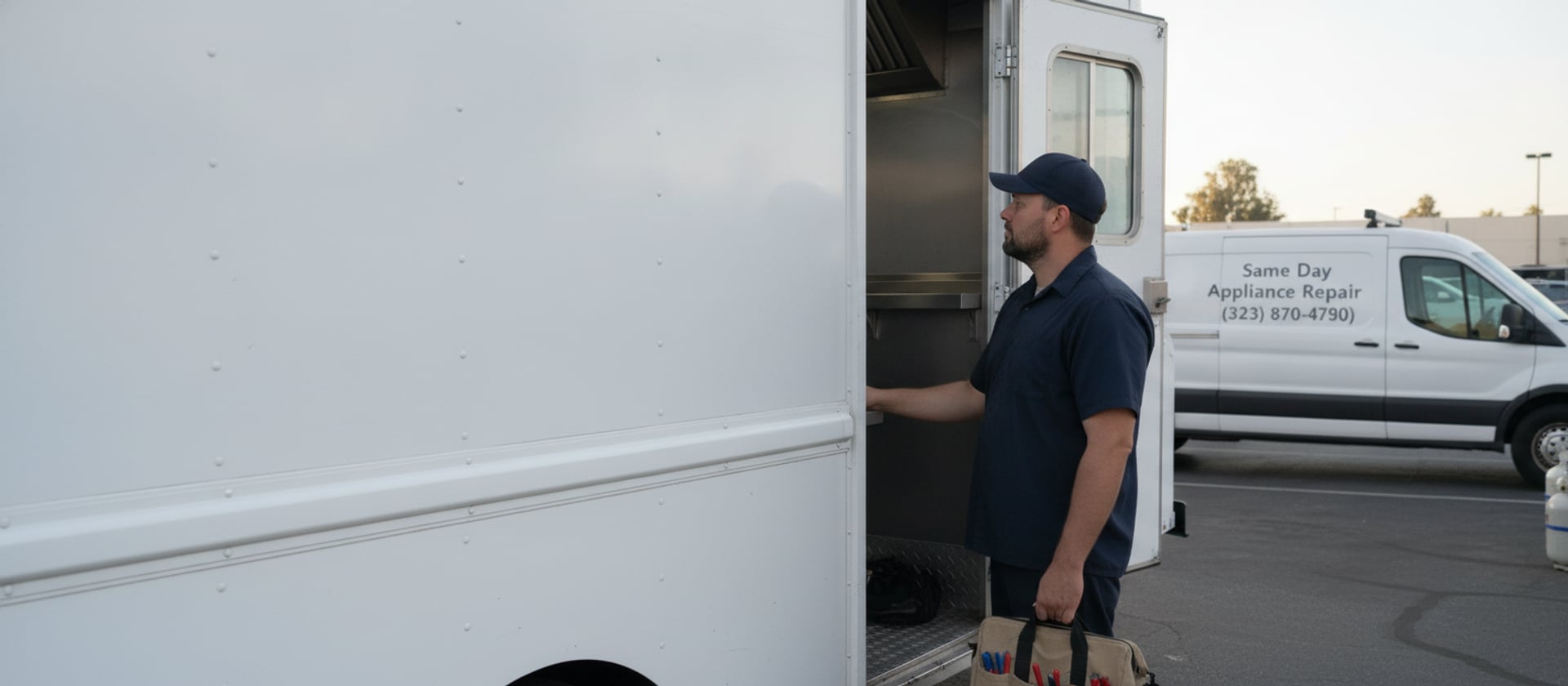
We come to the truck. Most calls we meet it at the commissary, where it's parked, level and plugged in, which makes testing faster. If the truck is down at a lunch spot or an event lot and can safely stay put, our guys can work there too. Same-day service is available across Los Angeles County and the rest of Southern California; phones are answered 24/7.
How much does a food truck repair visit cost?
The diagnostic is $120, and it comes off the bill as soon as you approve the repair. After the diagnostic you get a written quote before any part is ordered, and the number on the quote is the number on the invoice. No emergency surcharge.
Can you convert a natural gas griddle or fryer to propane?
When the manufacturer makes an LP conversion kit for that model, yes. The kit brings the correct orifices and sets the valve or regulator for LP pressure. We don't drill out or swap in random orifices, and if no factory kit exists for your unit, we'll tell you that straight instead of improvising a conversion on a gas appliance.
My fridge cools fine at the commissary but warms up at events. Is the fridge broken?
Often it isn't. When a refrigerator holds temperature on commissary power and struggles on a generator, the first suspect is the power: voltage sagging when the compressor starts, a long thin extension cord, or a generator carrying more load than it can start. Our diagnostic starts with a voltmeter under load, and we show you the readings before we quote any refrigeration parts.
Do you work on propane tanks, regulators, or the hood fire suppression system?
No. Propane cylinders, regulators and the LP line outside the appliance belong to a licensed propane contractor, and the hood fire suppression system belongs to a licensed fire protection contractor. We check gas pressure at the appliance inlet and tell you whether the problem is upstream, then fix what's inside the cooking or refrigeration equipment.
What warranty comes with the repair?
Our repairs carry a 90-day labor warranty on the work we performed. Brand component warranties, where they apply, are handled separately.
Can you help my truck pass a health inspection?
We can fix the equipment that's causing the problem, like a prep table that won't hold 41°F or an ice machine that needs cleaning, and we document the repair on the invoice. Plan check, permits and inspections for mobile food facilities are handled by LA County Environmental Health, not by us.
09 · Related
The same equipment, restaurant side.
Truck down before service? Call now.
$120 diagnostic, waived with repair. We meet you at the commissary. Mon–Sat 8am–6pm · Sun by arrangement · Phone answered 24/7.