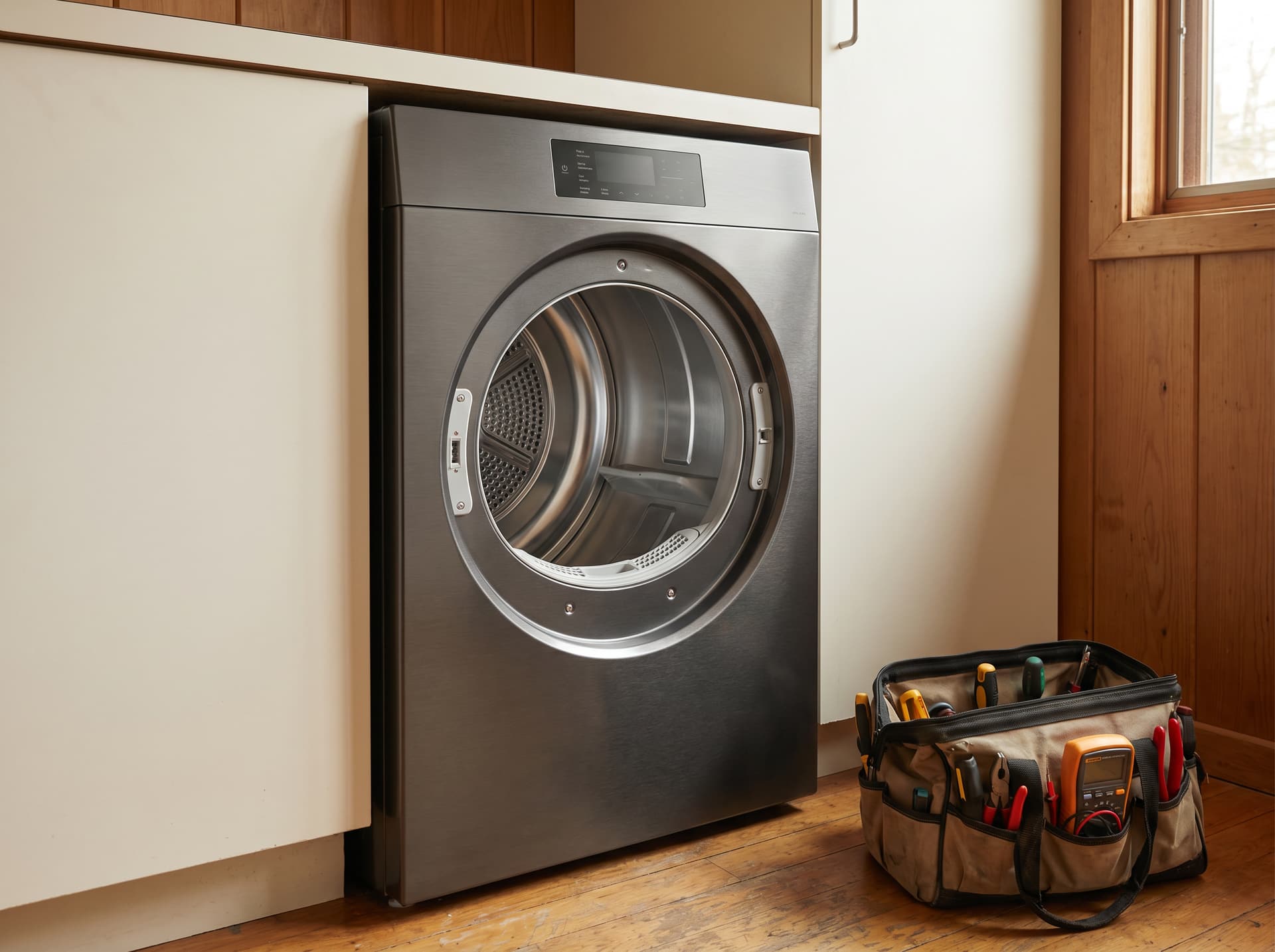

Miele · T1 heat-pump
Miele Dryer Repair in Los Angeles
Clothes still damp, cycles getting longer, a condensate or airway message — most T1 problems start with airflow, and that's where we start too.
AI Diagnostic · free · about a minute
Miele dryer acting up?
Describe it in your own words — get the likely causes and a repair cost range before you book.
Our Branches
10 service territories across Southern California
Before anything else
A heat-pump dryer lives or dies by its airflow
Miele T1 heat-pump dryers don't vent outside. Instead of a heating element and an exhaust duct, they use a small sealed heat-pump circuit to warm the air and to condense the moisture out of it, and the water goes into the condensate container in the top drawer or down a drain hose. That makes them gentle on clothes and economical, and it is why they fit in closets where a vented dryer can't go.
It also means the dryer depends on air moving freely through its filters and heat exchanger. When lint builds up in the lint filters at the door opening or in the plinth filter behind the flap at the bottom, drying slows down a little every week until the display asks you to clean the airways. Most of our “it doesn't dry anymore” calls on T1 dryers turn out to be airflow, not a failed part.
Model lines
Which Miele dryer do you have, and what tends to fail on it
The model number is on the type plate around the door opening. Heat-pump models end in WP; tell us if yours is stacked on a W1 washer and whether it drains into the container or a hose.
T1 heat-pump dryers
TWF 160 WP · TWI 180 WP · TXR 860 WP
The current T1 range, from the basic models to the top ones with touch controls and FragranceDos.
What we see fail: lint packed into the plinth filter and the heat exchanger area behind it, the condensate pump and its hose, door seals, and on older units the drum belt and support rollers.
Older Miele dryers
Earlier vented and condenser dryers that predate the T1. Many are still worth repairing; some electronics are no longer available, and we check before booking the repair.
What we see fail: heating elements and thermal cutouts on vented models, belts and rollers, and a clogged condenser on condenser models.
Stacked W1 and T1 pairs
Most Miele dryers we see are stacked on a W1 washer in a closet. A heat-pump dryer warms the room it sits in, so a closet with solid doors and no gap for air can stretch every cycle.
What we see fail: nothing in the dryer itself — the fix is airflow around the machine, which we check before suspecting a part.
Symptom to likely cause
What your Miele dryer is doing, and where we look first
| What you notice | Where the technician looks first |
|---|---|
| Clothes still damp, cycles longer every week | Lint filters, the plinth filter, the heat exchanger area behind it, air around the machine in a closet, then the drying sensors. |
| “Clean airways” on the display | The lint filters and the plinth filter first; if the message returns with clean filters, the heat exchanger area and the sensors. |
| Condensate container message keeps coming back | Container seated properly, a kinked or raised drain hose on plumbed installs, then the condensate pump. |
| Water on the floor | The drain hose connection, the container not pushed fully home, then the condensate pump and its hoses. |
| Drum doesn't turn, motor hums | Drum belt, support rollers, then the motor. |
| Squeal, rattle or scraping | Support rollers and drum seals, a coin or button in the airway, then the fan. |
| Won't start | Door closing properly and the door switch, power to the machine, then the control. |
The heat-pump circuit
Why we don't start with the heat pump
The heat pump in a T1 is a small sealed refrigerant circuit with its own compressor. It is the part owners worry about, and it is the part that fails least. A dryer that runs, warms the air a little and simply takes too long is almost always choked by lint or starved of room air.
So the diagnostic goes in order: filters and heat exchanger area, air around the machine, drainage of condensate, sensors — and only then the heat-pump circuit, confirmed with temperature readings before anything is quoted. If the sealed circuit itself has failed, we tell you plainly what the repair involves before you decide.
What you can check first
Five minutes before you call
- Clean both lint filters. Pull them out of the door opening, remove the lint, and if they look greasy or clogged, rinse them under warm water and let them dry.
- Clean the plinth filter. Open the flap at the bottom front, take out the plinth filter, rinse it, squeeze it out and put it back. Gently remove loose lint from the area behind it without bending anything.
- Empty the condensate container and push it fully back in. On plumbed installs, check the drain hose for kinks.
- Give it air. If the dryer is in a closet, leave the doors open for one cycle and see whether the time drops.
- Note the message and the program. The exact text on the display and how long the cycle ran helps us bring the right parts.
Please don't poke the heat exchanger fins with tools or a vacuum nozzle; they bend easily, and bent fins block the airflow you are trying to clear.
How the visit works
Diagnostic, written quote, then the repair
Miele dryer repairs are quoted after the diagnostic. A good share of T1 calls end with a thorough airway cleaning and no parts at all, and that is the first thing we rule out.
The residential diagnostic is $89, waived with repair. You get a written quote for parts and labor before any work starts, and every repair carries our 90-day warranty on parts and labor. BHGS #A49573, EPA 608 Universal certified (#1346255700410). We are an independent repair company, not part of Miele's own service network — if your Miele is still inside its factory warranty, call Miele first; after that, we are the faster call.
More Miele service
Other Miele repairs
FAQ
Miele dryer repair: questions owners ask
Why does my Miele heat-pump dryer take so long?
Most often because the airflow is restricted: lint in the filters at the door opening, a clogged plinth filter at the bottom, lint in the heat exchanger area, or a closet that traps warm air. Clean the filters, run a cycle with the closet open, and if it is still slow we check the heat exchanger area, sensors and the heat pump.
What does “Clean airways” mean on a Miele dryer?
The dryer has detected that air isn't moving through it freely. Clean both lint filters and the plinth filter behind the bottom flap. If the message comes back with clean filters, lint has built up further in, around the heat exchanger, and that is a service visit.
Does a Miele T1 need a vent?
No. A heat-pump dryer is ventless: the moisture is condensed and collected in the container in the top drawer or sent down a drain hose. It does need air around the machine, because it warms the room it sits in.
Why is there water on the floor near my Miele dryer?
Usually the condensate container isn't pushed fully home or a drain hose has come loose or kinked. If both are fine, the condensate pump or one of its hoses is the next check.
How much does Miele dryer repair cost?
The residential diagnostic is $89 and is waived when you go ahead with the repair. The repair is quoted in writing after the diagnostic, before any work starts, and carries a 90-day warranty on parts and labor.
Can the heat pump in a Miele dryer be repaired?
The heat-pump circuit rarely fails, so we confirm it with temperature readings before blaming it. When it has failed, we explain what the sealed-system repair involves and what it costs before you decide whether it makes sense for your machine.
Miele dryer taking forever? Call the branch nearest you.
Same-day visits when a technician is free. $89 diagnostic, waived with repair. Written quote before we start.