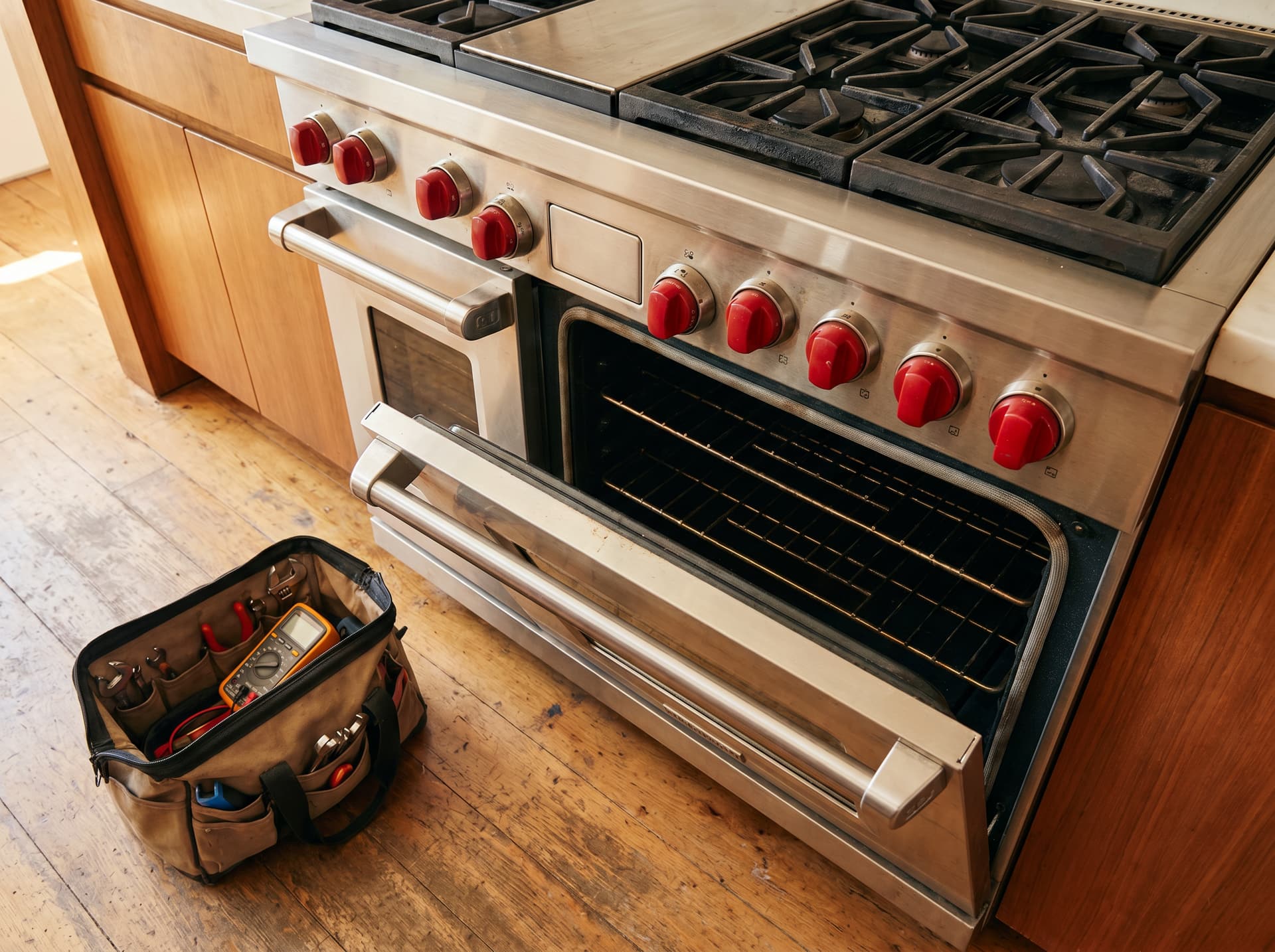
Wolf · DF dual-fuel · GR gas
Wolf Range Repair in Los Angeles
Burners that click and won’t light, a simmer that dies, ovens that won’t heat — on current DF and GR ranges and older pilot-light Wolfs.
AI Diagnostic · free · about a minute
Wolf range acting up?
Describe it in your own words — get the likely causes and a repair cost range before you book.
Our Branches
10 service territories across Southern California
How a Wolf range is built
Two burner tiers, spark re-ignition, and two kinds of oven
Current Wolf ranges use dual-stacked sealed burners: an upper ring for high heat and a separate lower ring for simmer, each fed through its own orifice. That is why a Wolf burner can roar on high and still hold a melt-butter flame on low — and why a burner problem is usually on one tier only. "Won't simmer" and "won't go high" are different repairs. Spark ignition re-lights a burner automatically if the flame is blown out, so the ignition system has more to sense than on an ordinary stove.
Underneath, the oven depends on which range you own. A DF dual-fuel range has an electric oven — elements, convection, a temperature probe. A GR all-gas range has a gas oven with an infrared broiler, lit by an igniter and gas valve. And plenty of Southern California kitchens still have older Wolf commercial-style ranges with standing pilots and open burners, which are a different repair again.
Model lines
Which Wolf range you have, and what tends to fail
The model and serial label is usually behind the kick panel at the bottom front or on the frame visible with the oven door open. Wolf revised parts across serial ranges, so the serial matters as much as the model.
DF dual-fuel ranges
DF304 · DF366 · DF364G · DF364C · DF484CG · DF486G · DF606CG
Gas burners over an electric convection oven, 30 to 60 inches wide, with griddle (G) or infrared charbroiler (C) options. 48- and 60-inch models have two ovens.
What we see fail: burner ignition switches and spark electrodes, the spark module, bake and broil elements, the oven temperature probe, the convection fan, self-clean latches.
GR all-gas ranges
GR304 · GR366 · GR364C · GR484CG · GR486G
Same dual-stacked burner top, with a gas oven and infrared broiler. Common where there is no 240-volt circuit behind the range.
What we see fail: the burner-side ignition parts above, plus oven ignition: an igniter that no longer gets hot enough to open the oven gas valve, and the valve itself.
Older commercial-style Wolf ranges
Standing-pilot, open-burner Wolf ranges
Heavy, simple ranges that predate the current sealed-burner designs. No spark module — a small flame at each pilot lights the burners, and a thermocouple proves the oven pilot before gas flows.
What we see fail: pilots that won't relight after the gas has been shut off, clogged pilot tubing, worn oven thermocouples. Parts take sourcing, but these ranges are very repairable.
Rangetops and cooktops
SRT sealed-burner rangetops · CG gas cooktops
The same burner and ignition system without an oven underneath, usually paired with Wolf wall ovens.
What we see fail: ignition switches, electrodes and spark modules. See our Wolf cooktop repair page.
Symptom to likely cause
What the range is doing, and where we look first
| What you notice | Where the technician looks first |
|---|---|
| One burner clicks but won't light | Burner cap seating, wet or dirty electrode, a blocked port, then that burner's electrode and ignition switch. |
| No burner clicks at all | Power to the range and the spark module, which feeds every burner. |
| Burner keeps clicking after it lights | Moisture or grease at the electrode stopping flame sensing, a shorted ignition switch on that valve, then the module. |
| Simmer flame goes out, or high flame is weak | The lower (simmer) or upper orifice and ports of that burner — the two tiers fail separately. |
| DF oven won't heat, or bakes off temperature | Bake element, the temperature probe (RTD), then the oven control relay. |
| GR oven slow to heat or won't light | The oven igniter: a weak igniter glows but never gets hot enough to open the gas valve. Then the valve. |
| Burners work, oven and display dead | Power to the oven circuit: a thermal cutoff, wiring and the oven control. |
| Older Wolf: pilots won't stay lit | Pilot tubing and orifices, pilot adjustment, and the oven thermocouple. |
Display codes and parts
Wolf range codes, and why we ask for the serial
- Err 00 — the control is in service (diagnostic) mode, not a failure. If it appears by itself after a power event, cycling the breaker usually clears it.
- 01 — the door lock or unlock switch wasn't sensed while the control drove the self-clean latch, often a stuck or heat-warped latch after a cleaning cycle.
- 0E — a power relay on the oven control reads closed when it should be open: the oven heats when it shouldn't or won't switch an element off. A control-level fault, confirmed against the wiring first.
An oven that runs hot or cold usually shows no code at all; that is the temperature probe drifting, which we measure rather than guess. On parts: the current Wolf burner ignition switch (813398) supersedes the earlier 807141 and is shared across DF, GR and sealed-burner rangetops, and the oven temperature probe (815572) is shared with Wolf wall ovens. Wolf generally supersedes retired part numbers instead of dropping them, which is why even older sealed-burner ranges stay repairable.
What you can check first
Before you call
- After cleaning, let the burners dry. Water in the burner base is the most common reason for clicking that won't stop; give it a few hours with the caps off.
- Reseat the caps. A cap sitting slightly off its base will click and not light, or light unevenly.
- Check power. Even an all-gas range needs electricity for spark ignition; a DF oven also needs its 240-volt breaker on.
- Older pilot range: if the gas was shut off, pilots must be relit by hand. If they won't stay lit after that, stop and call.
- Smell gas? Turn the knobs off, leave the house and call the gas company first.
From our job log
Recent Wolf range jobs
Taken from our job records, with names and addresses removed.
Santa Barbara · older Wolf commercial-style gas range with standing pilots
- What the owner reported
- The gas had been turned off and back on, and the pilot lights would not relight.
- What the technician found
- The oven thermocouple was worn out and the four open-top pilot burners and their pilot gas tubing needed replacing. Because of the range’s age, the correct parts had to be identified and sourced before the repair.
- What was done
- Replaced the oven thermocouple and the four open-top pilot burners with new pilot tubing; the range was put back in service.
How the visit works
Diagnostic, written quote, then the repair
Igniter replacement on a range typically runs $150–$240, and a Wolf oven temperature probe (RTD) $180–$280. Spark modules, valves, elements and controls are quoted in writing after the diagnostic, once we have the model and serial.
The residential diagnostic is $89, waived with repair. You get a written quote for parts and labor before any work starts, and every repair carries our 90-day warranty on parts and labor. BHGS #A49573, EPA 608 Universal certified (#1346255700410). We are an independent repair company, not part of Wolf's own service network — if your Wolf range is still inside its factory warranty, call Wolf first; after that, we are the faster call.
FAQ
Wolf range repair: questions owners ask
Why does my Wolf burner keep clicking after it lights?
Wolf spark ignition keeps sparking until it senses flame, and re-sparks if the flame goes out. Continuous clicking usually means moisture or grease at the electrode is stopping that sensing — very common right after cleaning — or the ignition switch on that burner's valve has shorted. Drying the burner fixes the first; the second is a switch replacement. The current Wolf switch (813398) supersedes the older 807141.
My Wolf burner won't hold a low simmer. What's wrong?
Wolf sealed burners are dual-stacked: the lower tier is a separate simmer burner with its own orifice. If the simmer flame dies or is uneven while high heat works, the problem is in that lower tier — a partly blocked orifice or ports, or the valve's low setting — not the burner as a whole.
What's the difference between repairing a DF and a GR Wolf range?
The burner tops are the same. The ovens are not: a DF dual-fuel oven is electric, so we check elements, the temperature probe and the oven control; a GR oven is gas, so a no-heat oven usually means an igniter that no longer gets hot enough to open the gas valve, or the valve itself.
Is an old Wolf range with standing pilots worth repairing?
Usually yes. These ranges are mechanically simple and heavily built. Typical repairs are pilot burners, pilot tubing and oven thermocouples. Parts for older units can take time to source, so we identify them first and quote before ordering.
What do Err 00, 01 and 0E mean on a Wolf range?
Err 00 means the control is in service mode, not failed. 01 means the self-clean door lock switch wasn't sensed in time, often a stuck latch. 0E means an oven power relay reads closed when it should be open, a control-level fault. Off-temperature baking usually shows no code at all; that is typically the temperature probe.
How much does Wolf range repair cost?
The residential diagnostic is $89 and is waived when you go ahead with the repair. An igniter typically runs $150–$240 and a Wolf oven temperature probe $180–$280; everything else is quoted in writing after the diagnostic. Repairs carry a 90-day warranty on parts and labor.
Wolf range down? Call the branch nearest you.
Same-day visits when a technician is free. $89 diagnostic, waived with repair. Written quote before we start.