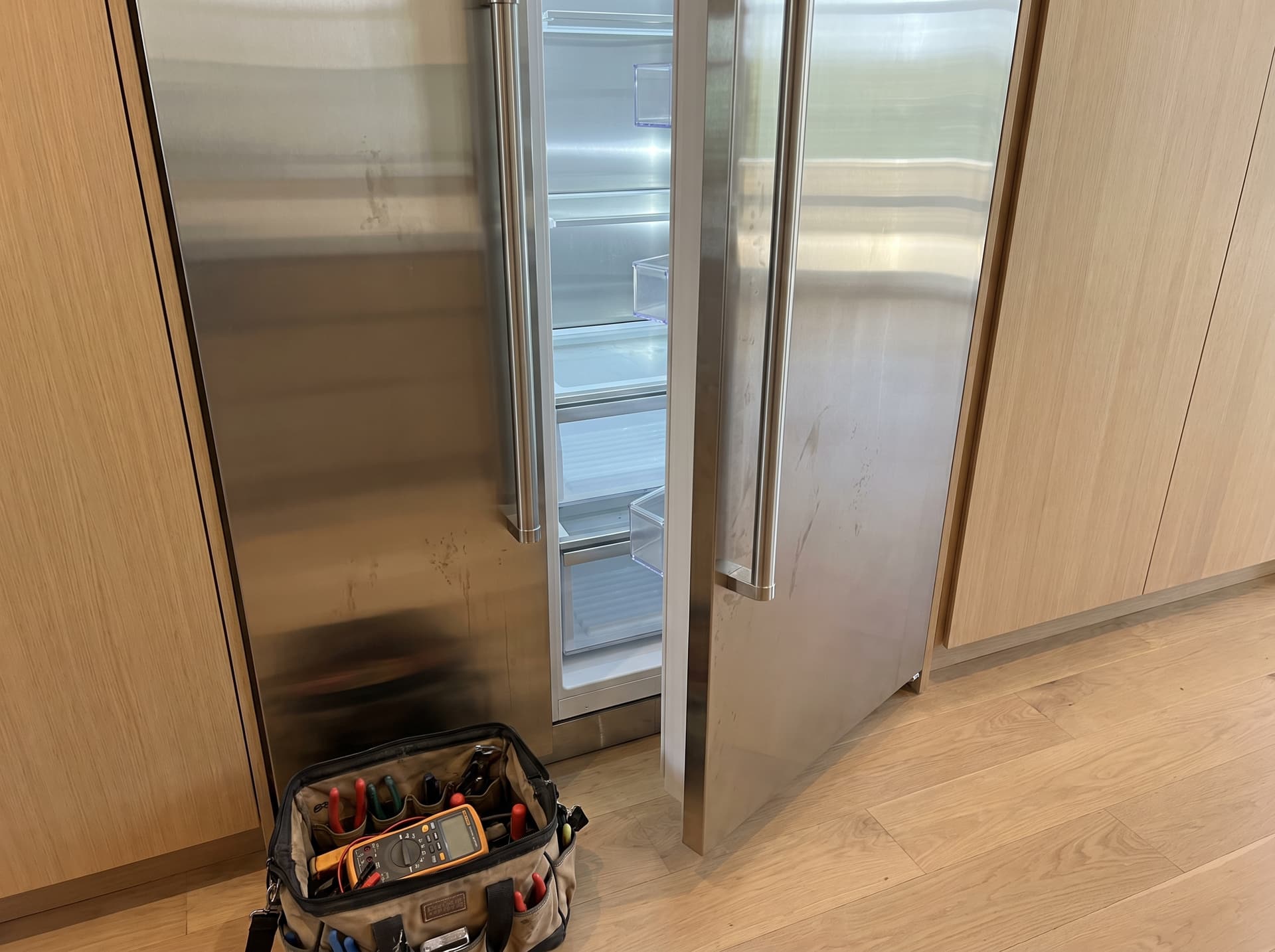

Sub-Zero · Classic · Designer · PRO
Sub-Zero Refrigerator Repair in Los Angeles
Warm refrigerator side, frosted coil, loud condenser fan or a freezer drifting up — diagnosed circuit by circuit, with the unit left in its cabinetry.
AI Diagnostic · free · about a minute
Sub-Zero refrigerator acting up?
Describe it in your own words — get the likely causes and a repair cost range before you book.
Our Branches
10 service territories across Southern California
Before anything else
The first question on a Sub-Zero: which compartment is warm?
Most full-size Sub-Zero refrigerators use what the company calls dual refrigeration: the fresh-food side and the freezer side each have their own sealed cooling circuit, with their own evaporator and fan. That design is why a Sub-Zero holds temperature and humidity so well, and it is also why the symptom tells us so much. A warm refrigerator side with a cold freezer points at one circuit; both sides warming together points at something they share — usually the condenser and its fan in the machine compartment, or power and controls.
On Classic built-ins the machine compartment sits at the top, behind the grille, which means the condenser, condenser fan and compressor area can be reached from the front with the unit still in its cabinetry. That is also where the most avoidable Sub-Zero failure starts: a condenser coil packed with dust makes everything up there run hot and hard.
Model lines
Which Sub-Zero do you have, and what tends to fail on it
The model and serial number are on a tag inside the refrigerator, usually near the top of the fresh-food compartment. Reading them to us on the phone lets the technician bring the right parts on the first visit.
Classic built-ins
BI-36U · BI-36UFD · BI-36R · BI-42SD · BI-48SD · CL3650U · CL4250SD · CL4850SD
The grille-on-top built-ins: over-and-under, French door, side-by-side and single-compartment versions in 30–48 inch widths. Older units carry BI model numbers; newer Classic models use the CL prefix.
What we see fail: dusty condenser and tired condenser fan motors, evaporator fans on one compartment, defrost faults that ice a coil, door gaskets and hinge wear, ice maker and water valve problems on the freezer side.
Designer (integrated) columns
IC-30R · IC-36R · IC-30FI · IC-24FI · IT-30R · DEC3050R
Fully panel-ready refrigerator and freezer columns that disappear into the cabinetry. Each column is a separate appliance with a single cooling circuit, so a warm refrigerator column and a cold freezer column next to it are two unrelated stories.
What we see fail: evaporator fan and defrost faults, ice makers in freezer columns, door closers and panel alignment that break the seal, condensation where two columns meet.
PRO 48 and PRO 36
PRO4850 · PRO4850G · PRO3650 · PRO3650G
Stainless pro-style models, often paired with a Wolf range. Heavy doors and, on the G versions, a glass refrigerator door.
What we see fail: the same airflow and defrost items as the Classic line, plus more wear on hinges and gaskets because of door weight.
Undercounter and drawers
UC-24R · UC-24BG · ID-24R · ID-30R
Island and bar refrigeration. Compact machine compartments that choke quickly when the front grille is blocked or the toe-kick collects dust.
What we see fail: condenser airflow, drawer slides and gaskets, fan motors.
Pre-2000s Sub-Zero units (older 500- and 600-series built-ins) can still often be repaired, but some parts are discontinued. We check availability before booking the repair, not after.
Symptom to likely cause
What your Sub-Zero is doing, and where we look first
| What you notice | Where the technician looks first |
|---|---|
| Refrigerator side warm, freezer still cold | That circuit only: the fresh-food evaporator fan, a frosted-over evaporator from a defrost fault, then the start components on that circuit's compressor. |
| Freezer warm or soft ice cream, refrigerator fine | Freezer evaporator fan, defrost heater and defrost thermostat, a door or drawer not sealing on the freezer side. |
| Both sides slowly warming | Shared items: condenser coil packed with dust, condenser fan not spinning, power supply, then the control. |
| Loud drone, hum or rattle from the top grille | Condenser fan motor and blade, fan mounting and rubber isolators, anything touching the shroud; compressor mounts after that. |
| Frost on the back wall, or a coil that never clears | Defrost system — heater, defrost thermostat or sensor — and the drain that carries defrost water away. |
| Water under the crispers or on the floor | A blocked or frozen defrost drain; on dispenser models, the water line and fill tube. |
| Door sweating, frost along the gasket | Gasket condition, door alignment and hinge or closer wear. On columns, the panel can pull a door out of square. |
| Ice maker stopped, everything else cold | Water supply and filter, a frozen fill tube, the water inlet valve, then the ice maker module itself. |
Sealed-system notes
Most warm Sub-Zeros are not a sealed-system failure
Owners often assume a warm Sub-Zero means the compressor is gone. In practice, most warm-compartment calls end at airflow and defrost: a fan that stopped, a coil buried in frost, a condenser that cannot shed heat. Those are component repairs done in one or two visits.
Signs that point toward the sealed system instead: the compressor runs constantly while the evaporator stays only partly frosted after a defrost, or an evaporator that should be cold is warm with its fan running. Sealed-system work means finding the leak or the failed compressor, brazing, evacuating the circuit and weighing in the exact refrigerant charge. On a dual-refrigeration Sub-Zero, that work touches one circuit; the other keeps its factory charge.
Sub-Zero's own warranty covers sealed-system parts for considerably longer than the rest of the refrigerator. If your unit is young enough that the sealed system may still be covered, have the serial number ready and check with Sub-Zero before paying anyone for compressor work.
What you can check first
Five minutes before you call
- Note which side is warm and, if you have a thermometer, the temperature in each compartment. It changes which parts we bring.
- Look behind the top grille on a Classic built-in (it lifts or swings up). If the condenser coil is grey with dust, that alone can explain a warm unit. Switch the unit off before brushing it, and keep your hands off the fan.
- Listen at the grille. A running compressor with a silent condenser fan, or a fan that changes pitch and rattles, is worth telling us.
- Check the seal. Close a dollar bill in the door at a few points around the gasket; if it slides out with no drag, that spot is not sealing. Make sure nothing inside is holding a door or drawer open.
- Ice maker only? Confirm the water supply valve is open and note when the filter was last changed.
Please don't chip ice off the evaporator or use a heat gun inside the cabinet; the coil and the plastic liner are easy to puncture.
From our job log
Recent Sub-Zero refrigerator jobs
Taken from our job records, with names and addresses removed.
Beverly Hills · Sub-Zero built-in, machine compartment at the top
- What the owner reported
- The refrigerator had stopped cooling.
- What the technician found
- The condenser fan motor in the top machine compartment had failed and the condenser coil was loaded with dust, so the unit could not shed heat.
- What was done
- Replaced the condenser fan motor and cleaned the condenser; cooling came back. Weeks later the owner reported that the new fan droned loudly — the enclosure above the unit was amplifying it — so we went back under our 90-day warranty, at no charge, to check the fan mounting, blade clearance and rubber isolators.
How the visit works
Diagnostic, written quote, then the repair
A routine Sub-Zero condenser cleaning typically runs $180–$280. Repairs beyond that depend on the part and the model, so we quote them after the diagnostic rather than guessing over the phone. Classic built-ins are almost always repaired in place through the top grille; when a column or built-in has to come out of its opening, the quote says so up front.
The residential diagnostic is $89, waived with repair. You get a written quote for parts and labor before any work starts, and every repair carries our 90-day warranty on parts and labor. BHGS #A49573, EPA 608 Universal certified (#1346255700410). We are an independent repair company, not part of Sub-Zero's own service network — if your Sub-Zero is still inside its factory warranty, call Sub-Zero first; after that, we are the faster call.
More Sub-Zero service
Other Sub-Zero repairs
Sub-Zero repair (all products)
Every Sub-Zero line we work on, in one place.
Sub-Zero built-in refrigerator repair
Panel-ready installs, column pairs and cabinetry-safe access.
Sub-Zero wine cooler repair
Wine columns and undercounter wine storage.
Sub-Zero ice maker repair
Built-in ice makers and freezer-side ice production.
FAQ
Sub-Zero refrigerator repair: questions owners ask
Why is my Sub-Zero refrigerator side warm when the freezer is still cold?
On a dual-refrigeration Sub-Zero the two compartments have separate cooling circuits, so the problem is almost always on the refrigerator circuit alone. The usual causes are the fresh-food evaporator fan, an evaporator that has iced over because of a defrost fault, or the start components on that circuit's compressor. We test that circuit and leave the working freezer side alone.
My Sub-Zero got very loud after a fan was replaced. Is that normal?
A condenser fan should be audible but not droning. Noise after a fan replacement usually comes from the mounting: a blade close to the shroud, a missing or hardened rubber isolator, or the fan housing touching a panel. Built-in installs can also amplify the sound through the cabinetry above the grille. It is a mounting and vibration check, and if we did the original repair it falls under our 90-day warranty.
Does a warm Sub-Zero mean the compressor is dead?
Usually not. Most warm-compartment calls are airflow or defrost problems — a stopped fan, a frosted coil, a dusty condenser. Sealed-system work is needed when the circuit has lost refrigerant or the compressor has failed, and we confirm that with measurements before quoting it. Sub-Zero's warranty on sealed-system parts runs well past the general warranty, so check your serial number with Sub-Zero first if the unit is young.
Do you have to pull my built-in Sub-Zero out of the cabinetry?
Rarely. On Classic built-ins the condenser, condenser fan and compressor area are reached from the front through the top grille, and fans, defrost parts, gaskets and ice makers are serviced from inside the cabinet. Removal comes up mainly for some sealed-system repairs, and if it is needed the quote says so before work starts.
How much does Sub-Zero refrigerator repair cost?
The residential diagnostic is $89 and is waived when you go ahead with the repair. A routine condenser cleaning typically runs $180–$280. Other repairs are quoted in writing after the diagnostic, before any work starts, and carry a 90-day warranty on parts and labor.
What should I check before calling?
Note which compartment is warm, look at the condenser coil behind the top grille for dust (with the unit switched off), listen for whether the condenser fan is running, and make sure the doors are sealing. If only the ice maker stopped, confirm the water supply valve is open.
Sub-Zero running warm? Call the branch nearest you.
Same-day visits when a technician is free. $89 diagnostic, waived with repair. Written quote before we start.