Residential Outdoor · Wine Cellar Maintenance · LA Estates + Coast · Same Day
Wine Cellar Maintenance, Across Southern California
WhisperKOOL · CellarPro · Wine Guardian · Breezaire · Fondis · US Cellar Systems · Vinotheque · Sub-Zero. Annual & semi-annual service plans, coastal-tuned cadence, EPA 608 certified for refrigerant work. From $280 annual; collection-protective scheduling for cellars 500+ bottles.
AI Diagnostic · free · about a minute
Not sure what's wrong?
Describe it in your own words — get the likely causes and a repair cost range before you book.
Our Branches
10 service territories across Southern California
01, Why this matters
A wine cellar is a piece of HVAC equipment protecting an asset.
When an estate wine cellar goes neglected at an LA-area home, our techs at Same Day Appliance Repair trace the wear to a handful of patterns: condenser coils fouled until heat-exchange efficiency drops, fan-motor bearings showing early wear, control boards with the first traces of moisture, and door gaskets two years from leaking (replacement $180 to $280). Coastal Malibu and Pacific Palisades cellars take salt aerosol on the condenser on a 4-to-6-month clock while inland Bel Air ridge and Beverly Hills cellars run summer heat load. A $280 to $420 annual visit is cheaper than the $800 to $1,200 sealed-system repair it prevents. $89 emergency diagnostic, waived with repair. BHGS #A49573, EPA 608 Universal certified (#1346255700410).
The cellars we service across Southern California hold collections from $10,000 to well past $500,000. At the lower end that's a thoughtful 600-bottle holding of mostly Napa cabs and Burgundy village wines. At the upper end it's a curated 4,000-bottle cellar with First Growth Bordeaux verticals, mature Burgundy from the 1980s and 90s, and pre-1990 California heritage producers that aren't replaceable at any price. The cooling unit on the wall, a WhisperKOOL Extreme 8000, a CellarPro 4200VSx, a Wine Guardian ducted split, a Fondis SP series, is purpose-built HVAC running 18-22 hours per day, and it's the only thing standing between that wine and ambient summer air at 80-90°F and 35-45% RH.
Wine cellar cooling units are more reliable than people expect. A properly designed cellar with a properly sized unit will run 10-15 years on the original compressor with 7-10 years before any major component replacement. That reliability is conditional on regular maintenance, coil cleaning before fouling cuts heat-exchange efficiency, drain service before salt deposits restrict the line, refrigerant verification before a slow leak becomes a lost charge, control-board inspection before moisture migrates onto the relays. Skip maintenance for three or four years and the failures that should have shown up at year 12 start showing up at year 7. The economics are clear: a $300 annual service visit is cheaper than the $800-$1,200 sealed-system repair it prevents, and dramatically cheaper than the wine that fails to age properly when the cellar drifts off-spec for six months before anyone notices.
The 55°F target and 60-70% RH window aren't arbitrary, they're the conditions under which fine wine ages slowly enough to develop tertiary character without chemical degradation. A cellar drifting to 62°F accelerates aging on every bottle inside; one dropping to 48% RH dries corks until oxygen migrates past the seal. Maintenance keeps both numbers where they belong and catches the failures that would push them out of range before you pull a bottle and find it cooked.
This page is for wine cellar refrigeration maintenance specifically. For a freestanding wine cooler, see wine cooler repair. Parent hub: outdoor wine cellar repair. For an active failure needing same-day diagnostic, see Beverly Hills, Malibu, Bel Air, Pacific Palisades, or Newport Beach repair pages or call (424) 325-0520.
02, What we do on a maintenance visit
What our wine cellar maintenance service covers.
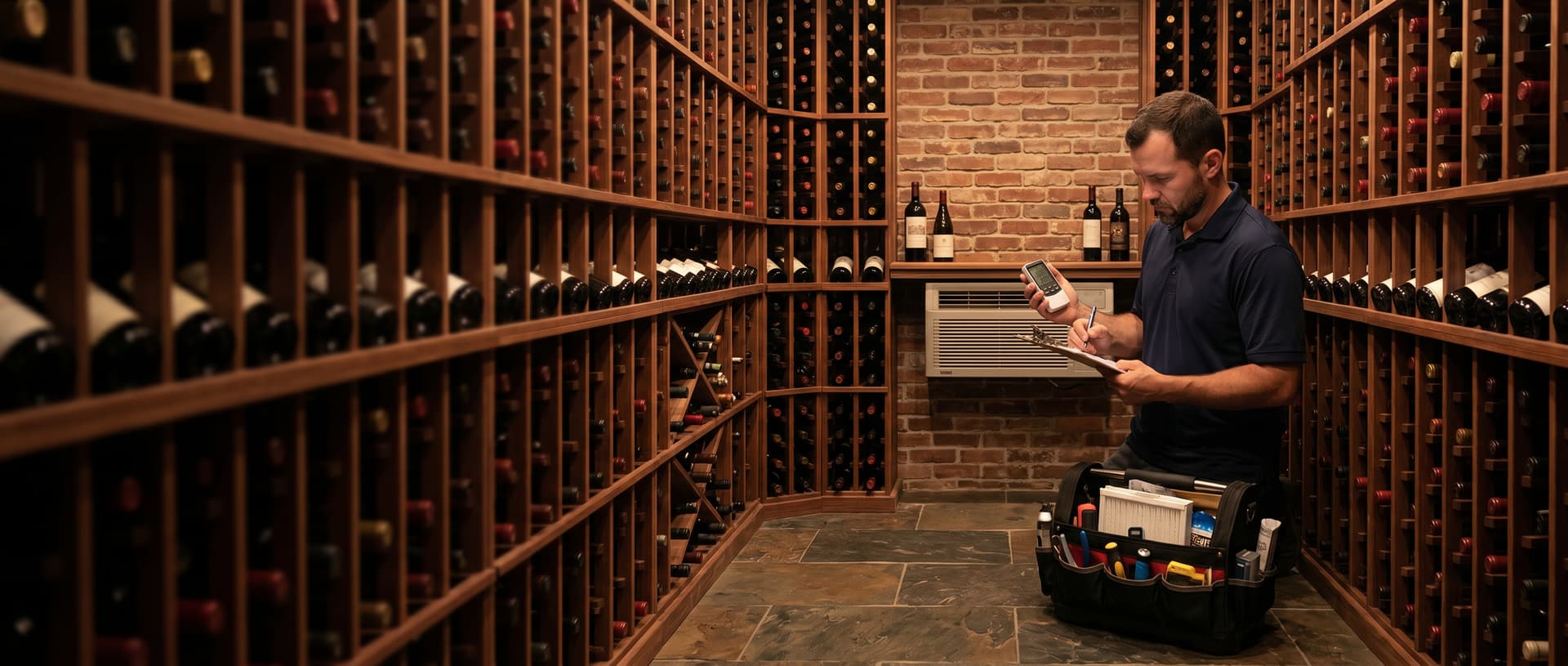
A structured ten-checkpoint procedure that takes 90 minutes for a single cabinet unit, 2-3 hours for a ducted split, and longer for multi-zone estate cellars. Every checkpoint generates a note in the written visit report, what we found, what we did, what we recommend.
1. Cooling unit inspection
Visual inspection of compressor, condenser fan, evaporator fan, refrigerant lines, mounting hardware, electrical connections. Compressor temperature spot-check. On split systems we inspect both indoor air handler and outdoor condensing unit; on ducted, duct insulation at accessible runs.
2. Condenser coil cleaning
Brush-and-rinse method appropriate for thinner cellar-unit fins, not the aggressive chemical cleaners HVAC techs use on AC condensers. Coil cleaning typically restores 10-20% of heat-exchange capacity on units 18+ months out from last service.
3. Evaporator coil inspection
Inspect for ice formation (diagnostic of humidity over-correction or refrigerant issues), check airflow, clean coil surface if needed. On CellarPro 4200VSx we specifically check for the known evaporator-freeze pattern in cellars with marginal vapor barriers.
4. Drain & condensate management
Drain pan removed, cleaned, inspected. Line flushed and cleared of salt deposits, biological growth, or sediment. Verify gravity termination has correct fall (1/4 inch per foot, builder installs often at 1/8 or less). Pan replacement quoted separately if cracked.
5. Refrigerant pressure verification
EPA 608 certified pressure check. Measure suction and discharge against manufacturer spec for the specific brand and refrigerant (R-134a, R-410A, R-407C), check superheat and subcooling. Top-off when a slow leak is identified and the leak path is repairable on the same visit.
6. Control board diagnostics
Visual inspection for moisture, salt residue, corrosion on relay contacts, bulged capacitors. Test diagnostic codes, verify firmware, apply conformal coating refresh on coastal installs. Ghost-temperature drift and unexplained relay chatter are early warnings we catch before full board failure.
7. Door seal & gasket inspection
Smoke-pencil leak test on the seal under cooling. Gasket conditioning treatment to extend rubber life. Hinge alignment, latch tension, door closure verified. Gasket replacement $180-$280 if degraded past conditioning.
8. Sensor calibration
Sensors calibrated against an independent reference meter at the wall location and at three bottle-level locations. Wall readings can be off by 3-5°F and 5-10% RH compared to where the wine actually sits.
9. Vibration & noise check
Wine cellar units are spec'd for low vibration to protect mature wine sediment. Excessive vibration traces to worn fan bearing, loose mounting, or line-set wear. Capacitor and start-relay early-failure modes show up audibly here before cooling failure.
10. UV light & vapor barrier screen
Where UV fixtures are present, inspect bulb life and seal integrity. Screen vapor barrier visually, wet drywall, ceiling drips, condensation on glass doors, label-edge curl. The diagnostic is part of every visit, and we do vapor barrier work too.
Refrigerant top-off: If pressure check identifies low charge and the leak path is repairable on the same visit (worn flare seal, service-port valve), we recover the existing charge, repair, vacuum-test, recharge to spec. EPA 608 certified, billed separately. Sealed-system leaks get quoted as a repair.
03, Cadence
How often should you service your wine cellar in Southern California?
Service cadence is set by exposure environment and collection scale, not by a one-size-fits-all calendar. Three patterns cover the territory.
Malibu · Pacific Palisades · Manhattan Beach · El Segundo · Newport Beach · Newport Coast · Laguna Beach
Beverly Hills · Bel Air · Pasadena · Calabasas · Hidden Hills · Thousand Oaks · Rancho Cucamonga · Riverside · Temecula
500+ bottles · regardless of location
The coastal-vs-inland line isn't a hard mile marker, bluff properties above PCH, the Conejo-Valley side of Malibu, and the inland edges of Manhattan Beach and Newport Beach see less salt exposure and may run on a longer interval. We set cadence on the first visit based on your specific install.
04, Brands
Wine cellar brands we maintain.
Eight brand families cover essentially every cellar we service across the seven-county footprint. Each runs a different parts chain, a different characteristic wear profile, and a different maintenance approach.
WhisperKOOL
Extreme 4000 tii · Extreme 8000 tii · Extreme 15000 tii · Platinum series
Most-specified brand in our service mix, particularly Extreme tii in 1,000-3,500 cu ft cellars. Focus: condenser fan motor wear year 5-9, control board moisture on coastal installs, drain management. Common parts on the truck.
CellarPro
1800QTx · 1800XTx · 3200VSx · 4200VSx · 6200VSxi · 8200VSi
Strong presence across estate cellars in Beverly Hills, Trousdale, Newport Coast, and the Conejo Valley. The 4200VSx evaporator-freeze pattern is checked first on every visit. 6200VSxi split requires service at both indoor and outdoor units.
Wine Guardian
Ductless (D025/D050/D088) · Ducted (D200/D300) · TTW · Sentry compact
Dominates larger estate cellars (3,000+ bottles) where the cooling unit is concealed in a mechanical room. Maintenance is more involved, line-set inspection, air-handler service, condensing-unit work, balance verification.
Breezaire WKL
WKL 2200 · WKL 3000 · WKL 4000 · WKL 6000 · WKL 8000
Workhorse self-contained units in older cellars (2002-2015). Mechanically simple, parts mature. Common items: condenser cleaning, fan motor and capacitor at year 8-10, gasket at year 6-8 on coastal.
Fondis
SP series · CHC series · Wine C25 · C50 · C100
French-manufactured premium cooling in higher-end Carbon Beach, Malibu Colony, Beverly Hills, and older European-design builds. Specialty parts (5-10 day lead). Units run 12-15+ years with proper maintenance.
US Cellar Systems
RM series · CM series · split · ducted commercial-grade
Heavy-duty cooling for commercial and large-residential estates, restaurants, hotels, retail wine programs, the largest residential cellars. Service closer to commercial HVAC: larger refrigerant volumes, longer line sets.
Vinotheque & Vinotemp
Vinotheque cabinet · Vinotemp Wine-Mate split · custom integrations
Share parts platforms with several OEMs, we identify the underlying source on the first visit. Wine-Mate splits common in mid-2000s installs. Cabinet units in dining rooms appear as supplemental storage.
Sub-Zero wine storage
427 series · 424 series · 24" undercounter · IW integrated
Sub-Zero wine storage in luxury kitchens and butler's pantries. Different service tree than dedicated cellar, closer to indoor refrigerator architecture. We service them on the same visit when both are in the home.
05, When maintenance isn't enough
Warning signs you need repair, not maintenance.
Maintenance is preventive, the appropriate response to a cellar that's working correctly. When a cellar is showing active failure symptoms, it needs a diagnostic, not a routine service visit. The five signals below should trigger a repair call rather than a maintenance booking.
Temperature above 60°F
Cellar reading 60°F or higher and not recovering to setpoint. The most common failure signal we get; almost always condenser fouling, fan motor failure, refrigerant undercharge, or compressor wear. Wine at risk above 62-64°F over multi-day windows. Diagnostic call, not maintenance.
Humidity below 50% or above 70%
Below 50% RH corks dry from the outside in and oxygen migrates past the seal. Above 70% RH mold grows on cork tops. Sustained excursion is a humidification module failure (Wine Guardian, Fondis), a dehumidification cycle fault (CellarPro, WhisperKOOL), or vapor barrier failure.
Condensation on bottles or walls
Visible condensation on glass doors, ceilings, interior walls, or bottle surfaces is almost always a vapor barrier defect, without an intact barrier the dew point lands on cellar surfaces. Diagnostic call confirms cause and rules out cooling-unit dehumidification fault.
Unusual compressor noise
Loud rattling, grinding, or any new noise the unit didn't make six months ago is a mechanical warning. Capacitor failure, start-relay degradation, fan-bearing wear, and compressor mounting issues show up audibly before they show up as cooling failure.
Ice formation on evaporator
Ice visible on the evaporator coil is a freeze-over fault. Common on CellarPro 4200VSx in cellars with marginal vapor barriers, but it appears on every brand under specific humidity-and-airflow conditions. Unit needs to be powered down and the underlying cause addressed.
Water under or behind the unit
Pooling water, drip stains on subfloors, or wet areas near the unit are condensate management failures, drain pan crack, line blockage, or condensate pump fault. Untreated, water migrates into adjacent cabinetry. Same-day diagnostic resolves the water issue and identifies any structural damage.
If any of the signals above match what you're seeing, call (424) 325-0520 for a same-day repair diagnostic ($89, applied toward repair) rather than booking maintenance. Maintenance is for cellars that are working; repair is for cellars that aren't.
06, Recent visits
Recent wine cellar maintenance visits.
Four representative maintenance scenarios from across the territory, neighborhood, cellar configuration, what we did, what we found, what comes next. Names and addresses omitted; the technical detail is typical of what we see on maintenance work in each context.
Beverly Hills, Annual service, WhisperKOOL Extreme 8000 tii
Cellar: 2,200 bottle walk-in in a North Beverly Hills inland basement. Mostly Napa cabs and Burgundy.
Findings: Last service 14 months prior. Condenser coil moderately fouled (pure dust, no salt). Drain clear, refrigerant within spec, control board clean. Wall sensor read 56°F; bottle-level reference showed 57.5°F front, 58°F rear, within drift but worth recalibrating.
What we did: Full coil cleaning, drain flush, refrigerant verification, sensor recalibration to 56°F at bottle level, gasket conditioning. Vibration check showed early condenser fan bearing wear, flagged for replacement next visit.
Cost & cadence: $340 standard annual. Continued annual cadence.
Malibu, Semi-annual coastal, CellarPro 6200VSxi split
Cellar: 3,200 bottle ducted-split, Malibu Colony beachfront with condensing unit in a hillside garage mechanical room. Significant Burgundy and a Champagne library.
Findings: Six months from last visit. Condenser coil with 4-month salt-and-dust paste-like film. Drain line beginning salt deposition at gravity termination. Line-set flares at the condensing unit showing early surface oxidation; no leak detected.
What we did: Brush-and-rinse coil cleaning, drain line flush with salt-deposit removal, line-set flare inspection and treatment, refrigerant verification, sensor calibration at three bottle-level locations, salt clean-down on the condensing unit cabinet.
Cost & cadence: $280 per visit, semi-annual. Will pull line-set flares at next visit if oxidation progresses.
Newport Coast, Semi-annual coastal, Wine Guardian D200 ducted
Cellar: 1,800 bottle hilltop estate, air handler in a mechanical chase above the cellar ceiling, condensing unit on a coastal-facing terrace. Mixed Bordeaux and California cabernet.
Findings: Five months from last visit. Line-set flares (replaced year 6) holding. Condenser fins showing year-9 coastal pitting but still functional. Air-handler coil clean. Humidification operational; 62-65% RH at bottle level, within target.
What we did: Coil cleaning, drain service on both air-handler condensate and condensing-unit drainage, refrigerant pressure check, humidification module flush, control electronics inspection. Started year-12 replacement budget conversation given coastal duty cycle.
Cost & cadence: $295 per visit, semi-annual.
Bel Air, Twice-yearly large collection, dual Wine Guardian zones
Cellar: 6,500 bottle estate with two zones (red cellar 58°F, white/Champagne cellar 52°F) on separate Wine Guardian ducted-split systems. First Growth Bordeaux verticals and mature Burgundy.
Findings: Six months from last visit. Both zones holding setpoint; 65% RH red, 62% RH white, within target. Condensing units showed normal inland dust. Air-handler coils clean. Control electronics clean across both zones. Door gasket on white-cellar entry showing year-8 hardening.
What we did: Full ten-checkpoint visit on both zones, coordinated through the estate manager on scheduling and post-visit reporting.
Cost & cadence: $580 per visit covering both zones, twice yearly. Gasket replacement scheduled for next visit, $220 add-on.
07, Pricing
Wine cellar maintenance pricing.
Maintenance pricing is set by cellar size, equipment type, and visit cadence. Standard annual service is $280-$420; coastal semi-annual runs $220-$320 per visit; large-collection twice-yearly runs $380-$580 per visit. Diagnostic-only call (when a cellar is failing rather than scheduled for maintenance) is $89, applied toward repair on approval.
Included: all ten checklist items, written visit report, sensor calibration against an independent reference meter, conformal coating refresh on coastal boards, gasket conditioning. Quoted separately: refrigerant top-off, parts replacement (gaskets past conditioning, sensors, capacitors, cracked drain pans), specialty cleaning, additional zones. Multi-cellar estates: discount on the second-and-subsequent cellar on the same visit. We set cadence for the right interval rather than locking customers into multi-year contracts.
08, FAQ
Wine cellar maintenance, frequently asked.
How often should I service my wine cellar in Southern California?
It depends on exposure and collection scale. Coastal cellars within roughly a mile of the Pacific (Malibu, Pacific Palisades, Manhattan Beach, Newport Beach, Laguna Beach) every 4-6 months because salt aerosol and marine-layer humidity drive condenser fouling and drain-line salt deposition on a faster clock. Inland cellars (Beverly Hills, Bel Air, Pasadena, Calabasas, Thousand Oaks, Rancho Cucamonga, Temecula) annually. Large collections of 500+ bottles twice yearly regardless of location, the consequence of a missed cooling cycle on a six-figure collection is too large to run on a longer interval. Our tech sets the cadence on the first visit based on your specific install.
What temperature and humidity should a wine cellar be?
55°F is the long-accepted target for long-term cellaring, with most professional cellars running between 55-58°F. Above 60°F accelerates aging and eventually damages tannin structure on age-worthy reds. Humidity target is 60-70% RH. Below 50% RH, corks dry from the outside in and oxygen migrates past the seal. Above 75% RH, mold grows on cork tops and label edges curl. Our maintenance visits include sensor calibration against an independent reference meter at multiple bottle-level locations, not just the wall sensor, wall readings can be off by 3-5°F and 5-10% RH compared to where the wine actually sits.
What's the difference between wine cellar maintenance and repair?
Maintenance is preventive, scheduled service to keep a working cellar working. Repair is reactive, a fix for a unit that has failed. Cellars on a regular maintenance program need fewer repairs because we catch failures before they happen, a fan motor showing early bearing wear, a control board with the first traces of moisture, a gasket two years from leaking. Maintenance is cheaper than repair over a 10-year horizon, and much cheaper than the wine you protect.
Can you service my cellar before I add to my collection?
Yes, a pre-stocking service visit is the highest-value visit we make. Before you load $50,000 or $200,000 of new wine, we verify the cooling unit is performing to spec, temperature and humidity are stable at bottle level, door seal is intact, drain is clear, and the vapor barrier shows no signs of failure. If anything is off-spec, you find out before the wine arrives. Written report delivered before the wine ships.
Do you cover all 7 Southern California counties?
Yes, Los Angeles, Orange, Ventura, Santa Barbara, San Bernardino, Riverside, and San Diego, routed to the closest technician from our branch dispatch grid. Coastal coverage runs from Carbon Beach through Pacific Palisades, Manhattan Beach, Newport Beach, Newport Coast, and Laguna Beach. Inland covers Beverly Hills, Bel Air, Pasadena, the Conejo Valley, the Inland Empire, and Ventura County. Remote estate cellars get coordinated around longer drive times, same service standard.
What about Fondis and other European cellar cooling units?
We service Fondis (French manufacturer) and Eurocave cabinet refrigeration. Maintenance follows the same checklist as on WhisperKOOL or CellarPro, coil cleaning, drain service, refrigerant verification, control-board inspection, but parts come through specialty European distribution with 5-10 day lead. Fondis units run 12-15+ years on properly designed cellars with regular maintenance. Older Fondis in pre-1990 estate cellars in Beverly Hills, Bel Air, and the Hollywood Hills are on our regular routes.
What does a wine cellar maintenance visit actually cover?
Ten checkpoints. (1) Cooling unit visual inspection. (2) Condenser coil cleaning. (3) Evaporator coil inspection. (4) Condensate drain pan and line service. (5) Refrigerant pressure verification (EPA 608 certified). (6) Control-board moisture and corrosion inspection. (7) Door and gasket integrity check with smoke-pencil leak test. (8) Sensor calibration at the wall and at three bottle-level locations. (9) Vibration check. (10) Salt-residue clean-down on coastal installs. Visit runs 90 minutes for a cabinet unit, 2-3 hours for a ducted split. Written summary after every visit.
Do you offer maintenance plans or one-time visits?
Both. Most homeowners start with a one-time visit ($280-$420 depending on cellar size) and roll forward into a recurring schedule once they see what we do. We don't lock customers into multi-year contracts. For multi-property estates we coordinate combined-visit scheduling and consolidate billing through estate managers. Discount on the second-and-subsequent visit applies for clients on a regular schedule. Call (424) 325-0520 with the cellar's location, size, and cooling brand, and we'll quote the right schedule on the call.
What if my cellar fails between maintenance visits?
Call us, same-day diagnostic across the territory when a technician is available, and active failures with collection-at-risk go first in the queue. The $89 emergency diagnostic is waived when you approve repair, so a maintenance customer calling between scheduled visits isn't paying twice. We carry the most common WhisperKOOL, CellarPro, Wine Guardian, and Breezaire parts on the truck so most repairs finish on the diagnostic visit. For specialty parts (Fondis, US Cellar Systems, older Vinotheque) we diagnose first, order parts, and return to complete, with bridge spot-cooling available if collection-at-risk justifies it.
Why do you check the CellarPro 4200VSx for evaporator freeze on every visit?
Because it has a known freeze-over pattern in cellars with marginal vapor barriers. Our techs at Same Day Appliance Repair inspect the CellarPro 4200VSx evaporator coil first on every visit for ice formation, since a freeze-over both signals a humidity or refrigerant issue and stops the unit from cooling until the underlying cause is addressed. Catching it during scheduled maintenance keeps it from becoming an off-spec event that puts the collection at risk. $89 emergency diagnostic, waived with repair.
My wall sensor reads 55 degrees, so why does my cellar still need sensor calibration?
Because the wall is not where the wine sits. Our techs at Same Day Appliance Repair calibrate sensors against an independent reference meter at the wall and at three bottle-level locations, and wall readings can be off by 3 to 5°F and 5 to 10% RH compared to the actual bottle environment. A cellar reading 55°F at the wall can be running 57.5°F front and 58°F rear, enough drift to matter on an age-worthy collection. $89 emergency diagnostic, waived with repair.
Ready to schedule a maintenance visit? Same-day across 7 Southern California counties.
From $280 standard annual service. Coastal semi-annual and large-collection twice-yearly programs available. WhisperKOOL, CellarPro, Wine Guardian, Breezaire, Fondis, US Cellar Systems, Vinotheque, Sub-Zero. EPA 608 certified for refrigerant work; written report after every visit.