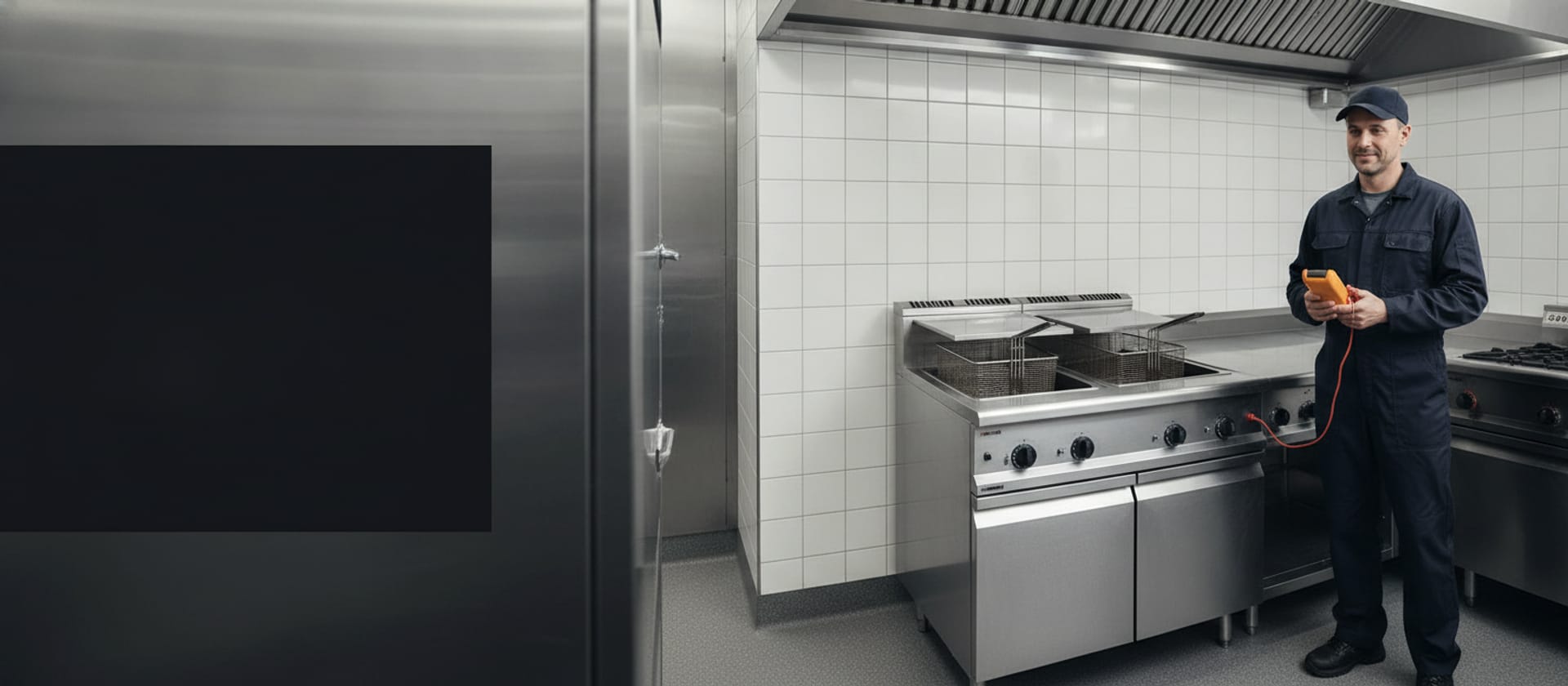
Commercial Kitchen · Fryer Temperature Recovery · BTU & Element Diagnostic
Commercial Fryer Recovery Slow
Fryer takes 4 minutes to recover after a basket drop instead of 90 seconds. Throughput is suffering during peak service. Slow recovery is usually burner fouling, gas pressure, oil quality, or probe drift, not compressor or major component failure. $120 commercial diagnostic, waived with repair. Most calls resolve at $280-440 with cleaning and tune.
AI Diagnostic · free · about a minute
Fryer acting up?
Describe it in your own words — get the likely causes and a repair cost range before you book.
01 · What recovery time should be
Spec by fryer type.
A commercial fryer that takes too long to recover temperature after basket drop in LA commercial kitchens usually traces to one of three root causes our techs at Same Day Appliance Repair diagnose first across Korean Fried Chicken corridors with continuous high-throughput operations, fast-casual fried chicken concepts, and LAUSD school nutrition Pitco fleet. (1) BTU drop from burner manifold carbon buildup or burner orifice partial blockage year 7+ — restricts gas flow to specific burner zones, recovery time degrades 30-50%. $180 to $290 per burner deep cleaning + manifold inspection. (2) Oil temperature probe drift year 5-7 — probe reads incorrectly relative to actual oil temperature, controller calls for less heat than needed. $240 to $380 probe replacement. (3) Gas pressure issues — LA gas line pressure varies by neighborhood and feeder line; pre-2000 LA gas infrastructure occasionally delivers below 7 inches water column, which is below minimum spec for heavy-duty commercial fryer. $220 to $380 regulator calibration (CARB + LADBS commercial gas equipment compliance work). About 1 in 5 'slow recovery' calls trace to supply pressure rather than fryer itself. Plus oil quality issues (degraded oil holds less BTU, slower recovery — $0 cost fix with fresh oil) and undersized installation infrastructure (gas line below spec). $120 commercial diagnostic at Same Day Appliance Repair, waived with repair.
Recovery time = the time from basket drop (oil temperature drops below setpoint) to oil temperature returning to setpoint. Operators measure this informally during peak service: the fryer 'feels slow' when recovery times stretch beyond what the kitchen workflow is built around.
- Open-vat 40-50 lb gas fryer (Pitco Solstice SG14, Frymaster MJ150, Vulcan LG400): 90-180 seconds typical from 350°F to 350°F after a 1.5-2 lb basket drop.
- High-efficiency / tube-fired fryer (Pitco Solstice Supreme, Frymaster FPRE): 60-120 seconds. Tube-fired design with multiple burner tubes increases heat transfer surface.
- Open-vat 25-30 lb electric (Frymaster CE Series, Wells F-67): 120-240 seconds. Electric heating elements have lower instantaneous heat output than gas.
- Pressure fryer (Henny Penny 600 series): different metric, full cycle time 9-13 minutes for chicken cooking; recovery between cycles 90-180 seconds.
When the actual recovery is 50% or more above these targets, the fryer needs service.
02 · Causes of slow recovery
Five things that drag recovery times.
Across LA County commercial fryer slow-recovery service calls our techs at Same Day Appliance Repair dispatch — Korean Fried Chicken corridors running continuous high-throughput Vulcan LG-series and Pitco Solstice c basket drops every 90 seconds, fast-casual fried chicken concepts (Raising Cane's, Popeyes, Chick-fil-A LA locations), LAUSD school nutrition Pitco fleet running 4-hour lunch service, plus stadium concession fryer fleet event-day operations (Dodger Stadium, SoFi Stadium) — the failure distribution clusters predictably. About 30 percent burner manifold carbon buildup or burner orifice partial blockage (year 7+, $180-$290 per burner deep cleaning). 20 percent oil temperature probe drift (year 5-7, $240-$380 replacement). 15 percent gas pressure issues (CARB + LADBS commercial gas equipment compliance, $220-$380 regulator calibration). 15 percent oil quality issues (degraded oil holds less BTU — $0 cost fix with fresh oil). 10 percent undersized gas line infrastructure (commercial requires 1" line minimum, undersized in pre-2000 LA buildings — plumbing contractor scope $800-$2,400). 10 percent burner tube wear on tube-fired units (year 10+, $380-$580 tube refurbish).
1. Burner orifice fouling and port carbon buildup
The leading cause across our fryer service calls. Kitchen grease, soot from incomplete combustion, and time accumulate deposits on the burner ports and the gas orifice. Symptom: yellow flame instead of clean blue, slow recovery, gradual decline noticed over 3-6 months. Burner cleaning + orifice service runs $280-380. Often we recommend a quarterly PM contract for high-volume restaurants because deferred maintenance is the leading cause of unscheduled recovery complaints.
2. Gas supply pressure below spec
Commercial gas fryers spec natural gas at 4-7 inches WC at the appliance regulator (varies slightly by model and rating plate spec). LP fryers spec 11-13 inches WC. Multi-appliance kitchens pulling more total gas demand than the gas line can deliver during peak service can drop pressure at any individual appliance. Diagnostic: manometer at the gas valve outlet, comparing measured to rating plate spec. Cause-side fixes: regulator replacement ($480-720), gas line upsizing (plumbing scope, separate trade).
3. Oil quality degradation
Oil thermal capacity and heat transfer characteristics change as oil oxidizes and breaks down through cooking cycles. Old oil takes longer to reach setpoint after a basket drop than fresh oil even when the burner is performing perfectly. Operators should filter daily and replace oil per the manufacturer's schedule (typically 7-14 days for high-volume operations). Sometimes 'slow recovery' calls resolve at the diagnostic with an oil quality conversation rather than parts replacement.
4. Temperature probe drift
The probe reads cooler than actual oil temperature, so the controller keeps calling for heat past the real setpoint. The fryer might be reaching setpoint quickly, but the display shows it still 30°F under target. We diagnose with a reference thermometer dipped in the oil compared against the controller display. Drift over 15°F warrants probe replacement, $280-440 typical. Common at year 5-9 on gas fryers.
5. Ventilation pulling combustion air
Kitchen hoods that exhaust more CFM than the building has makeup air create negative pressure affecting gas burner combustion. Symptom: pilot flickers when hood is on full, burner produces yellow tips, recovery slows during peak service when hood is at maximum. CA Title 24 requires makeup air balanced with hood exhaust. Fix is mechanical/HVAC trade (makeup air unit installation), not appliance repair. We diagnose to confirm and refer to HVAC partners.
03 · Recent slow-recovery calls
Composite stories from the route.
West Hollywood restaurant, Pitco Solstice Supreme SSH55 (year 5)
High-volume operation, basket-drop recovery had stretched from 90 seconds to 4 minutes over 6 months. Burner ports heavily fouled with grease and carbon, orifice partially restricted. 90-minute deep clean of burner assembly and orifice service. Tested under load, recovery back to 100 seconds. Set restaurant on quarterly PM contract. Total: $120 plus 90 minutes labor = $300.
Hollywood diner, Frymaster MJ150 (year 8)
Recovery stretched to 5 minutes during lunch rush. Manometer test at gas valve outlet: pressure at 3.2 inches WC (spec 4.5-5.0). Diagnosed regulator drift on the gas valve. Replaced regulator, retested at 4.7 inches WC, recovery back to 110 seconds. Total: $120 plus $580 part plus 75 minutes labor = $760.
Pasadena chicken franchise, Henny Penny 600 (year 7)
Pressure fryer cycle time stretching from 11 minutes to 14 minutes. Diagnosed temperature probe drift: reference thermometer showed actual oil 22°F higher than controller display. Replaced probe, recalibrated controller. Cycle time back to 11 minutes. Total: $120 plus $380 part plus 60 minutes labor = $560.
OC restaurant, Vulcan LG400 (year 9, high-volume)
Recovery times had stretched gradually over a year. Multi-issue diagnosis: burner orifice fouled (about 40% of the slowdown), oil age 12 days against operator's 7-day schedule (about 30% of the slowdown), pilot drafting from over-pulled hood (about 30%). Cleaned burner, advised oil schedule reset, referred customer to HVAC partner for makeup air assessment. Recovery improved 60% from cleaning + oil reset alone. Total: $120 plus $280 burner service plus 75 minutes labor = $475.
04 · Pricing
What this work costs.
| Repair | Typical Cost |
|---|---|
| Diagnostic + manometer + probe reference test | $120, waived with repair |
| Burner cleaning + orifice service | $280 to $380 |
| Gas regulator replacement | $480 to $720 |
| Temperature probe replacement | $280 to $440 |
| Pilot orifice cleaning + ignition tune | $200 to $280 |
| Heating element replacement (electric fryer) | $480 to $820 |
| Multi-component PM service (year 7+ unit) | $540 to $900 |
| Quarterly PM contract | Quote-based |
| Warranty | 90 days parts and labor |
05 · Why we get called back
What separates our slow-recovery diagnostic.
- Manometer test on every gas fryer recovery call. Gas pressure is invisible without measurement; competitors who skip this miss 30-40% of root causes.
- Reference thermometer probe drift test. 5-minute test that distinguishes probe drift from burner issues; saves customers from replacing the wrong part.
- Burner cleaning expertise across brands. Pitco Solstice, Frymaster MJ/RE, Vulcan LG, Imperial IFS, Henny Penny pressure burners. Each has slightly different access and orifice tooling.
- Oil quality consultation built into the diagnostic. Sometimes the answer is a changed oil schedule, not a parts replacement.
- Ventilation/makeup air diagnostic referral. When the issue is HVAC scope, we tell you and refer to partners; we don't oversell appliance work.
- BHGS #A49573 plus EPA 608 Universal certified #1346255700410. Verifiable.
- Same-day across LA, OC, Ventura. Phones answered 24/7.
06 · FAQ
Questions we hear on these calls.
Why is my fryer slow to recover temperature?
A commercial fryer that takes too long to recover temperature after basket drop usually traces to one of three causes our techs at Same Day Appliance Repair diagnose first across Vulcan LG300/LG400/LG500, Pitco Solstice, Frymaster H-series, and tube-fired commercial fryer architectures. (1) BTU drop from burner manifold carbon buildup or burner orifice partial blockage year 7+ — restricts gas flow to specific burner zones, recovery time degrades 30-50%. $180-$290 per burner deep cleaning + manifold inspection. (2) Oil temperature probe drift year 5-7 — probe reads incorrectly relative to actual oil temperature, controller calls for less heat than needed. $240-$380 probe replacement. (3) Gas pressure issues — LA gas line pressure varies by neighborhood and feeder line, pre-2000 LA gas infrastructure occasionally delivers below 7 inches water column. $220-$380 regulator calibration (CARB + LADBS commercial gas equipment compliance). About 1 in 5 'slow recovery' calls trace to supply pressure rather than fryer itself. Plus oil quality issues (degraded oil holds less BTU — $0 cost fix with fresh oil). 5-step cheap-first diagnostic at the $120 commercial diagnostic: oil quality visual check + recovery time test with known load + burner flame quality inspection + oil probe calibration + gas pressure manometer test.
How do I know if my fryer burner is underperforming?
Four signs point to burner BTU drop on commercial fryer operations. (1) Recovery time after basket drop exceeds spec — most commercial fryers spec recovery time 90-180 seconds from basket drop to back-to-setpoint; recovery exceeding spec indicates BTU drop. (2) Visible flame quality changes — flame should be predominantly blue with yellow tips; mostly yellow flame indicates incomplete combustion from carbon buildup or gas pressure issues. (3) Oil heating to setpoint but losing heat during cooking — burner can heat empty oil to spec but can't maintain under cooking load. (4) Soot accumulation on burner tube outlets or manifold — visible black deposit indicates incomplete combustion. Our techs at Same Day Appliance Repair test burner BTU output with infrared thermometer plus recovery time measurement plus flame quality visual on every slow-recovery service call. Burner manifold deep cleaning $180-$290 per burner resolves 60+ percent of BTU drop cases without parts replacement. Burner tube refurbish year 10+ runs $380-$580 on tube-fired units.
How fast should my commercial fryer recover after a basket drop?
Manufacturer specs vary by fryer type and oil capacity. Open-vat 40-50 lb capacity fryers (most common): 90-180 seconds to recover from 350°F to 350°F after a normal basket drop (1.5-2 lb of food). High-efficiency / tube-fired fryers: 60-120 seconds. Pressure fryers (Henny Penny): different metric (cycle time 9-13 minutes typical). When recovery slows past these targets, food cooks longer per basket, throughput drops, and oil quality degrades faster. The diagnostic looks for what changed: burner cleanliness, gas supply pressure, probe drift, oil quality, kitchen ventilation pulling combustion air.
What's the most common cause of slow recovery on a gas fryer?
Burner orifice fouling and burner port carbon buildup. Kitchen grease, soot from incomplete combustion, and time accumulate deposits on the burner that restrict gas flow and produce yellow flame instead of blue. The fryer is still 'heating' but heat output is reduced, recovery times stretch. Burner cleaning plus orifice service runs $280-380 and often returns recovery times to spec. We schedule this as a quarterly PM item for high-volume commercial fryers; deferred maintenance is the leading cause of unscheduled recovery-time complaints.
Can low gas pressure cause slow recovery?
Yes. Commercial gas fryers are spec'd for natural gas at 4-7 inches WC (water column) or LP at 11-13 inches WC at the appliance regulator. When supply pressure drops below spec (multi-appliance kitchen pulling more total demand than the gas line can deliver, regulator drift, restricted gas line), the burner runs at reduced BTU output and recovery slows. Diagnostic with a manometer at the appliance gas valve outlet, comparing to spec. Repair depends on the cause: regulator replacement runs $480-720, gas line upgrade is plumbing scope and quoted separately.
Why does old oil cause recovery problems?
Two reasons. (1) Oil thermal capacity drops as oil oxidizes and breaks down: the same BTU input takes longer to bring degraded oil back to setpoint than fresh oil. (2) Oil viscosity changes with degradation, affecting heat transfer from burner tubes (in tube-fired designs) into the cooking medium. Oil should be filtered daily and replaced per the operator's oil management schedule (typically every 7-14 days for high-volume operations). Recovery complaints often resolve at the diagnostic with an oil quality conversation rather than parts replacement.
How does ventilation affect fryer recovery?
Kitchen ventilation hoods that pull more CFM than the building has makeup air create negative pressure that affects gas burner combustion. Symptom: pilot drops or flickers when hood is on full, burner produces yellow tips, recovery slows during peak service. CA Title 24 requires makeup air balanced with hood exhaust; older buildings retrofit to current code can have this issue. Fix is mechanical/HVAC trade (makeup air unit installation), not appliance repair. We diagnose to confirm the issue is ventilation rather than the fryer, and refer to HVAC contractors who handle makeup air work.
What does temperature probe drift look like?
The probe reads cooler than actual oil temperature, so the controller keeps calling for heat past the real setpoint. Symptom: oil overheats (food browns too fast, oil smokes), and after the basket drop the apparent recovery time is actually fine but the displayed temperature is wrong. Diagnostic with a reference thermometer dipped in the oil compared against the controller display. Drift over 15°F warrants probe replacement, $280-440 typical. Common at year 5-9 on gas fryers, year 4-7 on electric.
Is slow recovery a fire hazard?
Indirectly. Slow recovery in itself isn't a fire issue, but the underlying causes can be: burner producing yellow flame from clogged orifice indicates incomplete combustion (CO and soot), which is both an indoor air quality concern and a long-term fryer maintenance issue. Hi-limit trips from elevated oil temperatures (probe drift causing overheat) are a fire-prevention safeguard but not the desired operating condition. We address the root cause rather than just resetting the symptom. We coordinate with LA Fire Marshal documentation when the operator needs records of corrective action.
07 · Related
More commercial fryer service.
Recovery slow? Call today.
Same-day across LA, OC, Ventura. $120 commercial diagnostic waived with repair. BHGS #A49573, EPA 608 Universal #1346255700410. Phones answered 24/7.