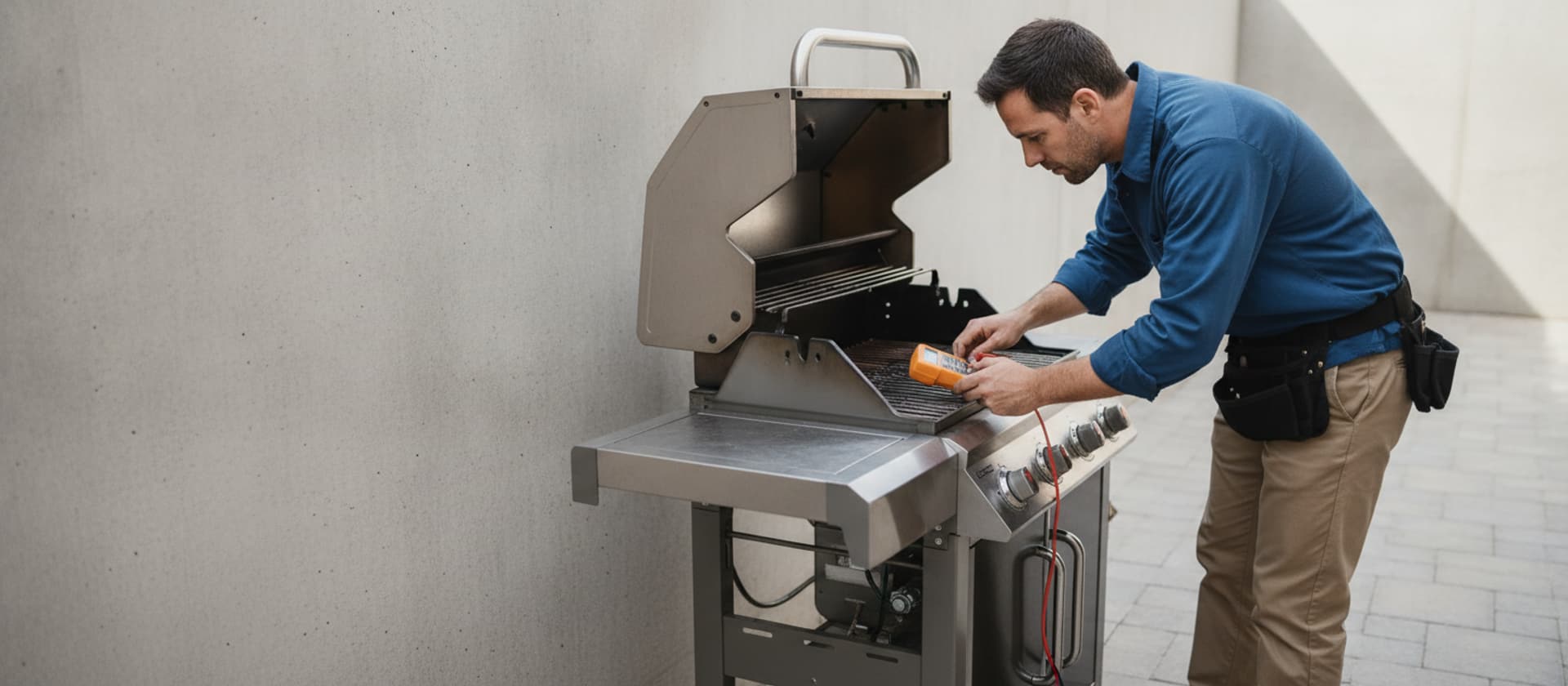
Outdoor Service · Gas Grill Low Heat · Low Flame Diagnostic
Gas Grill Not Getting Hot? Start With the Regulator
A weak flame that won't climb on high is almost always a tripped regulator. Reset it in a minute. $89 outdoor diagnostic. Same-day across LA, OC, Ventura.
AI Diagnostic · free · about a minute
Not sure what's wrong?
Describe it in your own words — get the likely causes and a repair cost range before you book.
Our Branches
10 service territories across Southern California
01 · The most common answer
Weak flame on every burner? Reset the regulator first.
When a propane grill won't get hot — a weak flame that won't climb even with every burner cranked to high — the number-one cause is a tripped regulator, also called bypass mode or the safety trip. The regulator's excess-flow safety senses a gas surge (usually from opening the tank valve while the burners were on) and throttles the gas down to a trickle. It's not a broken grill, and it's an operator-safe reset: turn all burners OFF, close the tank valve, disconnect the regulator, open the lid, wait 30 to 60 seconds, reconnect hand-tight, open the tank valve slowly, then light. That fixes most low-flame grills without a single part.
If the flame is still weak after a couple of clean resets, the regulator itself is worn out and needs replacing — an inexpensive part. Beyond the regulator, the other real causes of low heat are clogged burner ports, a nearly empty or very cold propane tank, or a kinked hose. This page walks the reset step-by-step, then the rest of the checks, then the gas-safety rules that always come first. For the deeper regulator and natural-gas-conversion detail, see our grill regulator issues page.
$89 outdoor diagnostic, waived with repair. BHGS #A49573, EPA 608 Universal #1346255700410. Related symptoms: uneven temperature, burner not igniting. Parent: built-in grill repair.
02 · The regulator reset
The one-minute fix, step by step.
- Turn all burner knobs OFF.
- Turn the propane tank valve fully OFF.
- Disconnect the regulator coupling from the tank (counter-clockwise).
- Open the grill lid — never reset or light with the lid closed.
- Wait about 30 to 60 seconds for the internal excess-flow valve to release.
- Reconnect the regulator hand-tight — snug by hand, no wrench, don't over-torque.
- Slowly open the tank valve — a quarter turn, pause a few seconds, then open it all the way.
- Light the grill and bring the burners to high. Full, steady flame means the reset worked.
Optional purge step: some grill makers add a step where you briefly turn the burners to high (with the regulator disconnected) to bleed off residual gas before reconnecting. Sources differ on whether it's needed and on the exact wait time, so treat it as optional — the part that always matters is: burners off, tank off, disconnect, wait, reconnect hand-tight, open the tank slowly, then light.
Prevention: always open the tank valve slowly and with the burners off, and turn the burners off before you close the tank — that keeps the pressure balanced and stops the safety from tripping in the first place. If the grill still runs weak after two or three clean resets, the regulator has fatigued and needs replacement.
03 · The other causes
If the reset didn't do it.
- Clogged burner ports or a spider-web blockage. Spiders and insects love to nest in venturi tubes, and grease clogs the burner ports — both starve the flame. You can brush the ports clear and clean the venturi tubes with a venturi brush or pipe cleaner per your grill's manual. (Operator.)
- Low or nearly empty tank. A tank running low delivers weak pressure. Check the level and swap or refill it. (Operator.)
- Very cold tank. In cold weather propane vaporizes slowly and the regulator can frost over, cutting output. Keep the cylinder upright, shaded, and not overfilled. (Operator.)
- Kinked, cracked, or aged hose. Rubber hoses harden and microcrack over the years. Inspect the full length and the fittings; replace a damaged hose assembly. (Operator inspect / replace.)
- Corroded or worn burner tubes. Burners eventually rust through and won't carry a full flame; the OEM burner part is replaceable, but the gas connections behind it are technician territory.
Technician only — never DIY: the gas control valve internals, the burner orifices (never drill or re-size an orifice yourself), and any fixed gas-line or manifold work. A wrong orifice or a nicked gas line risks a leak, carbon monoxide, or fire. A propane-to-natural-gas conversion also belongs to a licensed pro with the OEM kit and a pressure check — not a DIY job. Our techs carry EPA 608 Universal certification for that side of the work.
04 · Gas safety first
The leak test — and the rules that don't bend.
Any time you disconnect and reconnect gas, check for leaks with the soapy-water test — never a flame. Mix roughly one part dish soap to three or four parts water in a spray bottle. With the burners off, slowly open the tank valve and spray the solution on every hose connection and the fittings between the tank valve and the regulator. Bubbles forming anywhere mean a leak — bigger bubbles, bigger leak. Close the valve, tighten the connection, and re-test.
Never do these: never check for a leak with a match, lighter, or any flame. Never keep using a grill you suspect is leaking — shut off the tank valve if it's safe to reach, stay away from flames, sparks, and electrical switches, move clear, and call a professional or your propane supplier. If bubbles keep appearing after you tighten a fitting, stop and get it serviced.
05 · When to call us
Reset didn't hold, or it's past the operator line.
If the regulator reset doesn't hold, the burners are corroded, or the trouble is in the gas valve, an orifice, or the manifold, that's our call. Our techs at Same Day Appliance Repair check the regulator, tank, and hoses first — because that's where most low-flame calls resolve — then the burners and venturi tubes, and we verify manifold pressure and leak-test every fitting on the gas side. We service the pro-tier built-in brands across LA, OC, and Ventura, and we don't sell you burners you don't need.
More grill help: the deep regulator issues page (bypass, NG regulator drift, LP-to-NG conversion), uneven temperature, burner not igniting, and the built-in grill repair hub. $89 outdoor diagnostic, waived with repair. Book online or call (424) 325-0520.
06 · FAQ
Gas grill low heat: common questions.
Why is my gas grill not getting hot?
On a propane grill, the most common cause of low heat — a weak flame that won't climb even with every burner on high — is a tripped regulator, also called bypass or the safety trip. The excess-flow safety in the regulator senses a surge (usually from opening the tank valve with the burners on) and throttles gas down to a trickle. The fix is a reset: turn all burners OFF, close the tank valve, disconnect the regulator, open the lid, wait 30 to 60 seconds, reconnect hand-tight, open the tank valve slowly, then light. If it's still weak after a clean reset, the regulator itself has failed and needs replacement. Other causes are clogged burner ports, a nearly empty or very cold tank, or a kinked hose. $89 outdoor diagnostic, waived with repair.
How do I reset a gas grill regulator (bypass mode)?
Turn all burner knobs OFF. Turn the propane tank valve OFF. Disconnect the regulator coupling from the tank (counter-clockwise). Open the grill lid. Wait about 30 to 60 seconds for the internal safety to release. Reconnect the regulator hand-tight only — no wrench. Slowly open the tank valve a quarter turn, pause a few seconds, then open it fully. Now light the grill normally and bring the burners to high. Some manufacturers add an optional purge step (briefly run the burners on high while disconnected to bleed residual gas); it's optional and sources differ, so the load-bearing sequence is off, off, disconnect, wait, reconnect, slow-open, light. If the flame is still weak after two or three clean resets, replace the regulator.
My grill only reaches a low temperature even on high — is it the burners?
Usually not. When every burner is weak at the same time, the problem is upstream of the burners — almost always the regulator in bypass mode, or a gas-supply issue like a low or cold tank. Burners themselves tend to fail one at a time, not all at once, and that shows up as one weak or uneven zone rather than the whole grill being cool. Reset the regulator first. If only one or two burners are weak, look at clogged burner ports or a spider-web blockage in that burner's venturi tube instead. Our deep dive is on the grill regulator issues page.
How do I check my grill for a gas leak?
Use the soapy-water test — never a flame. Mix roughly one part dish soap to three or four parts water in a spray bottle. With the burners OFF, slowly open the tank valve, then spray the solution on every hose connection and the fittings between the tank valve and the regulator. Watch for bubbles: bubbles mean a leak (bigger bubbles, bigger leak). If you find one, close the valve, tighten the connection, and re-test. Never check for a leak with a match or lighter, and never use a grill you suspect is leaking — shut off the tank, keep away from flames and sparks, and call a professional or your propane supplier.
What does the $89 outdoor diagnostic cover?
The $89 residential outdoor diagnostic gets a technician to your grill to find the real cause of the low heat and give you a written quote, and it's waived when you approve the repair. We check the regulator, tank, and hoses first because that's where most low-flame calls resolve, then the burners, venturi tubes, and orifices. We handle the parts of the job that aren't operator-safe — gas valve, orifice, and manifold work — with EPA 608 Universal certification and a proper leak test. BHGS #A49573.
Grill still won't get hot after the reset? Call today.
$89 outdoor diagnostic, waived with repair. Same-day across LA, OC, Ventura. Phones answered 24/7.