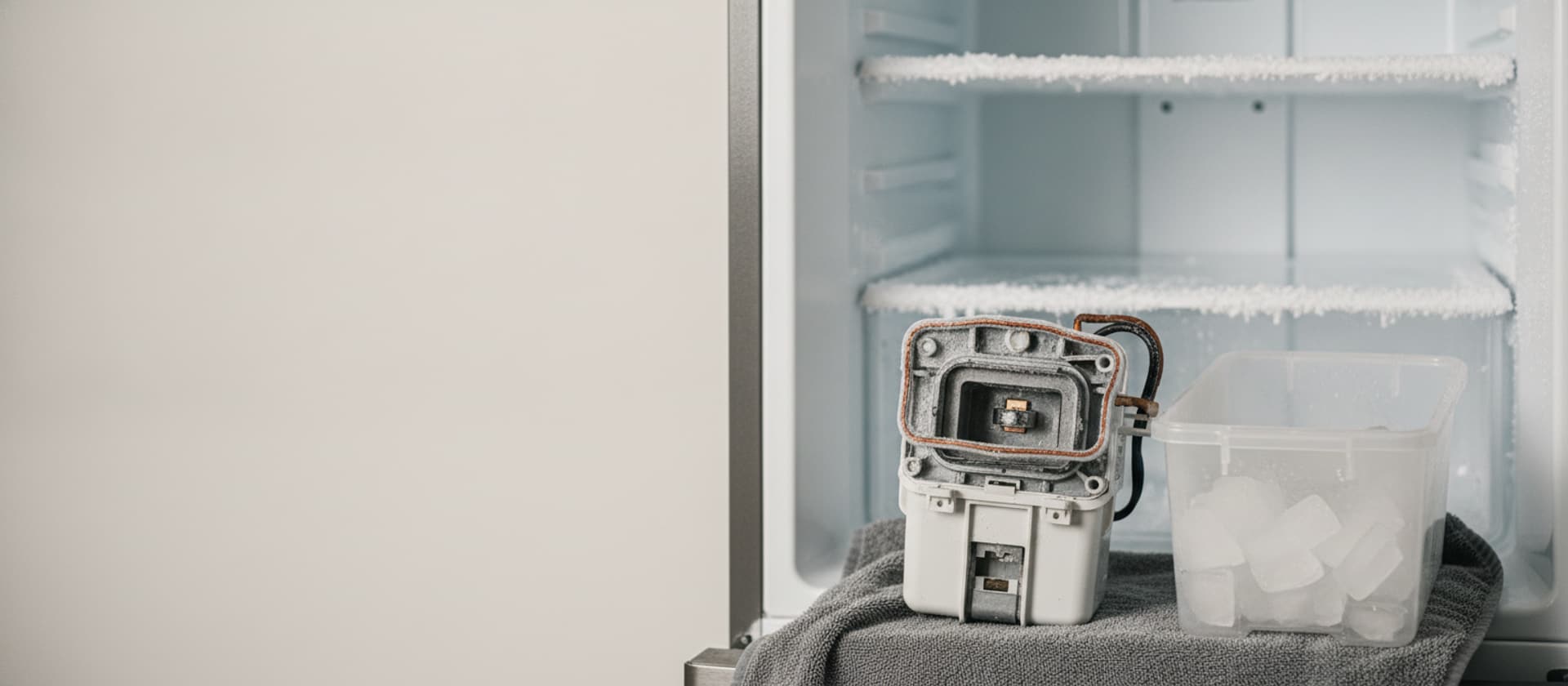
Ice & Frost Buildup · Freezer Diagnostic Guide · Same Day Southern California
Ice Buildup in Your Freezer? Here's Why It Keeps Coming Back
On a frost-free freezer, a growing sheet of ice means the defrost system has failed — or the door seal is leaking. Here's how to tell the difference, clear it, and know when it's a tech job.
AI Diagnostic · free · about a minute
Freezer acting up?
Describe it in your own words — get the likely causes and a repair cost range before you book.
Our Branches
10 service territories across Southern California
01 · The short answer
On a frost-free freezer, ice buildup means the defrost system failed.
A frost-free freezer is designed to melt off its own frost on a timed cycle, so a growing sheet of ice — usually on the back wall — almost always means the automatic defrost system has stopped working: a failed defrost heater, defrost sensor, or timer. The next most common causes are a door seal leaking humid air and a door that keeps getting left ajar. Ice on the floor of the freezer is a different signature — that's a clogged defrost drain. First, check whether yours is frost-free or a manual-defrost unit, because a manual freezer is supposed to frost up and just needs defrosting. If it's frost-free and icing over, it's a diagnostic. $89 residential diagnostic, waived with repair.
The mistake we see most is people chipping the ice out every few weeks and treating that as normal. On a frost-free unit it isn't — it's a failed part making you do the work the machine should be doing, while a straining compressor quietly runs up your power bill. Clearing the ice is the temporary fix; finding why it came back is the real one.
02 · First, which freezer do you have?
Frost-free and manual-defrost fail differently.
Frost-free (most modern uprights and fridge-freezers)
These run an automatic defrost cycle. They should never accumulate a thick layer of ice. If yours does, a defrost component has failed — this page is for you. You'll typically find frost heaviest on the back interior wall, where the evaporator coil sits behind the panel.
Manual-defrost (many chest freezers, some compact uprights)
These are built to frost up over time and are meant to be defrosted by hand every so often. If a chest freezer in the garage has slowly built frost over months, that's expected maintenance, not a fault — empty it, unplug it, and let it thaw. Only worry if it frosts over again within days of a full defrost.
03 · Why a frost-free freezer ices over
The causes, in the order we find them.
Failed defrost system
The heater, sensor, or timer that runs the defrost cycle has failed, so frost is never melted off the coil. It grows until it's a solid block and airflow stops. This is the leading cause of recurring ice on a frost-free unit, and it's usually an affordable part once the failed piece is identified.
Leaking door seal
A cracked or dirty gasket lets warm, humid room air seep in. That moisture condenses and freezes, so frost concentrates around the leak and along the door edge. Coastal Southern California humidity makes this worse. The dollar-bill test — close the door on a bill and see if it drags — tells you fast.
Door left ajar or opened constantly
A drawer that stops the door from latching, a freezer packed so full the door won't seal, or simply frequent opening on a humid day all pour moisture inside. Sometimes the "failed defrost system" turns out to be a bin blocking the door — which is why we check the simple things first.
Clogged defrost drain (ice on the floor)
When defrost meltwater can't drain — the drain tube has iced or clogged — it pools on the freezer floor and refreezes into a slab, often leaking out under the fridge. This is a distinct signature from back-wall frost. On some models the drain is reachable; on many it's behind the rear panel and needs a tech.
04 · What you can safely do
Reset it with a full defrost, then watch it.
- Do a complete defrost. Empty the freezer, unplug it, and leave the door open until all the ice is gone — often a full day. Towels down for runoff. This clears the symptom and gives you a clean baseline.
- Clean and test the door seal. Wipe the gasket, check for cracks and gaps, and run the dollar-bill test around all four sides. A seal that no longer grips is a frequent, fixable cause.
- Check door habits and fit. Make sure nothing blocks the door from latching, the freezer isn't packed past the seal, and the door actually closes on its own.
- Clear the drain if it's accessible. If you have ice on the floor and can reach the drain opening at the back of the freezer floor, gently flush it with warm water. If it's behind a sealed panel, leave it for a tech.
- Watch for a week. If it stays clear, it was a seal or door issue. If ice returns within days, the defrost system has failed — that's the handoff point.
Where to stop: defrosting, cleaning the seal, and flushing an accessible drain are all safe homeowner work. Do not pull the rear evaporator panel to test the defrost heater or thermostat yourself, and never open the sealed refrigeration system. Testing electric defrost components against spec is a tech job.
05 · When it's a tech job
Ice back within days means a failed defrost part.
When a full defrost buys you only a few days before the ice returns, the defrost system has failed and needs diagnosis: our techs test the defrost heater, the defrost sensor/thermostat, and the timer or control board in order, and replace only the piece that's actually dead. A drain buried behind the rear panel gets cleared and re-routed at the same visit. We verify the door seal ourselves first, because there's no point replacing a defrost heater if warm air was pouring in past a bad gasket.
More help: the full freezer repair hub, and if the freezer is warm rather than iced, see freezer not freezing. Ice makers have their own failure modes — see ice maker not making ice. If water is leaking out onto the floor, the refrigerator leaking guide covers the drain path in more detail. Brand-specific: LG freezer repair, Frigidaire freezer repair. Same-day across Los Angeles, Beverly Hills, and Pasadena in most cases. $89 residential diagnostic, waived with repair. Book online or call (424) 325-0520.
06 · FAQ
Freezer ice buildup: common questions.
Why does ice keep building up in my freezer?
In a frost-free freezer, constant ice buildup means the automatic defrost system has stopped doing its job. Normally the unit heats the evaporator coil briefly on a cycle to melt off frost before it accumulates. When the defrost heater, defrost sensor, or timer/control fails, frost is never cleared and it grows into a solid sheet of ice — usually on the back wall. The other common causes are a door seal that leaks humid room air and a door that gets left ajar or opened constantly. A manual-defrost freezer, by contrast, is supposed to frost up and simply needs periodic manual defrosting.
Is frost buildup in the freezer normal?
A thin, even dusting of frost is normal, especially in humid coastal areas or if the door gets opened a lot. What isn't normal is a thick, growing sheet of ice on the back wall, ice creeping over the vents, or a slab forming on the floor of the freezer. Those point to a failed defrost system, a bad seal, or a clogged defrost drain rather than everyday frosting. If you're chipping ice more than once or twice a year on a frost-free unit, something has failed.
How do I get rid of ice buildup in my freezer?
The reset is a full defrost. Empty the freezer, unplug it, and leave the door open until every bit of ice has melted — that often takes a full day, so keep towels down for the runoff. While it's thawing, clean the door gasket and check it for cracks, and make sure the door has been closing fully. Plug it back in and watch it for a week. If it cools normally and stays clear, the buildup was from a seal or door-habit issue. If the ice returns within days, the defrost system has failed and needs a tech.
Why is there a sheet of ice on the floor of my freezer?
Ice forming on the floor of the freezer — often with water pooling under the fridge too — usually means the defrost drain is clogged. When the unit defrosts, the meltwater is supposed to run down a small drain tube to a pan underneath. If that tube ices over or clogs with debris, the water backs up, refreezes on the freezer floor, and eventually leaks out. Clearing the drain is sometimes a homeowner job on accessible models, but on many freezers the drain sits behind the rear panel, which is where our techs come in.
Will ice buildup damage my freezer?
Left alone, yes — it makes the problem worse and costs you money. A coil buried in ice can't cool efficiently, so the compressor runs longer and harder, your energy bill climbs, and the freezer struggles to hold 0°F even as it looks packed with ice. Frost over the vents chokes airflow to the point where food starts to soften. Catching a failed defrost part early is far cheaper than letting it run a straining compressor for months. Our diagnostic identifies the failed part for $89, waived with the repair.
Ice back a few days after defrosting? Call today.
$89 diagnostic waived with repair. Same-day across LA, OC, Ventura. Phones answered 24/7.