Ice Maker Not Making Ice · Diagnostic Guide · Same Day Southern California
Ice Maker Not Making Ice? Start With the Water
Most no-ice calls come down to water not reaching the unit, a clogged filter, a raised shut-off arm, or a frozen fill tube — not a dead ice maker. Here's the order to check, and when it's a tech job.
AI Diagnostic · free · about a minute
Not sure what's wrong?
Describe it in your own words — get the likely causes and a repair cost range before you book.
Our Branches
10 service territories across Southern California
01 · The short answer
It's usually water not arriving — or the unit switched off.
When an ice maker stops making ice, the cause is almost always upstream of the ice maker itself: the shut-off arm or switch is in the OFF position, the water supply valve is closed or the line is kinked, the water filter is clogged and overdue, or the fill tube has frozen solid. On a fridge ice maker, the freezer also has to sit around 0°F to 5°F to trigger a harvest. Only after those are ruled out is it usually the water inlet valve or the control module. Find the reset/test button and force a cycle to see whether the mechanism runs at all. $89 residential diagnostic, waived with repair.
People assume "no ice" means the ice maker died. Our techs find the ice maker is usually fine — it's just not getting water, or it was never turned back on after someone cleaned the freezer. Checking the cheap, upstream things first is exactly how you avoid paying to replace a part that was working the whole time.
02 · Why it happens
Check the water path, then the machine.
Shut-off arm raised or ice maker switched off
Every ice maker has a way to stop itself when the bin is full — a wire bail arm that lifts, or an on/off switch or setting. It's easy to knock the arm up while grabbing ice, or to leave the unit off after cleaning. This is the very first thing to check, and it costs nothing.
Closed valve, kinked line, or low pressure
The water supply valve behind or under the appliance may be partly closed, and the line can kink when the fridge is pushed back against the wall. Without steady water pressure, the ice maker can't fill. Follow the line from the unit back to the valve and confirm it's fully open and unkinked.
Clogged water filter
A water filter is good for about six months. Past that it clogs, flow drops, and ice production tapers and then stops — often with no other warning. Replacing an overdue filter is one of the most common fixes for a fridge that "suddenly" stopped making ice.
Frozen fill tube
The small fill tube that delivers water to the ice mold can freeze into a plug, usually when a slow leak dribbles and refreezes. Thawing it clears the block, but if the tube keeps freezing, the water valve or fridge temperature is the real cause.
Hard-water scale
Southern California's hard water leaves mineral scale that slowly narrows the fill tube and coats the valve until it can't deliver a full fill. It builds gradually and then looks like a sudden failure. Descaling and, on undercounter units, running the cleaning cycle addresses it.
Water inlet valve or control module
When water is confirmed available but still isn't filling the mold, the water inlet valve has usually failed. If a forced cycle won't run at all, the ice maker's motor or control module is the culprit. Both are tech-level replacements — the valve is electrically live and the module drives the whole harvest sequence.
03 · What you can safely check
Run through these before calling anyone.
- Confirm the ice maker is ON. Lower the shut-off arm if it's raised, or switch the ice maker on in the controls. Then force a harvest with the test/reset button if your unit has one.
- Check the water supply. Trace the line to the shut-off valve, open it fully, and straighten any kink. Low or no pressure means no ice.
- Change the water filter. If it's been more than six months, replace it. This alone restores a lot of ice makers.
- Verify the temperature. A fridge ice maker needs the freezer around 0°F to 5°F. If the freezer is warm, fix that first — see our freezer guides below.
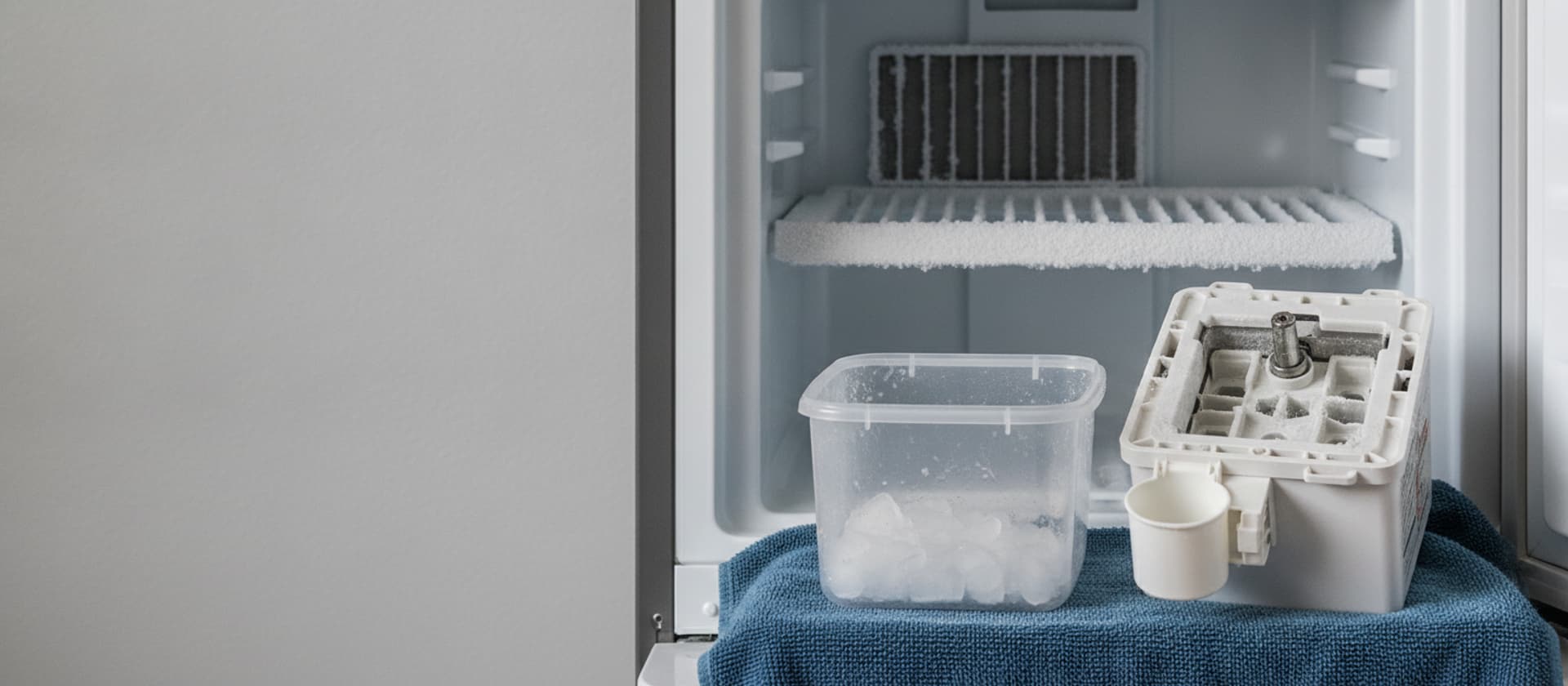
- Thaw a frozen fill tube. Gently warm the fill tube (a hair dryer on low or a warm damp cloth) to melt a plug. If it refreezes within days, the valve or temperature needs a tech.
- Undercounter units: run the cleaning cycle. If your standalone machine has a service/cleaning light, run its cleaning cycle and clear the condenser of dust. A scaled-up unit often revives.
Where to stop: arm, supply valve, filter, temperature, fill-tube thaw, and cleaning cycles are all safe homeowner work. Do not replace the water inlet valve, open the ice maker's wiring, or touch the sealed refrigeration side of an undercounter unit — those are shock, water, and pressure risks for a tech.
04 · When it's a tech job
Water confirmed, still no ice? Now it's diagnostic time.
When the arm is down, the supply is open, the filter is fresh, the temperature is right, and there's still no ice, the fault is in the machine: a failed water inlet valve, a dead ice-maker motor or control module, or — on undercounter and nugget units — a water pump, a scaled water line, or a sealed-system problem. Our techs force a harvest, check for water at the valve, and test the module in sequence, so you replace the one part that actually failed rather than the whole assembly.
Which ice maker do you have? If yours is built into your refrigerator's freezer, the refrigerator ice maker issues guide covers the fridge-integrated details. This page and the ice maker repair hub focus on ice makers as their own appliance, including standalone and undercounter units. If you have a Samsung fridge specifically, its ice maker has a documented pattern all its own — see Samsung ice maker not working.
More help: brand coverage on Samsung ice maker repair and LG ice maker repair. If ice is building up instead, see freezer ice buildup. Same-day across Los Angeles, Beverly Hills, and Irvine in most cases. $89 residential diagnostic, waived with repair. Book online or call (424) 325-0520.
05 · FAQ
Ice maker not making ice: common questions.
Why is my ice maker not making ice?
Nine times out of ten it comes down to water not reaching the ice maker or the unit not being cold enough to freeze. Start with the basics: the ice maker's shut-off arm or switch may be in the OFF position, the water supply valve may be closed or the line kinked, the water filter may be overdue and clogged, or the fill tube may have frozen solid. On a fridge ice maker, the freezer also has to be cold enough — roughly 0°F to 5°F — to trigger a harvest. When those are all ruled out, the water inlet valve or the ice maker's control module is usually the failed part.
How do I reset my ice maker?
Most ice makers have a test or reset button on the unit itself — a small button on the underside or front of the ice maker head. Pressing it forces a harvest cycle, which is the fastest way to see whether the mechanism runs at all. If your model doesn't have a visible button, cycling the shut-off arm up and down or turning the ice maker off and on in the settings does the same thing on many units. If a forced cycle runs but no water arrives, the problem is upstream — supply, valve, or filter. If nothing moves at all, it's the motor or control module.
Why did my ice maker stop working after I changed nothing?
Two quiet culprits cause this in Southern California. The first is the water filter finally clogging — filters have a life of about six months, and once flow drops below what the ice maker needs, production tapers off and then stops. The second is hard-water scale. LA and the surrounding valleys have hard water, and mineral buildup slowly narrows the fill tube and gums up the valve until it can't deliver a full fill. Both are common, both look like a sudden failure, and both are fixable without replacing the ice maker.
My undercounter ice maker stopped producing — what's different about it?
Standalone and undercounter ice makers (the nugget and gourmet-cube units from brands like Scotsman, U-Line, and Marvel) have parts a fridge ice maker doesn't: their own condenser, a water pump, a reservoir, and often a required periodic cleaning cycle. When one stops, the usual causes are a dirty condenser coil choking the cooling, a clogged water line or pump, or a unit overdue for its cleaning cycle that's now scaled up. Many of these units display a service or cleaning light. They're worth repairing, but the diagnosis is different from a fridge ice maker, and the sealed side is a tech job.
Is a broken ice maker worth fixing?
For an integrated fridge ice maker, almost always — a water valve, a fill-tube thaw, a filter, or a control module is a modest repair against a fridge you're keeping. For a dedicated undercounter or nugget machine, it depends on the fault: a pump, valve, or cleaning-related issue is a clear repair, while a sealed-system problem on an older unit is worth weighing against replacement. Our techs tell you which situation you're in before any work. $89 residential diagnostic, waived with the repair.
Water's on but still no ice? Call today.
$89 diagnostic waived with repair. Same-day across LA, OC, Ventura. Phones answered 24/7.