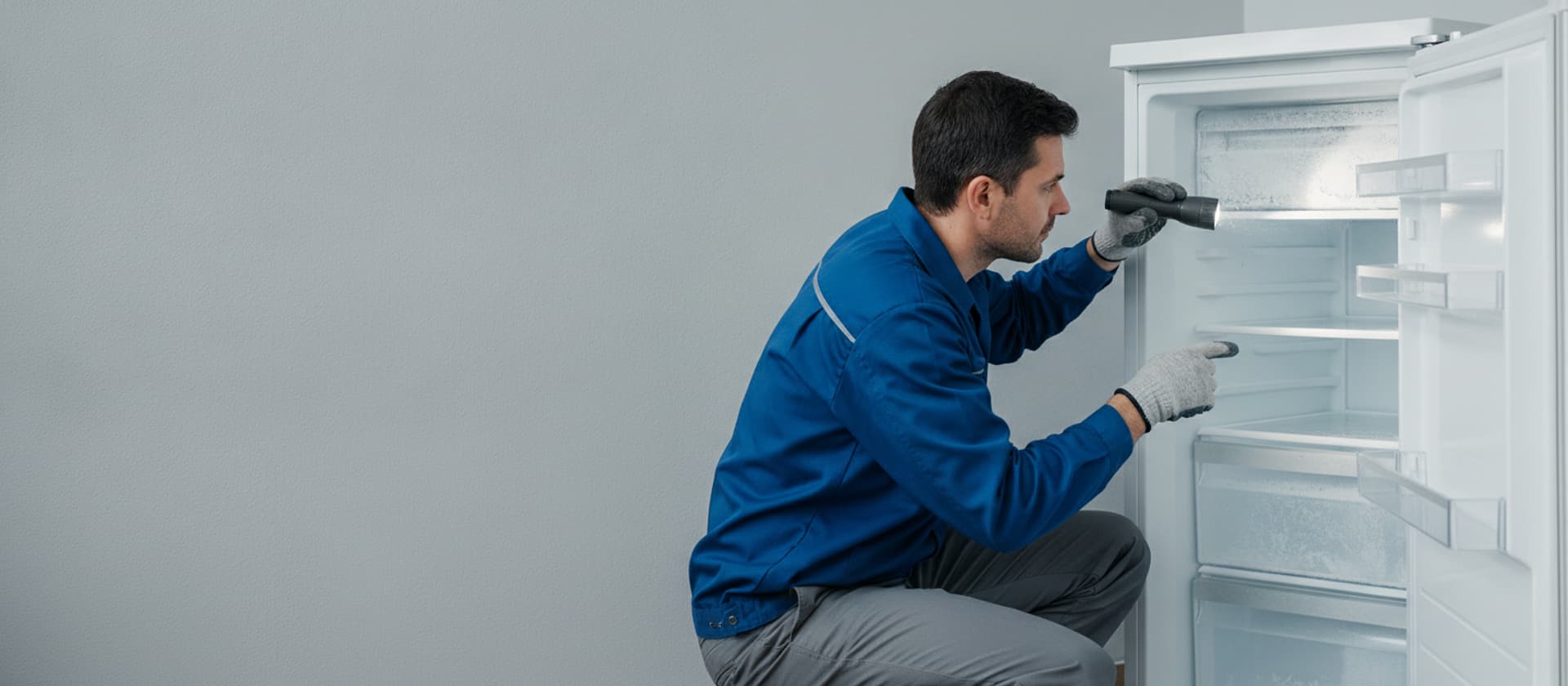
Freezer Not Freezing · Diagnostic Guide · Same Day Southern California
Freezer Running but Not Freezing? Here's What's Wrong
A freezer that hums along but won't hold 0°F usually has a frosted-over defrost system, dirty coils, or a stalled fan — not a dead compressor. Here's how to tell, what you can check, and when it's a tech job.
AI Diagnostic · free · about a minute
Freezer acting up?
Describe it in your own words — get the likely causes and a repair cost range before you book.
Our Branches
10 service territories across Southern California
01 · The short answer
Cold air is being made but not moving — or the coils are choked.
When a freezer runs but won't freeze, cold air is usually being blocked, not missing entirely. The four most common causes, in the order we find them, are a defrost system that has iced over and buried the evaporator coil in frost, a stalled evaporator fan that can't circulate the cold air, condenser coils packed with dust so the compressor can't shed heat, and a door seal that no longer closes tight. A failed compressor or a sealed-system refrigerant leak is real but less common — and that's the good news, because the frequent causes are the affordable ones. Set the freezer to 0°F, and if it still won't hold, it's a diagnostic. $89 residential diagnostic, waived with repair.
People see a warm freezer and assume the compressor is dead. Our techs find that's the exception, not the rule. Far more often the compressor is working fine and something in front of it — frost, a stuck fan, a dirty coil — is stopping the cold from reaching your food. Sorting the cheap causes from the expensive ones is exactly what a proper diagnostic is for.
02 · Why it happens
The usual causes, cheapest to most serious.
Frosted-over defrost system
Every frost-free freezer runs a periodic defrost cycle to keep the evaporator coil clear. When the defrost heater, defrost sensor, or timer fails, frost builds on the coil until it's a solid block of ice — and air can no longer pass through it. The freezer runs constantly but the cold never reaches the compartment. The tell: a wall of frost at the back or under the floor of the freezer. This is one of the most common causes we see.
Stalled evaporator fan
The evaporator fan blows the cold air off the coil into the freezer. If its motor fails — or if frost from the problem above has jammed the blade — the air stops moving. You'll sometimes hear it: silence where there used to be a soft whir, or a grinding tick as the blade catches ice.
Dirty condenser coils
The condenser coils shed the heat the compressor pulls out. Caked in dust, pet hair, or lint, they can't release that heat, so the whole system loses efficiency and the freezer can't reach temperature. This is the single most common cause of a freezer that's "not cold enough" rather than fully warm — and it's the easiest to fix yourself.
Door seal that no longer closes tight
A cracked, warped, or gunked-up door gasket lets warm room air leak in continuously. The freezer runs and runs trying to overcome it, frost builds around the leak, and it never fully catches up. Run a dollar bill through the closed door — if it slides out with no drag, the seal is done.
Heat, overpacking, and airflow
Southern California summers matter here. A freezer in a hot garage or against a wall with no clearance has to work far harder, and a unit that was borderline in spring gives up in an August heat wave. Blocked interior vents (food shoved against the back wall) and a wall-tight installation both choke airflow. Give it room, keep vents clear, and don't overpack.
Start relay, thermostat, or compressor
If the compressor won't start, a failed start relay is a common and inexpensive culprit. A bad thermostat can stop calling for cooling. A genuinely failed compressor or a sealed-system leak is the serious end — less frequent, but real. These live inside the electrical and refrigeration systems and are a tech job, not a DIY one.
03 · What you can safely check
Try these before you call anyone.
- Confirm the setting and give it 24 hours. Set the freezer to 0°F and verify with an inexpensive appliance thermometer. Some units get bumped to a warmer setting by accident.
- Vacuum the condenser coils. Unplug the unit, find the coils (behind the rear panel or under a front kick-plate grille), and clear the dust with a vacuum and coil brush. This alone fixes a lot of "not cold enough" freezers.
- Check the door seal. Inspect the gasket for cracks and clean it. Do the dollar-bill test. A seal that no longer grips is why warm air keeps leaking in.
- Clear the airflow. Make sure interior vents aren't buried under food, pull the unit a few inches off the wall, and improve ventilation if it lives in a hot garage.
- Thaw a frosted unit. If you see a block of ice on the back wall, unplug the freezer, empty it, and let it thaw fully with the door open — a full day is often needed. If it cools normally afterward but frosts up again within a week, the defrost system has failed and needs a tech.
Where to stop: cleaning coils, checking the seal, clearing airflow, and thawing frost are all safe and fix a large share of these calls. Do not open the sealed refrigeration system, test or replace the start relay or capacitor, or handle refrigerant — those carry real shock and pressure risks and belong to our techs.
04 · When it's a tech job — and whether it's worth it
A clean coil and good seal, still warm? Now it's diagnostic time.
When the coils are clean, the seal is good, the airflow is clear, and the freezer still won't hold 0°F, the fault has moved into the system: a failed defrost heater or sensor, a dead evaporator fan motor, a bad start relay, a failing thermostat, or — at the serious end — a compressor or sealed-system problem. Our techs test each of these in order, so you don't pay to replace a compressor when a $-few defrost part was the real issue.
On cost, we'll be straight with you. A standalone freezer typically lasts 10 to 20 years (NAHB life-expectancy data), and a common appliance repair runs roughly $200 to $500 depending on the part and unit. If a newer freezer needs a defrost heater, a fan motor, or a start relay, repair is the clear call. If a 15-plus-year-old unit needs a compressor or has a refrigerant leak, the repair can approach the price of a new freezer — and we'll say so rather than sell you a fix that doesn't add up. $89 residential diagnostic, waived with the repair.
More help: the full freezer repair hub, and if your problem is a wall of ice rather than warm food, see ice buildup in the freezer. If it's the fridge section that's warm while the freezer is fine, that's a different fault — fridge not cooling, freezer works. Brand-specific coverage: LG freezer repair and Frigidaire freezer repair. Same-day across Los Angeles, Beverly Hills, and Pasadena in most cases. Book online or call (424) 325-0520.
05 · FAQ
Freezer not freezing: common questions.
Why is my freezer running but not freezing?
The freezer is powered and the light works, but nothing stays frozen — that almost always means cold air is being made but not moving, or not being made at all. The three usual culprits are a defrost system that has iced over and choked the evaporator coil, a stalled evaporator fan that can't push cold air into the compartment, or dirty condenser coils that keep the compressor from pulling heat out. A door seal that no longer closes tight comes next. A true compressor or sealed-system failure is real but less common than people assume, which is good news, because the frequent causes are far cheaper to fix.
What temperature should a freezer be?
0°F (about −18°C) is the standard target for a home freezer, and it's the point at which food stays safely frozen long-term. If your freezer is holding 10°F or 20°F, food will look frozen but slowly degrade and the unit is telling you something is wrong. Set the freezer to 0°F, give it 24 hours, and check with a cheap appliance thermometer. If it won't hold 0°F no matter the setting, that's a diagnostic, not a dial problem.
Can I fix a freezer that isn't cold enough myself?
Some of it, yes, and it's worth trying before you call anyone. Vacuum the condenser coils, make sure the door seals fully and isn't blocked by an overpacked shelf, confirm the interior vents aren't buried under food, and give the unit a few inches of breathing room from the wall. If it's a manual-defrost or frost-choked unit, unplugging it and letting it thaw fully for a day often restores it. What you should not do is open the sealed refrigeration system, test the start relay or capacitor, or handle refrigerant — those are where our techs take over.
Why did my garage freezer stop freezing in the heat?
This is common in Southern California summers. A freezer in a hot garage has to fight the ambient temperature, and once the garage climbs past the mid-90s, a unit with even slightly dirty condenser coils or a marginal compressor can't keep up. The compressor runs constantly and still loses ground. Cleaning the coils and improving airflow around the unit helps a lot; if it still can't hold 0°F on a hot afternoon, the cooling system is near the end of its capacity and worth having looked at.
Is it worth repairing a freezer that won't freeze?
It depends on the part and the age. A standalone freezer typically lasts 10 to 20 years (NAHB life-expectancy data). If a 6-year-old unit needs a defrost heater, a fan motor, or a start relay, repair is an easy yes — those run a fraction of a new freezer. If a 16-year-old unit needs a compressor or has a sealed-system leak, the repair can approach the cost of replacement, and we'll tell you that honestly rather than sell you a repair that doesn't make sense. Our diagnostic pins down which situation you're in for $89, waived with the repair.
Freezer still warm after cleaning the coils? Call today.
$89 diagnostic waived with repair. Same-day across LA, OC, Ventura. Phones answered 24/7.