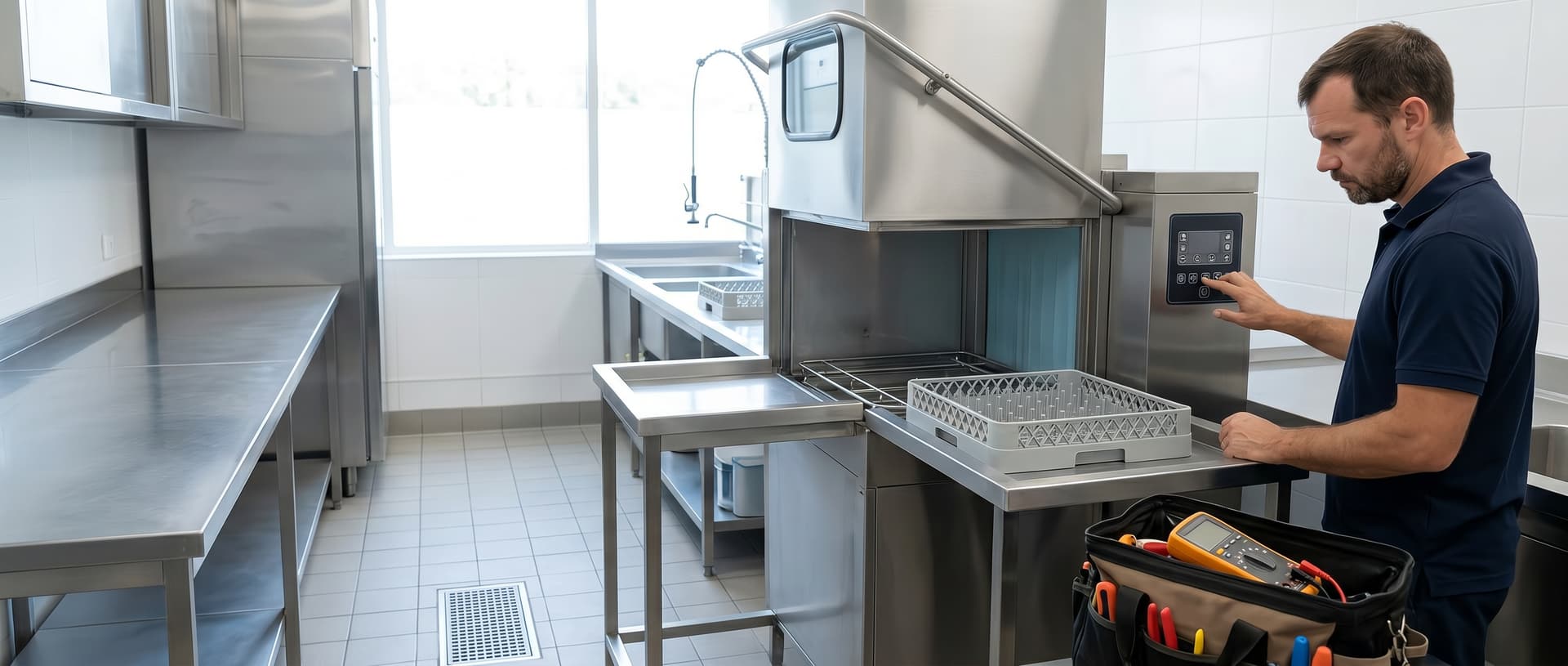
Commercial Kitchen · Dishwasher Not Cleaning · Rinse Arm & Wash Pressure Diagnostic
Commercial Dishwasher Not Cleaning: 5-Root-Cause Diagnostic
Wash arm clog, tank temp, detergent dispenser, mineral scale, conveyor speed. LA hard water primary on scale-driven failures. $120 commercial diagnostic. Same-day across LA, OC, Ventura.
AI Diagnostic · free · about a minute
Dishwasher acting up?
Describe it in your own words — get the likely causes and a repair cost range before you book.
Our Branches
10 service territories across Southern California
01 · Not cleaning diagnostic
Five root causes. We work through them in order.
A commercial dishwasher producing dirty or spotted dishes in LA commercial kitchens usually traces to one of three root causes our techs at Same Day Appliance Repair diagnose first across hotel banquet, restaurant kitchens, and institutional cafeteria operations running Hobart, Jackson, Champion, CMA, Fagor, and Meiko commercial dishwasher installations. (1) Scale-clogged wash arm holes from LADWP hard water 8-12 grains/gallon (#1 cause in LA) — mineral deposits block small holes in spray arms, water pressure and distribution drop progressively. Descaling service runs labor $250–$520 (simple jet clogs often resolve at the $120 commercial diagnostic). (2) Wash pump motor failure year 8-10 — wash pressure drops below spec, dishes don't get cleaned regardless of detergent dose. Wash pump rebuild runs labor $300–$640 + parts. (3) Detergent dispenser pump or chemistry calibration year 7-9 — detergent dose drops below spec, dishes lack chemical contact time. Dispenser rebuild + chemistry calibration runs labor $250–$520 + parts. We descale wash arms before recommending part replacement. $120 commercial diagnostic at Same Day Appliance Repair, waived with repair.
"Dishes coming out dirty" is the most common commercial dishwasher service call. The customer report is consistent (food residue on plates, glassware spotted, silverware filmy), but the root cause splits into five distinct paths. We diagnose all five at the $120 visit, in priority order, and quote the actual fix once we have data.
The five root causes in honest frequency:
- Clogged wash arm jets. 40 to 50% of "not cleaning" calls. Mineral scale, food debris, or grease blockage in the spray arm jets reduces flow and coverage.
- Wash tank temperature below 150°F. Tank heater element failed, thermostat drift, or scale insulation on element. Cold water plus detergent does not break grease.
- Detergent dispenser fault or empty. Pump failure, line clog, or operator-side empty container. Sometimes the simplest cause.
- Mineral scale on heating elements and spray arms. LA hard water (LADWP 5 to 9 grains, Calleguas and MWD blends 8 to 14 grains) accelerates buildup 2 to 4 times softer-water regions.
- Conveyor speed out of spec on rack-conveyor units. Operator overrode default to clear backlog. Dishes did not get full chemical contact time.
$120 commercial diagnostic, waived with repair. BHGS #A49573 and EPA 608 Universal certified (#1346255700410). 90-day warranty. Same-day across LA, OC, Ventura. Sister sub-services: not heating, leaking water, error codes. Overview: commercial dishwasher repair.
02 · LA hard water angle
Why LA dishwashers scale faster than national average.
Across LA County commercial dishwasher not-cleaning service calls our techs at Same Day Appliance Repair dispatch — DTLA hotel banquet running Hobart AM16 + CL conveyor 24/7, Beverly Hills luxury hospitality, LAUSD school nutrition FT2000 flight-type fleet, hospital cafeteria service, restaurant kitchens 8-14 hr daily, plus bar glass washer operations — the failure distribution clusters predictably. About 40 percent LADWP hard water scale-clogged wash arms (LA 8-12 grains/gallon, roughly double national average, descaling labor $250–$520). 20 percent wash pump motor failure (year 8-10, labor $300–$640 + parts). 15 percent detergent dispenser pump or chemistry calibration (year 7-9, labor $250–$520 + parts). 10 percent water temperature below spec (booster heater scale buildup or contactor failure, labor $300–$640 + parts). 10 percent water hardness above spec (water softener service required, handled by a water-treatment contractor). 5 percent rinse-aid dispenser miscalibration (labor $250–$520 + parts). Skip quarterly delime and LA wash arms scale noticeably within 6-8 months — daily filtration not enough alone.
LA-region commercial dishwashers run high cycle volume on hard water. The combination accelerates mineral deposit accumulation on every internal surface that contacts water at temperature. Hardness levels by water authority:
- LADWP (Los Angeles). 5 to 9 grains per gallon depending on neighborhood and seasonal source mix.
- MWD blend regions (most LA County, OC, parts of inland). 7 to 12 grains.
- Calleguas Municipal Water District (Ventura). 8 to 14 grains, hardest in our service area.
- Santa Margarita Water District (south OC). 5 to 8 grains.
- Rancho California Water District (Temecula). 7 to 12 grains, well-source variability.
Field pattern at 200+ rack equivalents per day:
- No softener: visible scale on spray arms at 4 to 6 months. Element insulation drop at 8 to 12 months. Complete jet flow blockage at 9 to 14 months without descale service.
- Softener installed: visible scale at 12 to 18 months. Element insulation maintained 24 to 36 months. Annual descale typically sufficient.
Softener installation $1,800 to $3,400 plus $40 to $90 monthly salt. The math works for high-volume operations. We do not install softeners ourselves but coordinate with water-treatment contractors when scale becomes the recurring root cause.
03 · Detail on each root cause
What we test, what we replace.
1. Clogged wash arm jets (40-50% of calls)
Spray arm rotation looks normal but flow through individual jets is reduced. We pull the arms, run a probe through each jet, descale with citric acid solution if scale is the cause, replace arm assembly if jets are deformed or pitted. Cleaning and descale service alone runs labor $250–$520; full arm assembly replacement runs labor $300–$640 + parts. Hobart CRS and other premium brands run labor $375–$750 + parts.
2. Wash tank temperature below 150°F
Tank heater element failure or scale insulation. We test temp with a digital thermocouple at three points in the tank during a live wash cycle. Element replacement runs labor $300–$640 + parts on most units, labor $375–$750 + parts on premium brands (Hobart, Jackson, Meiko). On units with heavy scale we descale alongside the element, with parts quoted after diagnosis. Thermostat replacement runs labor $300–$640 + parts if element tests good but temp still drifts.
3. Detergent dispenser fault
Peristaltic pump failure most common. We test with chemical line detached and pumping into a measured cup. Dispenser pump replacement runs labor $250–$520 + parts. Line clog cleaning $120, no parts. Empty container or operator-side issue: education at the dx visit, no parts.
4. Mineral scale on elements and spray arms
Visible white-to-tan deposit on heating element coil and inside spray arm bores. We descale with food-safe citric acid or commercial descaler depending on severity. Scale removal service runs labor $250–$520 standalone; included with element replacement when both needed.
5. Conveyor speed out of spec
Rack-conveyor units (Hobart CRS, Champion 86, Jackson AJ-66) run a factory-spec conveyor speed (typically 6.6 fpm). Operators override to clear backlog. Result: dishes get insufficient chemical contact time. We measure speed with a stopwatch at the conveyor and recalibrate to spec via the drive controller. No parts, $120 dx visit fee covers the service.
04 · Brand-specific notes on cleaning failures
Different brands, different failure profiles.
- Hobart (ITW Food Equipment). CRS-66A and CRS-86 most common in our service area. Heavy-gauge stainless build; spray arm assemblies built to last 8 to 12 years. Element scale most common cleaning failure cause. Strong parts pipeline through ITW authorized distribution.
- Champion (Ali Group). 86 series most common. Conveyor speed drift and detergent dispenser pump failure are the two top cleaning-related failures we see on Champion installs.
- Jackson WWS (Hoshizaki Group). AJ-66 (rack conveyor) and Tempstar (door type). Hoshizaki acquisition completed parts pipeline integration; sourcing now consistent with Hoshizaki ice machine timelines.
- CMA Dishmachines (Welbilt subsidiary). Mid-tier door-type and undercounter primary. Scale-related failures more common than mechanical because chemical and water systems are competitive but build is lighter than Hobart pro-tier.
- Fagor Industrial (Onnera Group, Spanish). European wiring conventions; some replacement parts carry longer lead times (5 to 12 days) through Fagor USA distribution. We pre-order common parts when scheduled service indicates a known failure mode.
- Meiko (independent German). Premium tier above Hobart on some models. Authorized parts pipeline 7 to 14 days. Build quality means cleaning-related failures are usually downstream of water chemistry, not mechanical.
- Insinger (ITW family) and Stero (Welbilt subsidiary). Heavy-duty institutional. Hospital, university, and prison kitchens. Less common in restaurant service but we cover them.
05 · Pricing
Not-cleaning repair costs.
| Repair | Labor (parts quoted after diagnosis) |
|---|---|
| Diagnostic (commercial) | $120, waived with repair |
| Wash arm clean and descale (probe + citric acid) | labor $250–$520 |
| Wash arm assembly replacement | labor $300–$640 + parts |
| Tank heater element replacement (mid-tier) | labor $300–$640 + parts |
| Tank heater element replacement (pro-tier: Hobart, Meiko) | labor $375–$750 + parts |
| Thermostat replacement | labor $300–$640 + parts |
| Detergent dispenser pump replacement | labor $250–$520 + parts |
| Detergent line clog clean (no parts) | $120, included in dx |
| Mineral scale removal service (standalone) | labor $250–$520 |
| Conveyor speed recalibration (no parts) | $120, included in dx |
| Warranty | 90 days parts plus labor |
06 · Why operators call us
Seven reasons.
- 5-root-cause diagnostic discipline. We work through all five before quoting parts. No "parts cannon" approach.
- LADWP hard water specialty. We see scale-driven failures every week and know the timing curves by water authority.
- Temperature check. When service touches the heaters or final rinse, we check the temperature after the repair and tell you the reading.
- NSF 180°F final rinse verification. Manifold-tested, not rated-spec assumed.
- Brand pipeline knowledge. Hobart, Champion, Jackson, CMA, Fagor, Meiko, Insinger, Stero parts and service times.
- BHGS #A49573 and EPA 608 Universal certified (#1346255700410). See our licensing page.
- $120 commercial diagnostic, no emergency surcharge. Phones answered 24/7.
Cross-link: rack conveyor, flight type, undercounter, glass washer. Credentials: BHGS license, EPA 608.
07 · FAQ
Not cleaning, common questions.
Why is my commercial dishwasher not cleaning dishes?
A commercial dishwasher producing dirty or spotted dishes usually traces to one of three causes our techs at Same Day Appliance Repair diagnose first across Hobart AM16 / LXe / CL / FT2000, Jackson DishStar / TempStar / DynaStar / RackStar, Champion / CMA / Fagor / Meiko commercial dishwasher installations. (1) Scale-clogged wash arm holes from LADWP hard water 8-12 grains/gallon — single most common cause in LA. Mineral deposits block small holes in spray arms, water pressure and distribution drop progressively. Descaling service runs labor $250–$520. (2) Wash pump motor failure year 8-10 — wash pressure drops below spec, dishes don't get cleaned regardless of detergent dose or wash temperature. Wash pump rebuild runs labor $300–$640 + parts. (3) Detergent dispenser pump or chemistry calibration year 7-9 — detergent dose drops below spec, dishes lack chemical contact time. Dispenser rebuild + chemistry calibration runs labor $250–$520 + parts. We descale wash arms before recommending part replacement on every not-cleaning call at $120 commercial diagnostic.
How often does a commercial dishwasher need descaling in LA?
Quarterly minimum for high-volume operations (FT2000 flight-type, AM16 hotel banquet, CL conveyor cafeteria) in LADWP service territory; monthly for Inland Empire high-throughput operations on harder water. LADWP delivers water at 8-12 grains/gallon hardness across most service territory, roughly double the national average that Hobart, Jackson, Champion, and CMA national service literature assumes. Without quarterly delime: wash arm jets clog progressively, tank heaters scale (60% efficiency by year 3), rinse arm spray pattern degrades, FT-series spray manifolds throw temperature errors on final rinse zone. Real delime service (labor $250–$520 per visit depending on machine size) includes descale tank, descale wash arms, descale booster, water filter inspection, and final rinse temperature verification. Coastal sites add condenser fin salt-air corrosion inspection.
Dishes coming out dirty. Where do you start the diagnostic?
Five root causes in honest frequency order: clogged wash arm jets (most common, 40 to 50% of calls), wash tank temperature below 150°F, detergent dispenser fault or empty, mineral scale on heating elements and spray arms (LA hard water primary), and conveyor speed too fast on rack-conveyor units. We test temp at the manifold during a live cycle, run a probe through wash arm jets, check chemical concentration with a titration kit, and inspect for visible scale. $120 dx covers the full sequence.
Why does LA water scale our dishwasher faster than other regions?
LADWP water hardness runs 5 to 9 grains per gallon depending on neighborhood. Calleguas (Ventura), MWD blends, and inland sources push 8 to 14 grains. Commercial dishwashers running 60+ cycles a day accumulate calcium and magnesium deposits on heating elements, spray arm jets, and rinse manifolds 2 to 4 times the rate of softer-water regions. We see complete spray arm flow blockage at 6 to 9 months on units without water softener pretreatment.
Is a water softener worth it for a restaurant dishwasher?
Yes for high-volume operations (200+ rack equivalents per day). Softener installation runs $1,800 to $3,400 with $40 to $90 monthly salt cost. Math: extends element life from 14 to 24 months on average to 36 to 60 months, cuts descale service frequency from quarterly to annual, prevents the gradual wash-quality decline that ends in customer complaints. Most chain operators have softeners; most independents skip them and pay in element replacements and emergency descale calls.
Detergent dispenser working but dishes still spotted. Now what?
Two paths from there. Path one: rinse aid dispenser empty or set too low (rinse aid breaks water surface tension so it sheets off instead of beading and spotting). Path two: final rinse temperature below 180°F (NSF minimum). Cool rinse leaves more water residue regardless of rinse aid. We test rinse aid concentration with a titration drop test and rinse temp at the manifold. Both fixes typically resolve at the $120 dx visit if dispensers and heaters are healthy.
Conveyor too fast versus too slow, what's the right setting?
Manufacturer spec by model. Hobart CRS-66A factory spec is 4 to 6 minutes wash plus rinse cycle time at 6.6 fpm conveyor speed. Champion 86 series similar. Jackson AJ-66 slightly faster default. We measure actual time at the conveyor and recalibrate to spec if drift detected. Operators sometimes push conveyor speed to clear backlog faster; the result is dishes that didn't get full chemical contact time. Slow back to spec, throughput holds.
What's your warranty?
90 days SDAR labor warranty on every repair. BHGS #A49573 and EPA 608 Universal certified (#1346255700410).
Dishwasher not cleaning? Call today.
$120 commercial diagnostic. 5-root-cause discipline. LA hard water specialty. BHGS #A49573.