Whirlpool Dishwasher Not Draining · F9E1 Code · Same Day Southern California
Whirlpool Dishwasher Not Draining: Causes and Fix
Standing water in a Whirlpool, or an F9E1 code, is usually the filter, drain hose, disposal plug, or pump. Here's the order to check and when to call.
AI Diagnostic · free · about a minute
Dishwasher acting up?
Describe it in your own words — get the likely causes and a repair cost range before you book.
Our Branches
10 service territories across Southern California
01 · The short answer
Whirlpool won't drain? Clean the filter first.
Standing water in a Whirlpool dishwasher — and the F9E1 code, which just means the pump-out didn't finish in time — almost always traces to the lower filter, the drain hose (a kink, a clog, or a loop that sits too low), the garbage-disposal knockout plug after a new disposal, a blocked sink air gap, or a failed drain pump. The first four are safe to check yourself in a few minutes; the pump is where our techs take over. Start with the filter — it's the single most common fix, and it's the first step in Whirlpool's own F9E1 guide. $89 residential diagnostic, waived with repair.
Whirlpool dishwashers drain through the kitchen sink and, in most homes, the garbage disposal, so a lot of "Whirlpool won't drain" calls our techs at Same Day Appliance Repair take turn out to be a filter or a sink-side blockage rather than a broken machine. Working the problem in the right order saves you a service call more often than not.
02 · One platform, four badges
KitchenAid, Maytag, and many Kenmore are the same machine.
Here's the honest part most repair pages leave out: KitchenAid, Maytag, and many Kenmore (665-series) dishwashers are built on the same Whirlpool platform. They share the F9E1 drain code, the same removable lower filter, the same drain-pump-and-check-valve design, and the same drain path to the sink. So the diagnosis below is identical whether the badge says Whirlpool, KitchenAid, or Maytag — only the trim and price differ. If you have one of those, you're on the right page. Brand-specific detail lives on KitchenAid not draining, Maytag not draining, and Kenmore not draining.
Two design notes that matter for draining: older Whirlpool-family units used a hard-food disposer (a built-in grinder) with a coarse screen, while newer ones use a quiet removable filter you clean by hand. On the filter models, a skipped cleaning is the number-one cause of a slow drain — the filter packs with food and grease until F9E1 trips.
03 · The causes, in order
Five causes, most common first.
1. Clogged lower filter
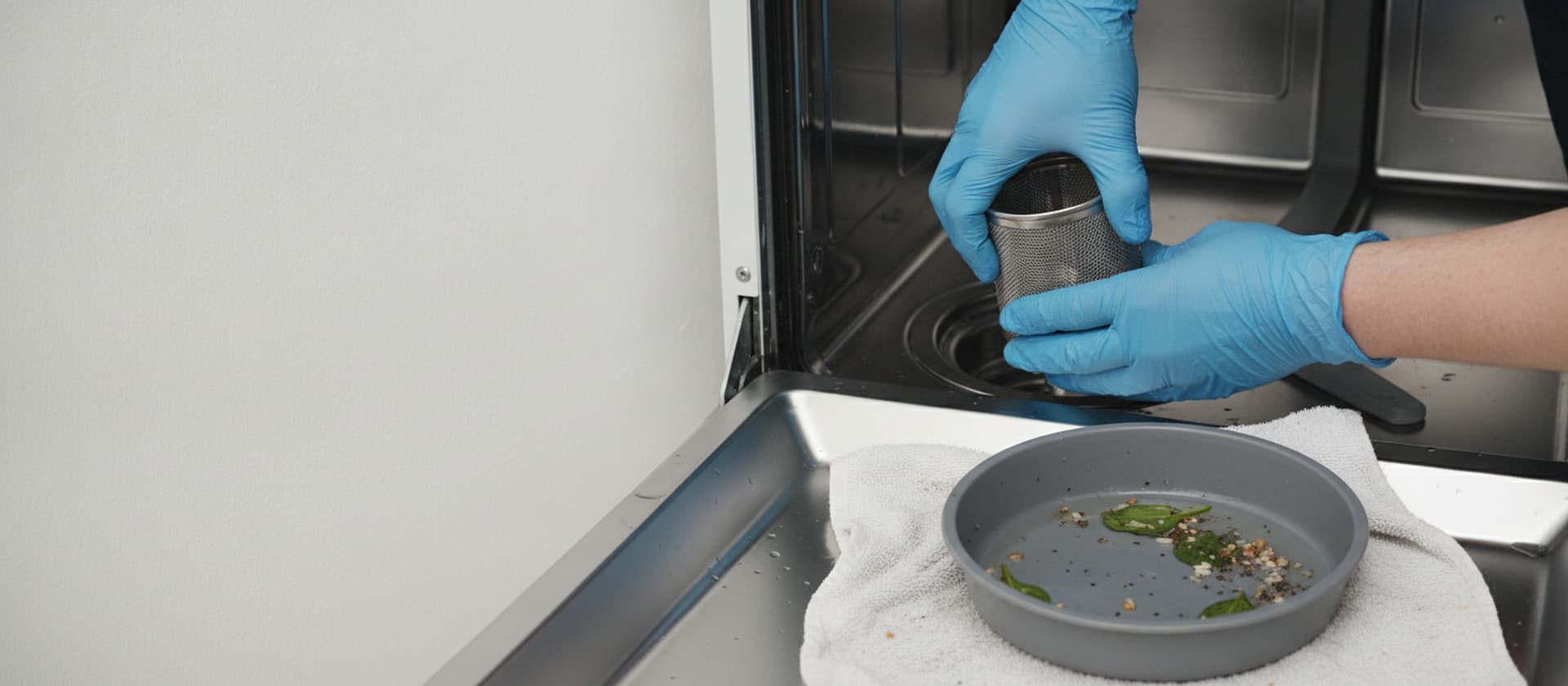
On modern Whirlpool-family units the removable filter packs with food, glass grit, and grease. A partial clog slows the drain until the F9E1 timeout trips; a full one stops it. Twist it out, rinse it, clear the sump below.
2. Drain hose — kink, clog, or low loop
Look behind the unit for a crushed or kinked hose, and confirm it loops up high before dropping to the drain. A low loop lets sink water siphon back and pool. Both are common right after an install or after the unit was pushed back into the cabinet.
3. Disposal knockout plug (new install)
New garbage disposals ship with a solid plug sealing the dishwasher drain port. If it wasn't punched out, the dishwasher physically can't drain. This is the answer when a Whirlpool stops draining right after disposal or sink work.
4. Blocked air gap (common in California)
Many California kitchens have an air gap — the small chrome cap on the counter behind the faucet — because it satisfies the plumbing code's backflow requirement. It packs with debris and backs water up into the dishwasher. Popping it open and clearing it is a two-minute fix.
5. Failed drain pump
When every path above is clear and water still stands (or F9E1 comes right back), the drain pump has usually failed or its check valve is stuck. This one needs a meter and a replacement part.
04 · What you can safely check
Five safe steps before you call.
- Scoop the standing water. Bail it out with a cup and sponge so you can see and reach the filter.
- Clean the filter. Twist out the lower filter, rinse it under the tap, and clear any debris in the sump — watch for broken glass.
- Check the drain hose and high loop. Straighten any kink, and route the hose so it loops up high before it drops to the drain.
- Run the garbage disposal. A disposal full of scraps blocks the shared drain. Run it with water, and if it's a new disposal, confirm the knockout plug was removed.
- Clear the air gap. Pop the chrome cap on the counter and clean out any gunk. Use only dishwasher detergent, never dish soap.
Where to stop: filter, hose, disposal, air gap, and a power-cycle (unplug or flip the breaker 30 seconds) are all safe. Do not remove the drain pump or open the electrical control yourself, and mind the broken glass that collects in the sump. If water still stands after these steps, it's the pump or the control, and that's our job.
05 · When to call us
Clear path, still standing water? It's the pump.
Once the filter, hose, disposal, and air gap are verified clear and the tub still holds water (or F9E1 keeps returning), the drain pump or its check valve is the likely fault, and that needs testing and a replacement part. Our techs at Same Day Appliance Repair carry the common Whirlpool-family drain pumps, so a confirmed pump failure is usually a one-visit fix. We check the upstream path first so we never swap a good pump that was fighting a clog, then quote before any work. $89 residential diagnostic, waived with the repair. Same-day across Los Angeles, Orange, and Ventura in most cases.
Related: the general dishwasher not draining page covers every brand, the dishwasher error codes guide decodes F9E1 alongside Bosch, LG, and Samsung, and brand coverage lives on Whirlpool dishwasher repair. Same platform: KitchenAid, Maytag, Kenmore. Full model coverage on the dishwasher repair hub. Book online or call (424) 325-0520.
06 · FAQ
Whirlpool dishwasher not draining: common questions.
Why is my Whirlpool dishwasher not draining?
On a Whirlpool the standing water almost always traces to one of these, most common first: a clogged lower filter, a kinked or clogged drain hose (or a hose loop that sits too low), a garbage-disposal knockout plug left in after a new disposal, a blocked sink air gap, or a failed drain pump. The first four are homeowner-checkable in a few minutes; the pump is the tech job. Whirlpool's own drain-fault code for this is F9E1, which just means the pump-out didn't finish in time. Start with the filter — it is the single most common fix. $89 residential diagnostic, waived with repair.
What does F9E1 mean on a Whirlpool dishwasher?
F9E1 is Whirlpool's "Long Drain" code: the dishwasher tried to pump out but didn't finish draining within its allowed time. It is a drain-timeout, not a diagnosis of which part failed. Whirlpool's documented causes are exactly the drain-path list — a clogged filter, a kinked or clogged drain hose, a blocked air gap, an un-removed disposal knockout plug, or excess suds from using dish soap instead of dishwasher detergent. Clear those first; if F9E1 returns with everything clear, the drain pump is the likely culprit. On light-only models there is no digital code, so you'd just see the tub holding water.
Do KitchenAid and Maytag dishwashers have the same problem?
Yes — KitchenAid, Maytag, and many Kenmore (665-series) dishwashers are built on the same Whirlpool platform, so they share the F9E1 code and the identical drain path and fixes. If you have one of those, the steps on this page apply. We keep brand-specific pages for each so you land on the right one, but our techs treat them as the same diagnostic under the hood.
How do I clear a Whirlpool dishwasher that won't drain?
Safe, in order: scoop out the standing water, then twist out and rinse the lower filter and clear the sump below it, check the drain hose behind the unit for a kink or clog and confirm it loops up high before it drops to the drain, run the garbage disposal for a few seconds (a full disposal blocks the shared drain), and clear the sink air gap if you have one. Use only dishwasher detergent, since dish soap over-suds and blocks draining. Re-run a rinse cycle. If water still stands, it's the drain pump or control — that's our job.
What is a drain hose high loop and why does it matter?
Whirlpool requires the drain hose to loop up higher than the inside of the tub before it drops to the sink drain or disposal. That high loop stops dirty sink water from siphoning back into the dishwasher and pooling. It's a top cause of a "won't drain" complaint right after an install or after the unit was pulled out and pushed back. If your hose runs low and flat under the sink, re-routing it into a high loop is a safe, free fix — and one an air gap accomplishes automatically, which is why California kitchens often use one.
Whirlpool dishwasher still full of water? Call today.
$89 diagnostic waived with repair. Same-day across LA, OC, Ventura. Phones answered 24/7.