KitchenAid Dishwasher Not Draining · F9E1 Code · Same Day Southern California
KitchenAid Dishwasher Not Draining: Causes and Fix
Standing water in a KitchenAid, or an F9E1 code, is usually the filter, drain hose, disposal plug, or pump. Here's the order to check and when to call.
AI Diagnostic · free · about a minute
Dishwasher acting up?
Describe it in your own words — get the likely causes and a repair cost range before you book.
Our Branches
10 service territories across Southern California
01 · The short answer
KitchenAid won't drain? Check the filter you forgot you had.
Standing water in a KitchenAid dishwasher — and the F9E1 code, which just means the pump-out didn't finish in time — almost always traces to a clogged lower filter, the drain hose (a kink, a clog, or a loop that sits too low), the disposal knockout plug after a new disposal, a blocked sink air gap, or a failed drain pump. The first four are safe to check yourself; the pump is where our techs take over. Because KitchenAid tubs run so quietly, most owners never clean the filter, so that's step one. $89 residential diagnostic, waived with repair.
KitchenAid dishwashers drain through the kitchen sink and, in most homes, the garbage disposal, so many "KitchenAid won't drain" calls our techs at Same Day Appliance Repair take turn out to be a packed filter or a sink-side blockage, not a broken machine. Right order, fewer surprises.
02 · Premium badge, Whirlpool platform
Same machine as Whirlpool and Maytag underneath.
KitchenAid, Maytag, and many Kenmore (665-series) dishwashers are built on the same Whirlpool platform. They share the F9E1 drain code, the same twist-out filter, the same drain pump and check valve, and the same drain path to the sink. KitchenAid sits at the premium end — quieter tubs, third racks, ProWash cycles — but the drain diagnosis is identical to a Whirlpool. That's good news: the fix is usually a five-minute filter clean, not an expensive premium part. Same platform, brand pages: Whirlpool not draining, Maytag not draining, Kenmore not draining.
03 · The causes, in order
Five causes, most common first.
1. Clogged lower filter
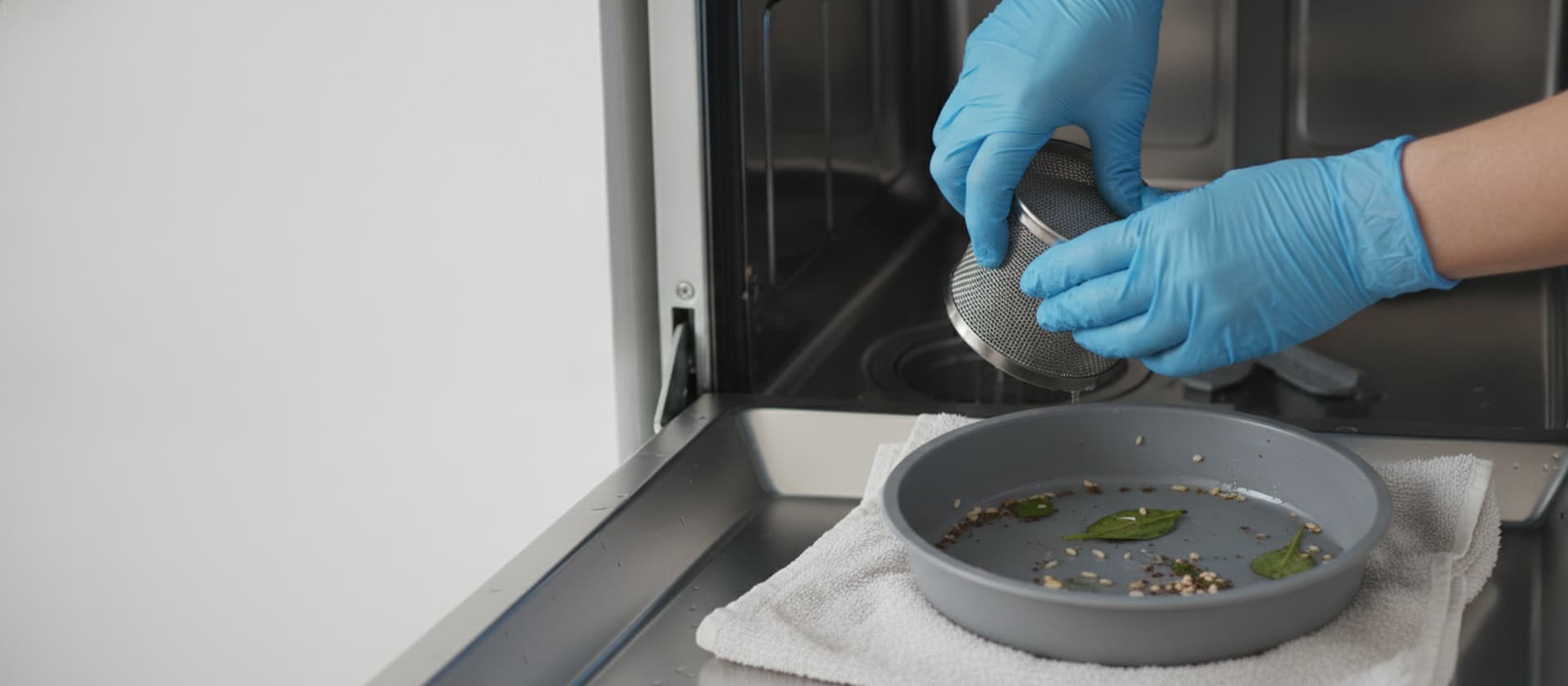
The cylindrical filter under the lower spray arm packs with food, glass grit, and grease — especially on quiet KitchenAid tubs owners forget to service. A partial clog slows the drain until F9E1 trips; a full one stops it. Twist it out, rinse, clear the sump.
2. Drain hose — kink, clog, or low loop
Check behind the unit for a crushed or kinked hose, and confirm it loops up high before dropping to the drain. A low loop lets sink water siphon back and pool.
3. Disposal knockout plug (new install)
A new garbage disposal ships with a solid plug sealing the dishwasher drain port. If it wasn't punched out, the dishwasher can't drain. This is the answer when a KitchenAid stops draining right after disposal work.
4. Blocked air gap (common in California)
Many California kitchens use an air gap — the small chrome cap on the counter — to meet the plumbing code's backflow rule. It clogs and backs water into the dishwasher. Popping it open and clearing it is a two-minute fix.
5. Failed drain pump or check valve
When the whole path is clear and water still stands (or F9E1 returns), the drain pump has usually failed or its check valve is stuck open. This one needs a meter and a replacement part.
04 · What you can safely check
Five safe steps before you call.
- Scoop the standing water with a cup and sponge so you can reach the filter.
- Clean the filter. Twist out the cylindrical filter under the lower spray arm, rinse it, and clear the sump — watch for broken glass.
- Check the drain hose and high loop. Straighten any kink, and route the hose so it loops up high before dropping to the drain.
- Run the garbage disposal with water, and if it's a new disposal, confirm the knockout plug was removed.
- Clear the air gap. Pop the chrome cap and clean it out. Use only dishwasher detergent, never dish soap.
Where to stop: filter, hose, disposal, air gap, and a 30-second power-cycle are all safe. Don't remove the drain pump or open the control yourself, and mind the glass in the sump. If water still stands after these steps, it's the pump or the control — our job.
05 · When to call us
Clean path, still standing water? It's the pump.
Once the filter, hose, disposal, and air gap are verified clear and the tub still holds water (or F9E1 keeps returning), the drain pump or its check valve is the likely fault, and that needs testing and a replacement part. Our techs at Same Day Appliance Repair carry the common Whirlpool-platform drain pumps, so a confirmed failure is usually a one-visit fix. We check the upstream path first so we never swap a good pump that was fighting a clog, then quote before any work. $89 residential diagnostic, waived with the repair. Same-day across Los Angeles, Orange, and Ventura in most cases.
Related: the general dishwasher not draining page, the dishwasher error codes guide, and brand coverage on KitchenAid dishwasher repair. Same platform: Whirlpool, Maytag, Kenmore. Full coverage on the dishwasher repair hub. Book online or call (424) 325-0520.
06 · FAQ
KitchenAid dishwasher not draining: common questions.
Why is my KitchenAid dishwasher not draining?
On a KitchenAid the standing water almost always traces to a clogged lower filter, a kinked or clogged drain hose (or a hose loop that sits too low), a disposal knockout plug left in after a new disposal, a blocked sink air gap, or a failed drain pump. The first four are homeowner-checkable; the pump is the tech job. KitchenAid's drain-fault code for this is F9E1, a drain-timeout that means the pump-out didn't finish in time. Many KitchenAid owners never realize their quiet dishwasher even has a filter to clean — start there. $89 residential diagnostic, waived with repair.
What does F9E1 mean on a KitchenAid dishwasher?
F9E1 is the "Long Drain" code: the dishwasher tried to pump out but didn't finish draining in the allowed time. It's a timeout, not a specific part failure. The documented causes are the drain path — clogged filter, kinked or clogged drain hose, blocked air gap, un-removed disposal knockout plug, or excess suds from dish soap. Clear those first; if F9E1 returns with everything clean, the drain pump or its check valve is the likely fault. It's the same code and cause list KitchenAid shares with Whirlpool and Maytag.
Is KitchenAid just a rebadged Whirlpool?
For repair purposes, largely yes — KitchenAid, Maytag, and many Kenmore (665-series) dishwashers are built on the same Whirlpool platform, with the same F9E1 code, the same removable filter, and the same drain pump and check valve. KitchenAid sits at the premium end (quieter tubs, third racks, nicer finishes), but the drain diagnosis under the hood is identical. So the steps here match our Whirlpool and Maytag pages.
Where is the filter on a KitchenAid dishwasher?
It's in the floor of the tub, usually under the lower spray arm — a cylindrical filter you twist a quarter turn and lift out. Because KitchenAid tubs are so quiet, plenty of owners run them for years without ever cleaning it, and it slowly packs with food and grease until the drain slows and F9E1 trips. Rinse the filter under the tap, clear the sump underneath (mind broken glass), reseat it flat and locked, and run a rinse cycle. This alone fixes a large share of KitchenAid drain calls.
My KitchenAid drains slowly but not fully — is that the same problem?
Usually yes, caught earlier. A partial clog in the filter, hose, or air gap slows the drain so a little water is left in the bottom after a cycle, and it will progress to a full F9E1 stop if ignored. Work the same list — filter, hose and high loop, disposal, air gap — before it becomes standing water. If the pump is weak rather than blocked, the drain stays slow no matter how clean the path is, and that's a pump we'd test and replace.
KitchenAid dishwasher still full of water? Call today.
$89 diagnostic waived with repair. Same-day across LA, OC, Ventura. Phones answered 24/7.